 Jan 30, 2026
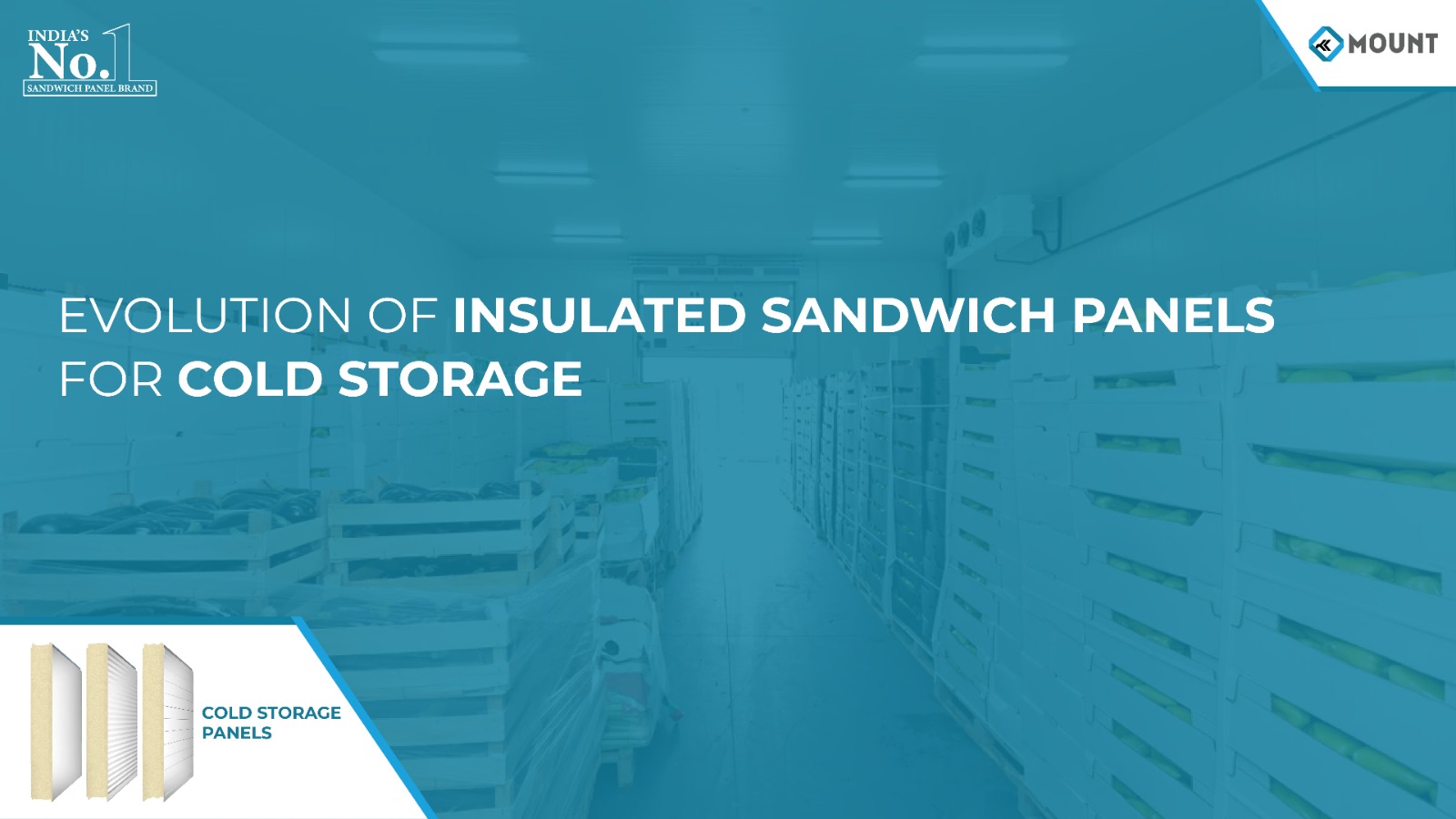
Evolution of Insulated Sandwich Panels for Cold Storage
Cold storage has always been a harsh environment for buildings. A small temperature defect, a loose joint, or non-uniform insulation can easily become a problem, resulting in energy loss, condensation problems, cleanliness issues, and higher running costs. As a result, there has been a paradigm shift in the design, specification, and installation of insulated sandwich panels, particularly in cold storage buildings.
In early cold storage projects, sandwich panels for cold rooms were selected largely on thickness and availability. The assumption was simple: thicker insulation meant better performance. In practice, these early systems struggled under real operating conditions. Uneven core density, basic joint profiles, and limited vapor control led to ice formation, thermal drift, and excessive refrigeration load.
Mount Roofing & Structures entered this space with a different engineering lens. Instead of treating panels as enclosure materials, Mount approached them as critical performance components within the cold-chain system.
Moving Beyond Insulation Thickness
As cold-chain operations expanded into larger footprints and multi-temperature zones, insulation thickness alone stopped being a reliable indicator of performance. What mattered more was how the panel behaved after installation under load, under pressure, and over time.
Modern insulated cold storage panels developed by Mount use controlled-density PU and PIR cores engineered for uniform thermal conductivity. The objective is not just insulation value, but stability. Panels must retain their thermal properties despite ceiling loads, suspended services, racking impact, and repeated temperature cycling.
This shift became especially relevant for facilities handling high-turnover perishables. In cold storage panels for food industry applications, temperature consistency directly affects product shelf life, audit outcomes, and energy predictability. Mount’s panel systems are designed to deliver that consistency without relying on over-specification.
Why Joint Engineering Changed Everything
In operational cold storage buildings, most thermal failures do not occur through the panel face. They occur at joints.
In earlier panel systems, the joints were merely overlapped or mechanically fixed with little air-tightness. With time, these joints became points of entry for moisture, causing condensation, growth of microorganisms, and failure of insulation.
Mount’s engineering focus moved decisively toward joint integrity. Precision tongue-and-groove profiles, controlled compression during cold storage panel installation, and airtight joint detailing became standard. These joints are designed to perform under negative internal pressure and frequent defrost cycles without opening or degrading.
For facilities handling milk, cheese, and processed dairy, this design discipline is essential. Cold storage panels for dairy products must prevent condensation not only for hygiene reasons, but to avoid structural corrosion and floor icing.
Thermal Performance That Holds Under Continuous Operation
Cold storage facilities rarely operate intermittently. Refrigeration systems run continuously, often for years without shutdown. Under these conditions, nominal insulation values are meaningless unless they hold in practice.
Mount’s insulated panel systems are designed to maintain consistent U-values across walls, ceilings, and internal partitions. This reduces temperature stratification inside chambers and lowers compressor cycling frequency. The benefit is not just energy efficiency, but operational stability.
In pharmaceutical storage environments, where temperature excursions are unacceptable, this consistency is non-negotiable. Panels must work as part of the refrigeration strategy, not against it. This performance-first approach is what separates engineered solutions from commodity offerings in the market of cold storage panel manufacturers.
Cost Evaluated Over the Building’s Life
When it comes to procurement talk, it is common for people to start off with a discussion about the price of cold storage panels. But those who have been in the industry for a while would know that it is not just about the cost. It is about factors such as energy consumption, maintenance in terms of moisture, and the lifespan of the structure that really matter.
Mount’s panel systems are engineered to reduce long-term refrigeration demand by minimizing air leakage and thermal loss. Over the life of a cold storage facility, these savings significantly outweigh marginal differences in material pricing.
For large cold-chain operators, this translates into predictable operating costs and fewer unplanned shutdowns ,factors that directly impact profitability.
Built for Hygiene, Compliance, and Expansion
Cold storage facilities develop. Capacities expand, designs vary, and regulatory demands become more stringent. Mount’s insulated panel line is developed with modularity and flexibility in mind, so that it can be expanded or rearranged without disrupting the temperature integrity.
Finishes, details, and construction tolerances are coordinated with the sanitation requirements of food processing and pharmaceutical applications. The system is designed to perform not only during initial start-up but also during prolonged industrial service.
Conclusion
The development of insulated sandwich panels is a reflection of the increasing maturity of cold storage engineering. From simple insulation, the technology has evolved into a high-performance building solution that has a direct impact on energy efficiency, cleanliness, and reliability.
Mount Roofing & Structures has advanced this evolution by focusing on core stability, joint performance, and real-world thermal behavior, rather than theoretical specifications. As cold-chain infrastructure continues to expand across food, dairy, pharmaceuticals, and logistics, engineered panel systems will remain fundamental to long-term facility performance and Mount’s approach is built precisely for that reality.
FAQ ‘S :
- Why use insulated panels in cold storage?
They keep rooms at the right temperature and prevent moisture, protecting stored products. - Is thicker insulation always better?
Not necessarily. Consistent performance and strong panels are more important than thickness alone. - Why are joints so important?
Poor joints let in air and moisture. Good joints keep the cold in and floors dry. - How do panels save money over time?
They reduce energy use and cut maintenance needs, making operations more efficient. - Can panels handle expansions or hygiene requirements?
Yes. They are modular and flexible, so changes don’t affect temperature or cleanliness.
Similar Events