 Feb 10, 2026
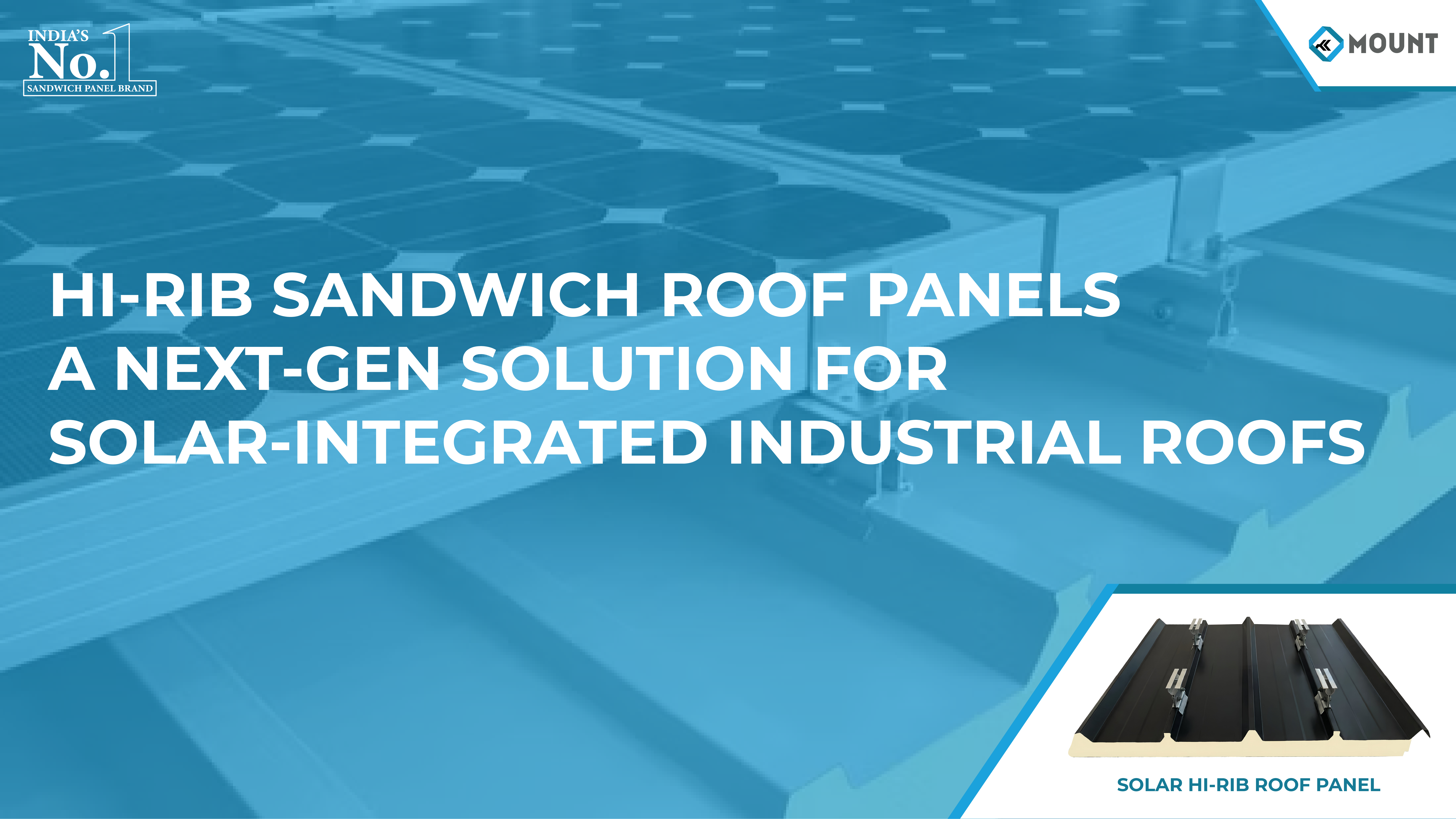
Hi-Rib Sandwich Roof Panels: A Next-Gen Solution for Solar-Integrated Industrial Roofs
Industrial roofs are no longer limited to acting as protective covers against external weather. In today’s manufacturing plants, warehouses, and logistics hubs, rooftops have become functional platforms supporting solar power systems as part of the core building design. This shift places additional demands on the roof structure, introducing sustained dead loads from solar arrays, variable wind uplift forces, thermal movement stresses, and regular maintenance traffic. Most traditional roofing assemblies were developed only for basic environmental protection and were not engineered to accommodate this combination of structural and operational loads over the building’s service life.
Hi-Rib sandwich roof panels are used in such applications because they combine structural capacity, insulation continuity, and waterproofing within a single roof assembly. Rather than acting as a surface covering, these panels function as a load-bearing and thermally efficient building envelope. Their use in solar-integrated industrial roofs is driven by how the roof behaves after solar modules and mounting systems are installed, not by appearance or trend.
Hi-Rib Sandwich Panels as Structural Roofing Systems
Hi-rib sandwich panels are composite roof elements consisting of profiled steel facings bonded to a rigid polyurethane insulation core. The rib profile is structural in nature. Increased rib depth improves stiffness and limits deflection across longer spans under combined roof loads and imposed solar loads.
The bonded sandwich construction enables composite action. Loads applied to the upper facing are distributed across the full panel depth instead of being resisted only by the outer sheet. As a sandwich panel manufacturer focused on industrial buildings, Mount Roofing & Structures designs Hi-Rib panels to act as load-sharing components within the primary steel framework rather than as independent roof skins.
Load Carrying Capacity for Solar Integration
Solar rooftop installations bring in continuous dead loads in the form of photovoltaic panels, support rails, and access walkways. If such loads are not considered during roof design, progressive deflection and joint damage may result.
In Solar Roof Sandwich Panel systems, panel span, purlin spacing, and allowable deflection limits are evaluated together with the solar layout. Load transfer is defined so that forces move directly into purlins and primary frames. This approach avoids long-term sagging that is commonly observed when solar systems are installed on roofs not designed for sustained imposed loads.
Penetration-Free Solar Mounting and Roof Integrity
Water entry at mounting points is still one of the most frequent types of solar-integrated roof failures. The use of mechanical penetrations of the roof surface creates a long-term risk of water entry, especially in cases where thermal expansion, vibration, and aging of the sealants coincide.
Hi-Rib panel geometry allows solar mounting systems that minimise or eliminate direct roof penetrations. Clamp-based or rib-aligned mounting systems can be used without disturbing the primary waterproofing layer. In Solar Roof PUF Panel applications, Mount integrates solar mounting logic during the roofing design stage. Waterproofing performance is achieved through detailing and geometry rather than dependence on sealants as the primary line of defence.
Thermal Performance and Energy Efficiency
Thermal behaviour in industrial buildings is strongly influenced by roof construction. Hi-Rib sandwich panels provide continuous insulation across the roof plane, limiting conductive heat transfer into the building interior.
When combined with rooftop solar, the roof contributes to both energy generation and the reduction of internal heat gain. In Solar PUF Roof Panels, insulation thickness and thermal conductivity are selected based on building usage and regional climate. This supports stable indoor conditions in production and storage areas, particularly in high-temperature Indian environments.
Wind Uplift Behaviour and Deflection Control
Solar installations modify wind flow across roof surfaces, increasing uplift forces at edges, corners, and exposed zones. If these forces are not addressed during design, fixings, mounting hardware, or roof panels can be overstressed.
Hi-Rib sandwich panels are detailed to resist uplift through controlled fastening patterns and positive rib-to-purlin engagement. As an industrial roofing manufacturer, Mount coordinates wind load calculations with panel configuration so that roofing panels and solar systems respond as a single structural assembly. Deflection limits are defined to reduce long-term fatigue in fixings and mounting interfaces.
Durability Under Indian Climatic Conditions
Industrial roofs in India are subjected to intense UV radiation, daily temperature fluctuations, monsoon rain, and dust in the air. Hi-Rib sandwich panels cater to these requirements with joint details, stable insulation, and corrosion-resistant steel surfaces.
For Solar Sandwich Panel for Building Roof applications, coatings, joint detailing, and drainage geometry are selected based on site exposure conditions. This reduces unplanned maintenance and supports consistent roof performance over extended service life.
Installation Efficiency and Project Execution
Hi-Rib panels are supplied as prefabricated units, allowing rapid coverage of large roof areas. Faster enclosure reduces exposure of the structure to weather and allows solar installation activities to begin earlier.
Mount’s execution approach focuses on early coordination between roofing and solar teams. Load assumptions, mounting interfaces, and fixing strategies are resolved during planning rather than adjusted during installation. This reduces schedule delays caused by late-stage structural modifications.
Lifecycle Cost Perspective
Roofing decisions affect operating costs over decades. Hi-Rib systems reduce lifecycle expenditure by limiting leakage risk, lowering cooling loads, and extending service intervals. For industrial roofing panels supporting solar installations, this results in predictable operational costs and improved asset reliability.
At Mount Roofing & Structures, this evolution is addressed through an engineering-first approach where panel profiling, load behaviour, fastening logic, and solar interface detailing are resolved as part of a single roof system. This system-level thinking is what enables Hi-Rib roofs to function reliably as next-generation, solar-ready industrial roofing solutions.
Frequently Asked Questions
Q: Are Hi-Rib sandwich panels suitable for supporting rooftop solar systems?
A: Yes. When panel thickness, rib geometry, and purlin spacing are designed for combined roof and solar loads, Hi-Rib panels can support solar installations without additional reinforcement.
Q: Can solar systems be installed without penetrating the roof?
A: Yes. Rib-aligned clamp systems allow penetration-free mounting while maintaining waterproofing continuity.
Q: How does insulation in sandwich panels affect solar roof performance?
A: Continuous insulation reduces heat transfer into the building and limits temperature rise beneath solar modules, improving overall energy efficiency.
Q: How are wind uplift forces managed on solar-integrated Hi-Rib roofs?
A: Through coordinated panel fastening, rib engagement, and alignment between panel layout and solar array positioning.
Q: Why is early coordination between roofing and solar design important?
A: Because roofing, structure, and solar act as one system. Late coordination often leads to leakage, excessive deflection, and reduced service life.
Similar Events