 Feb 4, 2026
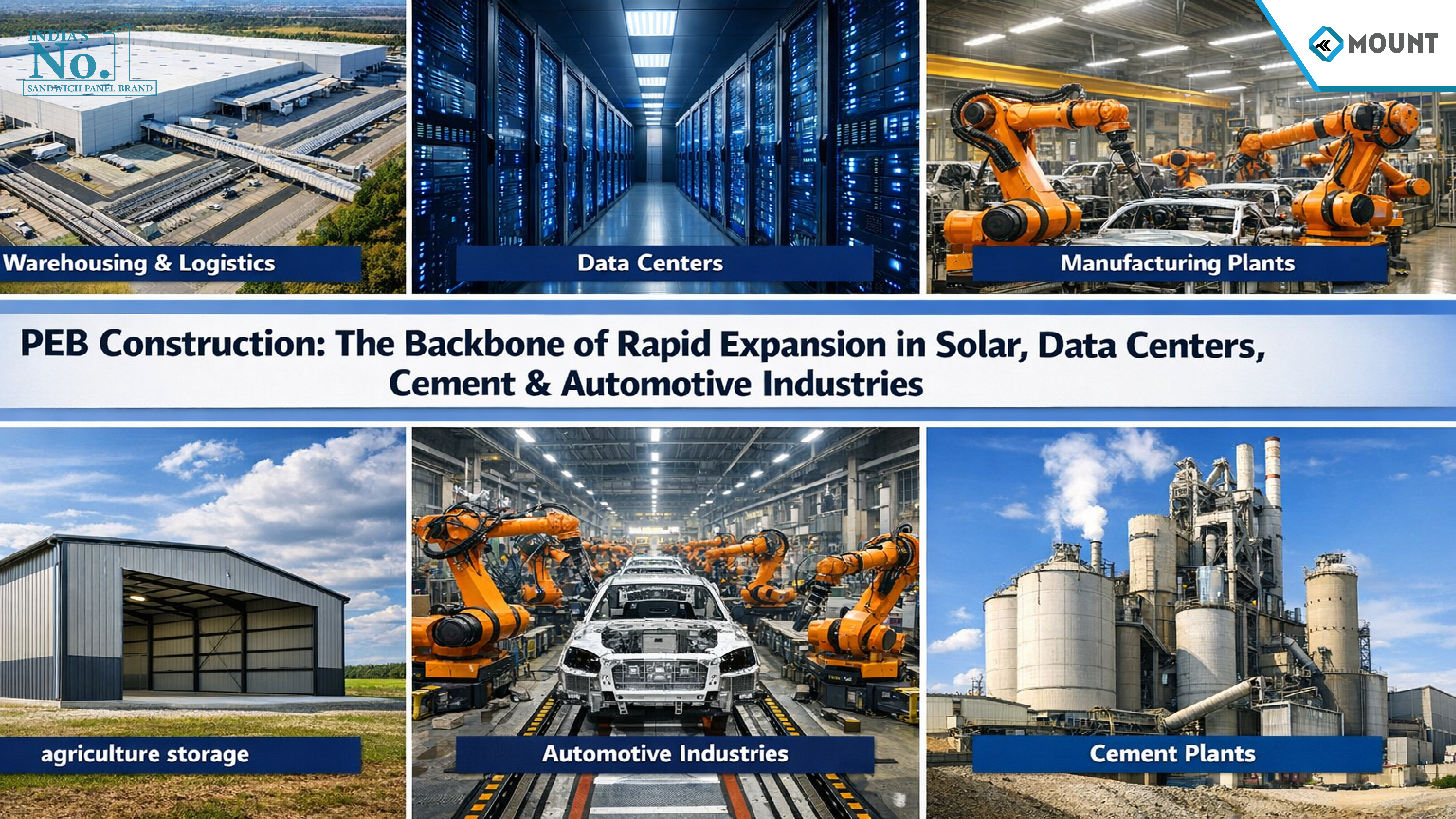
PEB Construction: The Backbone of Rapid Expansion in Solar, Data Centers, Cement & Automotive Industries
Industrial expansion across solar manufacturing, data centers, cement plants, and automotive facilities is increasingly constrained by execution certainty. In most large projects, the building is no longer a background asset but a schedule-critical system that influences equipment installation, commissioning sequence, and long-term operating stability. The adoption of pre-engineered building panels within industrial construction has gained prominence in this environment because it allows structural and envelope decisions to be resolved before site execution begins.
Unlike conventional steel projects, where detailing is executed alongside construction, the construction of PEBs integrates structural detailing, fabrication logic, and installation sequencing into a single controlled engineering workflow. This shift has enabled delivery within defined timelines while supporting early enclosure strategies using steel building roofing panels, which is a key requirement in capital-intensive industrial programs with fixed commissioning targets.
Engineering Basis for PEB Deployment
Each high-growth industrial segment introduces different constraints that directly affect building design. Solar manufacturing facilities require uninterrupted internal spans and roof systems capable of supporting service loads and future photovoltaic integration. Data centers impose continuous equipment loading with limited tolerance for thermal or fire-related deviation. Cement plants involve abrasive dust environments with vibration and heavy crane movement. Automotive plants require modular designs that can support staged expansion without disrupting in-process production.
PEB systems respond by converting operational requirements into quantified structural inputs at the design stage. The building is engineered around the process rather than adjusted after equipment placement.
Structural Design Efficiency and Material Optimization
Traditional steel construction relies heavily on standardized sections and conservative assumptions, often resulting in excess tonnage and increased foundation demand. At Mount Roofing and Structures, PEB structures are designed using load-path optimization, where primary members are profiled to match actual bending moments and axial forces derived from project-specific loading conditions.
This approach becomes particularly effective when coordinated with insulated panels for steel buildings, where framing and enclosure systems are treated as a single structural interface during Mount’s engineering phase. Deflection behavior, support spacing, and connection detailing are resolved together, reducing secondary steel and simplifying erection. For owners and EPC contractors, this results in tighter cost control and fewer downstream revisions.
Execution Certainty Through Parallelized Workflows
Speed in PEB construction is realized through overlap rather than acceleration. Engineering, fabrication, and site activities are executed concurrently, eliminating idle periods between work packages.
Factory-fabricated frames are delivered ready for bolted assembly, allowing enclosure to proceed without delay and internal activities to begin earlier. This sequencing is critical for data centers and automotive plants operating under fixed completion milestones.
Load Management in Equipment-Dense Buildings
Modern industrial buildings function as permanent load carriers. HVAC systems, cable trays, process piping, cranes, and rooftop utilities introduce continuous and variable loads that must be accounted for structurally. PEB systems integrate these loads into the primary structural model rather than addressing them as post-design additions.
When coordinated with insulated panels for data center buildings, dead load, wind uplift, and thermal movement are structurally resolved rather than absorbed through site-level adjustments. This improves long-term predictability as equipment configurations evolve.
Envelope Systems as Operational Assets
In data centers and automotive manufacturing facilities, roof and wall systems directly influence operational performance. Envelope assemblies are expected to deliver thermal stability, fire resistance, and airtightness over extended operating cycles.
Automotive plants rely on fire resistant panels for automobile plants to meet compartmentalization and insurance-driven fire safety requirements. Engineering these systems alongside the PEB structure eliminates interface conflicts and improves lifecycle reliability.
Sector-Specific Impact of PEB Construction
- In solar manufacturing facilities, PEB construction enables clear-span structures that support continuous production layouts. Roof systems engineered in coordination with peb roofing panels allow accurate planning for service loads and future solar installations, supporting capacity expansion without structural modification.
- Data centers benefit from PEB frameworks designed around optimized structural grids capable of supporting high rack densities. When envelope systems are sourced through a single data center insulation panel supplier, coordination risk reduces and phased commissioning becomes more predictable.
- Cement plants impose extreme operational stress due to dust abrasion, vibration, and heavy crane usage. PEB structures address these conditions through load-rated frames and durable roof and wall assemblies, supported by roofing solutions from an experienced roofing panel manufacturer operating in heavy industrial environments.
- Automotive manufacturing facilities use the modular nature of PEB systems to reconfigure bays as production requirements change. Expansion-ready steel frames and fire-safe insulated panels allow capacity additions without halting operations.
Mount Roofing and Structures: Engineering-Led PEB Delivery
Mount delivers PEB solutions as integrated industrial systems. Structural frames, insulated panels for steel buildings, and steel building roofing panels are engineered together to ensure compatibility across load transfer, thermal behavior, and installation sequencing.
This engineering-first methodology aligns building performance with operational realities, reducing execution risk across complex industrial projects.
PEB has become a core component of the industrial infrastructure ecosystem. Its application in combining efficiency, certainty of execution, and envelope performance makes it an ideal choice for industries where time delays directly affect financial risk.
For organizations looking to set up solar power stations, data centers, cement plants, or automotive manufacturing facilities, associating with an engineering-led service provider like Mount Roofing and Structures will ensure that the structure is supportive of their operations right from the start.
FAQ :
Q: How does PEB construction mitigate execution risk in industrial projects?
A: PEB construction addresses structural design, load behaviour, and construction sequencing in the engineering phase, thus minimising site-level changes and allowing parallel fabrication and construction within fixed project schedules.
Q: Why are PEB systems appropriate for equipment-intensive facilities such as data centres and automotive plants?
A: PEB systems model equipment, service, and crane loads within the primary structural model, thus providing predictable deflection and long-term stability as equipment layouts change.
Q: How does envelope integration enhance performance in PEB buildings?
A: Simultaneous engineering of roof and wall systems with the PEB structure enhances thermal performance, fire safety, and interface coordination, thus reducing operational and maintenance risks.
Q: What are the differences between an engineering-led PEB supplier and a conventional steel supplier?
A: An engineering-led PEB supplier provides a comprehensive structural and envelope solution that meets the operational needs, thus ensuring a minimal amount of redesign, rework, and uncertainty in the lifecycle.
Similar Events