 Feb 6, 2026
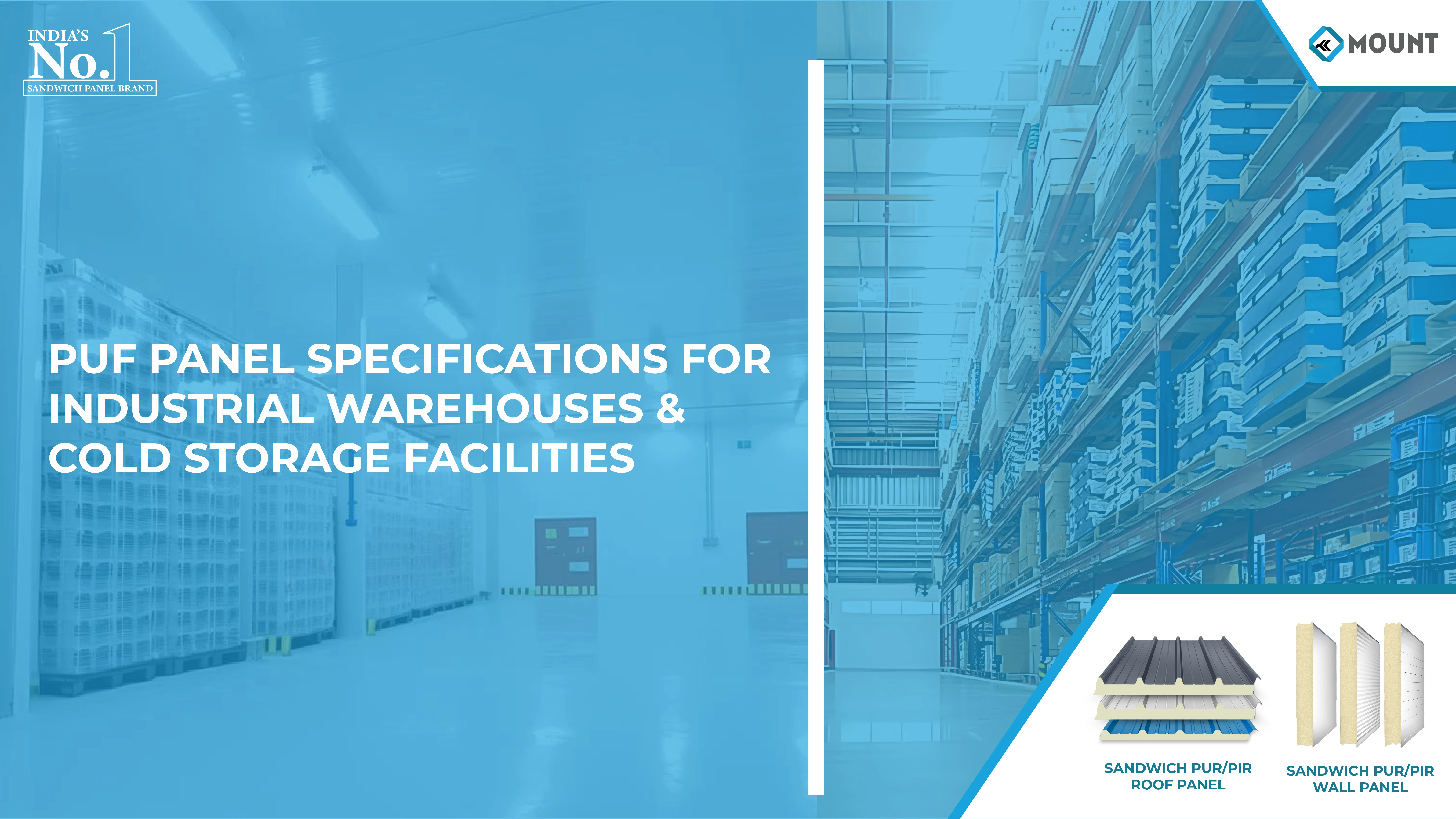
PUF Panel Specifications for Industrial Warehouses and Cold Storage Facilities
In industrial and temperature-controlled buildings, the envelope is a performance system. Roofs and walls influence internal heat transfer, moisture migration, fire exposure behavior, and structural continuity over decades of operation.In the absence of a correlation between material properties and operating conditions in the specification of industrial puf panels, the performance gap is likely to arise only after the facility is in operation. This has direct implications for energy consumption, maintenance, and exposure to compliance risks for owners, consultants, and EPC contractors.
Mount Roofing and Structures approaches insulated panel systems as engineered assemblies. Thermal behavior, structural response, and regulatory requirements are evaluated together so envelope performance remains predictable beyond commissioning.
Thermal Performance and Heat Flow Control
Thermal performance is defined by calculated system U-values rather than insulation material alone. In facilities using warehouse roofing panels, large roof spans amplify radiant heat gain, making continuity across panel joints and interfaces critical. Panel thickness, metal skin properties, and detailing at penetrations all influence heat ingress.
In temperature-regulated zones, the assemblies involving cold storage panels must ensure a uniform resistance value in the walls and ceilings. This is because the localized temperature weakness will result in increased refrigeration loads, thereby increasing the compressor duty cycles and shortening the equipment life.
Insulation Density and Long-Term Stability
PUF insulation density governs both thermal reliability and mechanical behavior. Industrial applications require controlled density to prevent long-term deformation under cyclic temperature loading. In facilities built with insulated warehouse panels, insufficient density often results in loss of panel flatness, which reduces joint compression and compromises air tightness.
Density consistency also ensures stable bonding between metal facings and the insulation core, preserving load transfer and alignment over extended service periods.
Thickness Selection Based on Operating Conditions
Panel thickness must be selected against internal temperature setpoints, external climate exposure, and operational duty cycles. Facilities integrating sandwich panels benefit from thickness optimization that balances thermal resistance with structural efficiency and roof load limits.
In low-temperature applications, under-specification increases energy demand throughout operation. This directly influences lifecycle cost and is a key contributor to overall cold storage panels price when evaluated beyond initial procurement.
Joint Engineering and Air Leakage Management
Panel joints are the most sensitive interfaces within insulated systems. Joint profiles must sustain compression during thermal expansion and contraction to preserve insulation continuity. In assemblies categorized as industrial roofing manufacturers–grade systems, joint performance is a primary determinant of envelope efficiency.
Air leakage at joints introduces thermal bridges that reduce system effectiveness. In cold environments, this accelerates frost formation and increases defrost frequency, placing additional load on refrigeration systems.
Fire Performance and Compliance Requirements
The fire behavior of insulated panels depends on core composition, metal thickness, and details of assembly. A facility choosing a system from an industrial roofing manufacturer has to depend on fire performance testing rather than material type.
Fire-rated panel systems are designed assemblies. Using non-certified components impacts regulatory compliance, insurability, and risk exposure of the facility.
Vapor Control and Moisture Risk
Vapor pressure gradients are responsible for the migration of moisture through building envelopes. Without proper vapor control, the entry of moisture will cause the insulation to deteriorate with time. In cold storage construction panels, vapor resistance is achieved by continuous metal cladding, sealed joints, and proper installation sequencing.Inadequate vapor control will cause hidden condensation within the insulation layer.
Operational Efficiency and Lifecycle Impact
Envelope performance directly influences operating expenditure. Facilities designed with properly specified cold storage panels demonstrate stable temperature control, lower refrigeration loads, and predictable maintenance intervals.
Lifecycle evaluations consistently show that engineered specification reduces total cost of ownership by limiting energy variability and minimizing corrective intervention across the asset lifespan.
Specification-Led Envelope Design
Treating insulated panels as interchangeable products introduces avoidable risk in industrial facilities. Specification-led design integrates thermal analysis, moisture behavior, fire response, and structural movement into a single envelope strategy.
This is how Mount Roofing and Structures delivers value. Operational requirements are translated into engineered panel systems that support compliance, efficiency, and long-term reliability. In industrial warehouses and cold storage facilities, correct specification converts the building envelope from a cost center into a controlled operational asset.
FAQS :
Q1. What governs the specification of PUF panels in industrial facilities?
Specification is driven by operating temperature range, thermal load calculations, vapor pressure differentials, fire compliance requirements, and expected service life rather than panel type alone.
Q2. How does insulation density affect long-term panel performance?
Density influences compressive strength, dimensional stability, and bond integrity between facings and core. Inconsistent density can lead to joint displacement and loss of airtightness under thermal cycling.
Q3. Why is joint design critical in insulated panel systems?
Joint geometry controls air infiltration, thermal bridging, and vapor ingress. Poorly engineered joints reduce effective insulation performance regardless of core thickness.
Q4. How does incorrect panel thickness impact operational efficiency?
Under-specified thickness increases heat transfer, elevating HVAC or refrigeration load across the facility lifecycle and accelerating equipment wear.
Q5. Why must vapor control be addressed during specification, not installation?
Vapor behavior is governed by panel construction and detailing. Once installed, vapor-related failures are difficult to detect and costly to correct.
Similar Events