 Jan 22, 2026
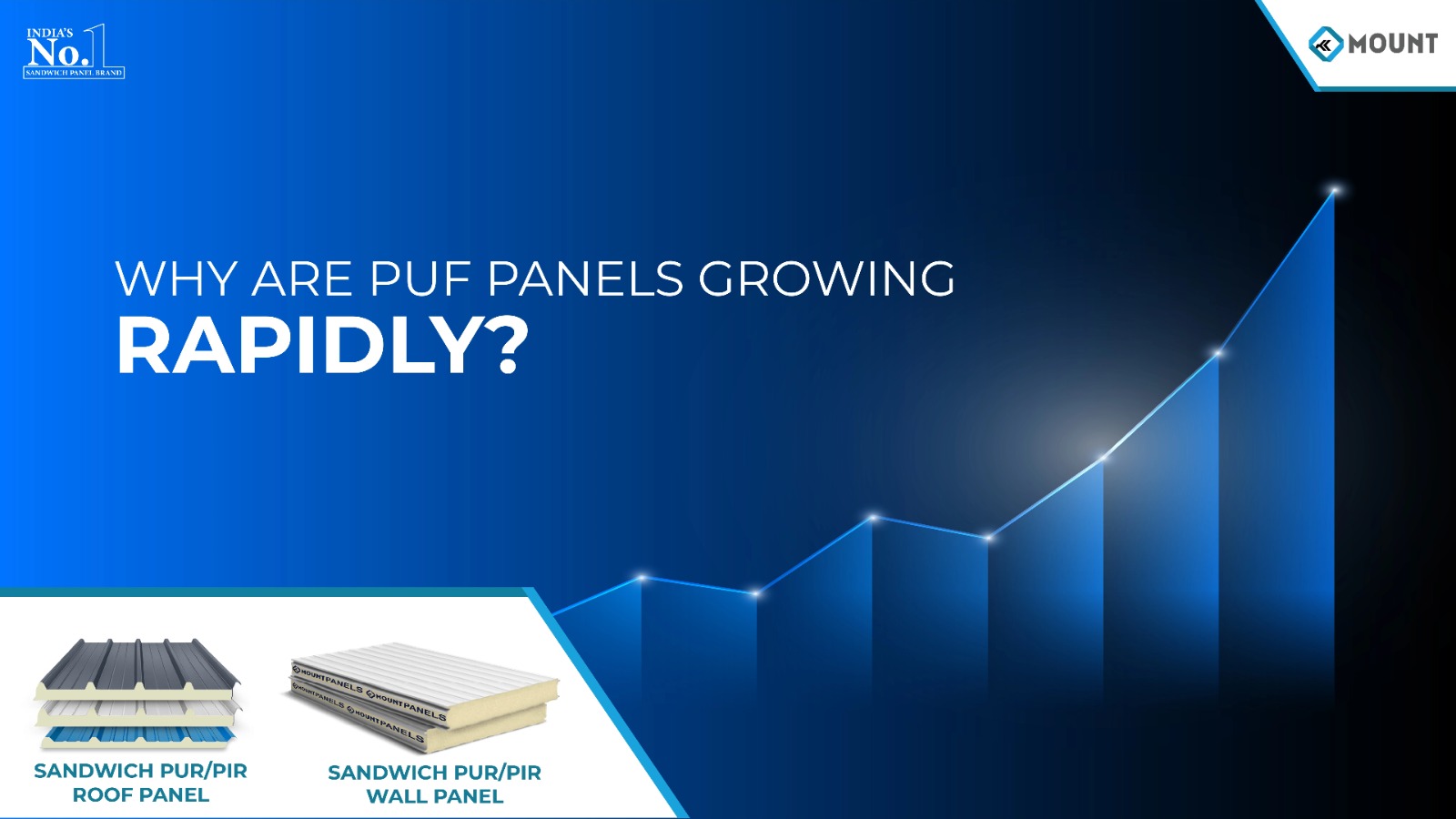
Why Are Sandwich PUF Panels Growing Rapidly?
The construction landscape in India is shifting in ways we haven’t seen before. Facility managers across the country are moving away from conventional building methods toward modern material solutions. At Mount, we’ve tracked this transformation across hundreds of projects,warehouses, manufacturing units, cold storage facilities, and logistics centers. The adoption rate accelerates every quarter. But understanding why requires looking beyond surface-level trends to the genuine operational challenges these materials solve for industrial operators managing tight budgets and demanding timelines.
The Energy Cost Problem Nobody Solves Traditionally
Operational expenses at industrial facilities tell a consistent story. HVAC systems consume 40-50% of total energy budgets. This reality creates constant pressure to find solutions that deliver measurable cost reductions. We’ve worked with dozens of facility managers facing this exact challenge, and traditional roofing approaches simply don’t address the underlying efficiency problem effectively.
This is where PUF panels become transformational. We documented several cases where facilities switching from conventional construction to modern insulation experienced 30-40% reductions in annual cooling costs. These are actual utility bill improvements, not theoretical projections. The polyurethane foam core creates continuous thermal barriers that prevent heat transfer far more effectively than traditional materials.
When Mount designed solutions for pharmaceutical storage requiring precise temperature control, the performance difference became immediately obvious. Products maintained exact specifications with minimal HVAC cycling. The operational benefit extended beyond cost,it improved product quality and regulatory compliance simultaneously. This combination of benefits explains why industrial roofing panels have become standard specifications across temperature-critical facilities.
Why Industrial Shed Construction Timelines Actually Compress
Time represents money in project development. A warehouse delayed by weeks translates directly into lost revenue, extended financing costs, and labor overhead extending beyond budgeted periods. This pressure on timelines has pushed facility managers toward solutions that actually accelerate construction without sacrificing quality.
Roofing PUF panels deliver substantial timeline advantages. Mount coordinated recent warehouse expansions where completion accelerated by 8-12 weeks compared to traditional construction. Panels arrive pre-manufactured and installation-ready. There’s no extensive on-site curing, no complex framing dependencies, and no weather-related delays affecting progress. One logistics client expanded their warehouse operations using Mount’s sandwich panels, compressing timelines from five months to ten weeks. Earlier revenue generation improved their capital return metrics significantly.
Examining PUF Panel Pricing Comprehensively
Many decision-makers evaluate PUF panel manufacturers’ proposals using incomplete financial analysis. Comparing only day-one acquisition costs leads to rejected proposals that would deliver superior financial performance across decades. Mount recommends a different approach,comprehensive cost-of-ownership analysis spanning the facility’s operational life.
While reviewing the proposals, the financial aspects should be considered in their entirety. The savings in energy add up to long-term gains. Maintenance costs also reduce because polyurethane foam is more resistant to moisture and the environment than traditional materials. Annual maintenance typically remains below one percent of initial installation costs. Installation labor decreases because work proceeds more efficiently with fewer skilled workers required for shorter durations.
Over twenty-five years, the total cost advantage becomes compelling.When spread out over operational savings, the initial impression of a premium price disappears. Facility managers reviewing sandwich PUF panels with this perspective consistently recognize superior financial performance over extended timelines.
PUF Panels for Cold Storage and Specialized Applications
Sandwich panels have emerged as solutions across virtually every industrial sector, but cold storage represents the most demanding application. Facilities preserving perishable goods depend entirely on superior insulation for maintaining precise temperatures consistently. Food processing companies, pharmaceutical operations, and agricultural businesses have adopted these solutions because traditional materials fail to meet performance requirements.
Manufacturing facilities incorporate industrial roofing panels in roof systems, exterior walls, and interior partitions based on specific operational demands. Each application requires formulations selected for particular environmental conditions. All Pharmaceutical manufacturers have to depend on thermal consistency for product quality and regulatory compliance. Logistics operations benefit from thinner wall systems maximizing interior space while reducing structural weight.
Mount’s technical team designs customized solutions addressing specific facility requirements rather than forcing projects into standard offerings.
Manufacturing Excellence and Quality Standards
Mount upholds strict quality standards that demonstrate a sincere dedication to PUF panel production excellence. Top Sandwich Panel manufacturers use advanced manufacturing techniques that combine expert craftsmanship and automation. Each unit produced maintains a precise dimensional specification, appropriate adhesive application, and uniform foam density.
These manufacturers invest in strict testing procedures and quality assurance protocols. Industry certifications reflect ga enuine commitment to environmental responsibility and performance reliability. Supply chain relationships have become increasingly important as demand for sandwich panels grows. Established manufacturers maintain infrastructure, ensuring project continuity regardless of market conditions.
Why Mount Recommends These Solutions
Mount’s position as an industry-leading Sandwich Panels & PEB solution provider is built on delivering results exceeding client expectations. Thirty Plus years of Industry experience have demonstrated that roofing PUF panels consistently outperform traditional construction across measurable parameters.
We recommend Mount’s industrial roofing panels because field experience shows their superiority in real-world conditions. Energy efficiency translates to operational cost reductions. Construction acceleration delivers faster revenue generation. Effective cost management is made possible by an extended lifespan and low maintenance. These results are not marketing claims; rather, they are the result of hundreds of finished projects. Mount’s technical team provides detailed engineering analysis when facility managers evaluate whether these solutions suit specific applications.
Making Informed Decisions About Your Facility
Organizations planning expansion should evaluate modern materials comprehensively. Request detailed performance data from multiple manufacturers. Examine warranty conditions, fire ratings, and thermal characteristics. Determine the total cost of ownership based on your operational limits.
Talk about the logistics of installation with seasoned contractors who have installed sandwich panels before. Compared to traditional sourcing methods, establishing connections with dependable manufacturers who comprehend the particular needs of your facility offers better long-term value.
Final Thoughts
The rapid growth of sandwich PUF panels reflects genuine operational advantages across industrial sectors. At Mount, we’ve witnessed this transformation and remain committed to helping facilities make intelligent material choices. Contact our technical team to discuss how modern building solutions can improve your facility’s performance and reduce operational costs.
Frequently Asked Questions
Q: Why are these panels gaining popularity so fast?
A. Industrial projects today demand faster completion and lower running costs.
Traditional materials struggle to meet both needs.
These panels offer a practical solution.
Q: How do they reduce energy usage in facilities?
A. They provide effective insulation that limits heat transfer.
Indoor temperatures remain stable for longer periods.
This reduces dependency on cooling systems.
Q: Are they a smart investment over the long term?
A. The initial cost can be higher than conventional options.
However, energy and maintenance savings continue year after year.
This results in better overall value.
Similar Events