 Mar 26, 2026
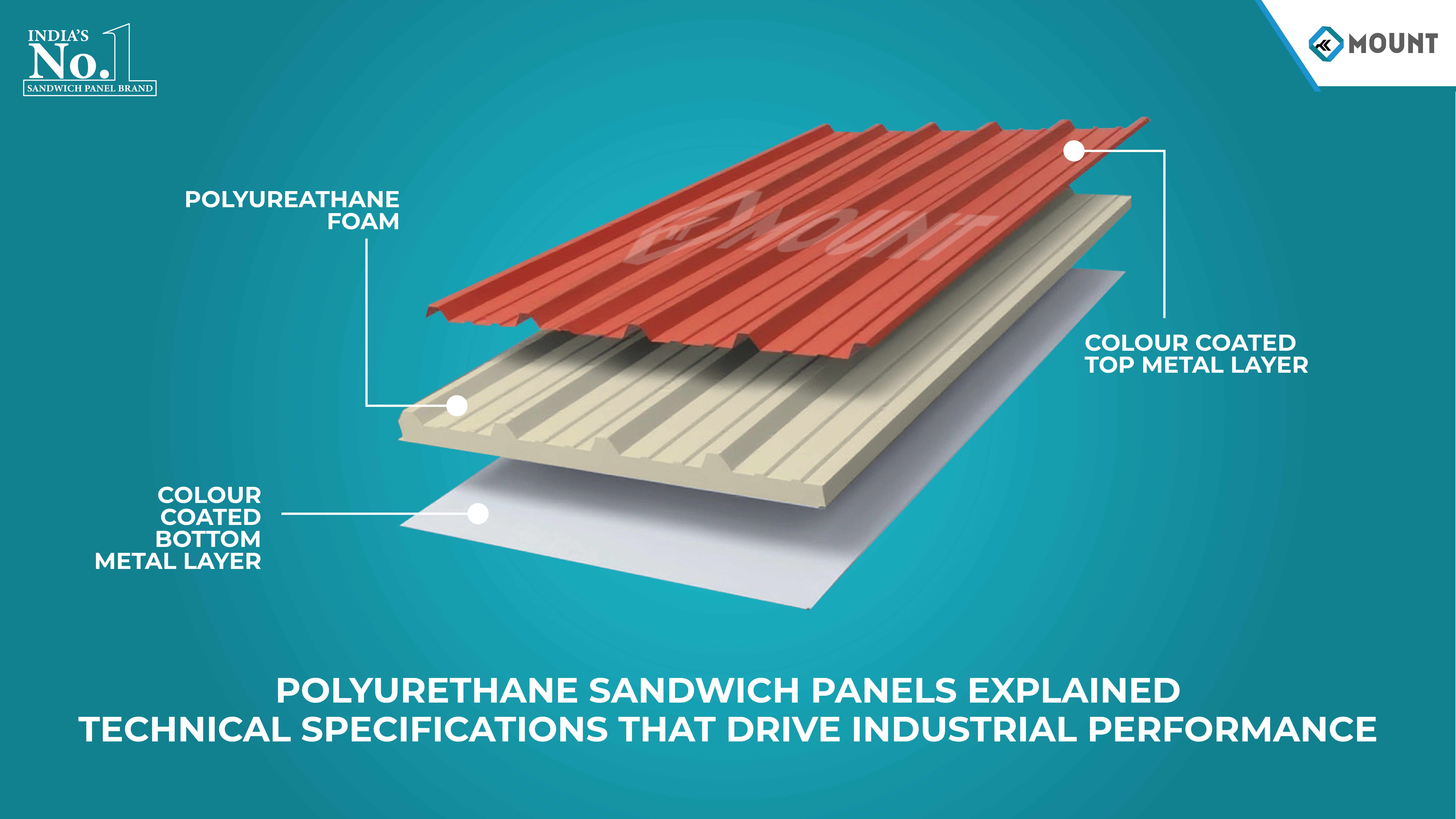
Polyurethane Sandwich Panels Explained: Technical Specifications That Drive Industrial Performance
In the high-stakes world of industrial infrastructure, the thin line between operational profit and mounting overhead is often found in the building envelope. For a modern facility, choosing sandwich panels for manufacturing plants isn’t just a purchasing line item; it’s a strategic engineering decision. While Polyurethane (PUF) systems are the industry benchmark, their true value isn’t found in marketing brochures, it’s hidden in the granular technical specs that dictate how a structure behaves under stress over twenty years.
The Material Science of Thermal Resistance
Thermal efficiency starts with the chemistry of the core. To hit peak performance, a panel needs a core density maintained strictly at 40 plus or minus 2 kilograms per cubic meter. This isn’t an arbitrary number; it’s the sweet spot where you achieve a closed-cell content of over 95%. This high density is what keeps thermal conductivity, often referred to as the Lambda value, at its lowest possible point.
When you specify sandwich panels for roofing, these metrics determine your facility’s long-term energy footprint. High-density cores prevent the “gas-aging” effect, where inferior panels lose their insulating power after just a few seasons. At Mount, we ensure our panels maintain their R-value integrity, directly slashing the HVAC load and protecting your bottom line from energy price volatility.
Structural Mechanics: Beyond Simple Insulation
An industrial shell has to do more than just keep the heat out; it’s a load-bearing component. The compressive strength of the PUF core, which should never dip below 150 kilopascals, allows the entire panel to function as a rigid composite unit.
However, the real engineering challenge is bond integrity. If the insulation peels away from the steel skin, the panel fails. To prevent this, Mount utilizes advanced corona treatment on the internal metal facers, ensuring a tensile bond strength of at least 100 kilopascals. This level of adhesion is critical when installing sandwich panels for walls in large-span warehouses. It allows for wider purlin spacing, which actually reduces the amount of secondary steel needed for the primary frame, saving you capital expenditure right out of the gate.
Joint Engineering and Environmental Control
The Achilles’ heel of any insulated building is the joint. A poorly designed seam leads to thermal bridging and moisture vapor transmission nightmare scenarios for food processing or chemical storage.
Reliable warehouse sandwich panels require a sophisticated double-tongue-and-groove profile. This “dry-joint” geometry creates a physical capillary break that stops moisture in its tracks. By ensuring a hermetic seal at every junction, Mount helps consultants maintain precision-controlled environments where even a minor shift in humidity can ruin a production batch.
Load Dynamics and Precision Fit
When dealing with sandwich panels for roofing, engineers have to account for the “bi-metal effect,” the physical bowing caused by the sun beating on the outer skin while the interior remains cool. Mount mitigates this by using high-yield strength steel (up to 350 Megapascals) and rigorous dimensional tolerances. We don’t just ship parts; we deliver a calibrated system where every panel fits within a 1 millimeter margin, ensuring a fast-track installation that stays weather-tight for decades.
The Mount Advantage: Engineering Over Commodities
At Mount Roofing and Structures, we treat manufacturing as a science, not a commodity. Our production lines use automated pressure sensing and infrared scanning to eliminate internal voids that plague cheaper alternatives. We provide the data, span tables, deflection limits, and thermal modeling to ensure your project is built on a foundation of verified physics.
Why Industrial Leaders Choose Mount:
- Zero-Void Insulation: Our continuous foaming process guarantees uniform density across the entire panel length.
- Structural Optimization: We assist consultants in calculating exact load-deflection ratios to minimize steel costs.
- Tested Reliability: Every production run is backed by rigorous pull-off tests and fire-response validation.
Technical FAQ for B2B Stakeholders
Q: How does closed-cell percentage impact facility hygiene?
A: If the closed-cell count drops below 95%, the panel can absorb moisture. In cold storage or food plants, this leads to internal mold growth and a total loss of thermal resistance. Mount’s high-density cores stay bone-dry internally.
Q: What prevents “thermal bridging” at the panel junctions?
A: Our interlocking joint design ensures the insulation of one panel meets the next without a metal-to-metal path. This breaks the thermal bridge, preventing the localized condensation that causes rust and heat loss
Q: Are these panels rated for heavy rooftop solar loads?
A: Absolutely. Because our core compressive strength is high, Mount panels can support the point loads of PV mounting systems without the insulation collapsing or the weather-seal breaking.
Q: How do you handle the thermal expansion of long-span walls?
A: We utilize specific fastening patterns and “floating” joint geometries that allow the outer skin to expand and contract without compromising the structural integrity of the inner skin or the core bond.
Q: What is the expected service life before the insulation value degrades?
A: With our stabilized chemical formulation, Mount panels are designed to maintain over 90% of their initial thermal performance for over 25 years, provided the joint gaskets remain intact.
Similar Events