 Feb 26, 2026
Common Coldroom Problems and How to Fix Them Efficiently
Your energy bills jumped 40% last quarter. The temperature logs show a drift nobody can explain. There’s ice building up on panels in places that make no sense. Most facility managers call the refrigeration contractor when these problems start. But here’s what years of troubleshooting have taught us, nine times out of ten, the problem isn’t your compressors. It’s the envelope. Those cold room panels forming your walls and ceiling are doing a lot more than keeping the weather out. They control thermal stability, manage moisture, maintain hygiene compliance, and determine whether your refrigeration runs efficiently or burns through electricity, fighting a battle it can’t win.
Temperature Instability Starts at the Envelope
Coldrooms that can’t stay within a half-degree variance across 24 hours usually have envelope issues, not mechanical problems. Insufficient insulation, thermal bridging at joints, and air leaking through poorly sealed penetrations are the usual suspects. Observed ranges in Indian industrial facilities show a cold room sandwich panel at 100mm thickness, which works fine for -5°C storage. But try pushing that same panel to -25°C blast freezing and watch what happens. Heat gain overwhelms your compressor capacity because the insulation can’t handle the temperature differential.
Thermal bridging gets less attention than it deserves. Every metal fastener punching through your insulation creates a conductive pathway for heat. Panel joints do the same when they’re not detailed correctly. Each thermal bridge works like a heat highway, letting exterior warmth bypass your insulation and flood into the controlled space. Add air leaking around door frames or service penetrations, and keeping stable temperatures becomes impossible, regardless of how much refrigeration capacity you’ve installed.
Energy Costs That Keep Climbing
We’ve seen facilities where actual energy consumption runs 40-60% above design projections. The refrigeration equipment usually isn’t the culprit. Cold room panel installation mistakes create the problem, joints that aren’t sealed properly, vapor barriers that got missed, and fastener spacing that’s wrong. These thermal weak points can double or even triple your calculated heat gain.
Panel thickness hits your operating budget harder than most people think. Field data typically shows that maintaining -18°C storage with 100mm panels, you’re looking at 180-220 kWh per cubic meter annually. Bump up to 150mm panels and consumption drops to 120-140 kWh per cubic meter. Run those numbers across 15 years of operation and the energy savings typically exceed the extra cold room puf panel cost by three to five times. Yet these projects keep getting value-engineered down to thinner panels to shave construction costs upfront.
Condensation and Vapor Barrier Breakdowns
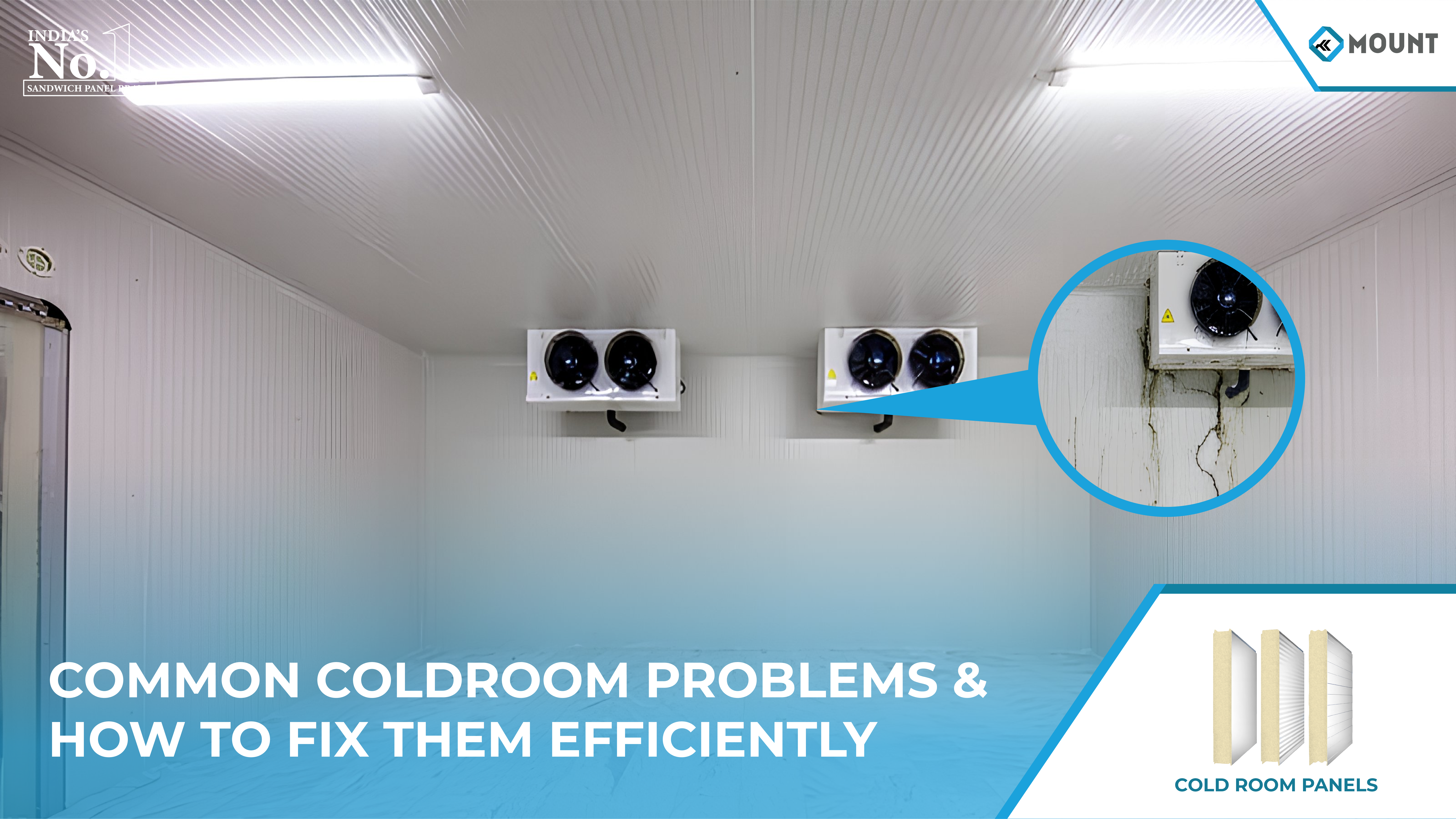
Condensation forming on interior surfaces means your vapor barrier failed somewhere. Warm, humid air gets into the envelope, hits those cold surfaces, and water condenses instantly. That moisture migrates into insulation cores, reducing thermal resistance, promoting corrosion, and eventually freezing. When frozen moisture expands, it creates pressure that delaminates panel facings from cores.
Sandwich panels for cold rooms need continuous vapour barriers on the warm side of the insulation. Standard approach uses 0.2mm polyethene sheets or factory-applied aluminium foil facings with vapor permeance below 0.01 perms. Every single penetration through this barrier, electrical conduits, structural supports, and door frames, needs vapour-tight sealing with proper gaskets and sleeves. Skip these details and you’ll see condensation within months, icing by the first cold season.
Exterior icing at panel joints tells you warm outside air is meeting escaping cold interior air. The temperature differential causes instant condensation that freezes and accumulates. These ice formations grow over time, eventually forcing panel joints apart and accelerating the whole failure cycle.
Water Infiltration That Destroys Insulation
Water infiltration wrecks coldroom envelopes faster than anything else. Capillary action pulls moisture into unsealed panel edges. Roof-to-wall transitions that aren’t flashed channel rainwater properly into wall cavities. Loading dock impacts crack exterior facings, creating entry points for bulk water that saturates insulation cores.
Once insulation gets saturated, it loses 80-90% of its thermal resistance. A 120mm polyurethane panel with just 5% moisture content by volume? R-value collapses dramatically, often losing the majority of its thermal resistance.. The refrigeration system tries to compensate by running nonstop. Energy costs multiply. Temperature control degrades. Worse yet, moisture cycling through freeze-thaw creates internal ice lenses that mechanically tear panel components apart.
Panels That Deflect Under Load
Cold room panel manufacturers publish maximum span and load ratings. Field installations ignore these limits constantly. Panels rated for 4-meter vertical spans get installed at 6 meters to reduce girt quantities. Snow loads in northern regions pile up beyond design assumptions. Forklifts hit panels during loading operations with impacts that exceed rated capacities.
When panels deflect under these loads, problems cascade. Deflected panels pull fasteners into tension, loosening weather seals. Joint profiles separate, breaking vapor barriers and creating air leakage paths. Severe deflection permanently warps panels, you can’t straighten them without cracking facings and compromising insulation adhesion, so replacement becomes your only option.
Proper load analysis during design prevents these failures. Panel selection has to account for actual roof snow loads, equipment loads from mounted refrigeration units, and worst-case wind pressures. Girt spacing must match panel span capabilities with appropriate safety factors, typically 2.0 for gravity loads, 1.5 for wind.
Hygiene Problems That Fail Inspections
Food safety regulations require cleanable, non-porous interior surfaces that resist bacterial growth and withstand chemical cleaning. When panel joints separate, they create crevices where organic material accumulates and bacteria colonise. Condensation on interior surfaces provides the moisture microbes need to thrive. Damaged panels with exposed insulation cores fail hygiene inspections immediately.
FSSC 22000 standard mandates smooth, impervious surfaces in food-contact zones. Meeting these standards requires cold room panels with food-grade interior facings, typically embossed stainless steel or plastisol-coated galvanised steel. Joint systems need flush profiles with sealed edges. Fastener penetrations require sanitary caps that prevent moisture accumulation and keep cleaning solutions from getting inside panels.
Engineering Solutions That Address Root Causes
Effective coldroom envelopes start with realistic thermal modelling. Calculate actual heat loads, transmission through panels, air infiltration, product loads, internal heat sources like lighting and personnel. This determines the minimum insulation thickness. Standard refrigeration (-5°C to +5°C) typically needs 120mm. Frozen storage (-18°C to -25°C) requires 150mm. Blast freezing below -30°C demands 200mm cores.
Vapour control requires continuous barriers without penetrations. When you can’t avoid penetrations, use vapour-tight sleeves with sealed flanges. Run electrical conduit in chases outside the envelope or within sealed raceways. Door frames need thermal breaks and continuous perimeter gaskets that compress 25-30% under closure force.
Joint detailing determines whether your panels form continuous barriers or leak. Tongue-and-groove profiles with concealed gaskets seal better than exposed fastener systems. Corners and transitions need prefabricated components rather than field-cut solutions that leave gaps. Roof-to-wall transitions require flashed curbs with properly sealed laps.
Installation Mistakes With Long-Term Consequences
Over-torquing fasteners cracks the sealing washers, creating water entry points. Under-torquing leaves gaps in compression seals. Cold room panel installation teams need calibrated torque drivers and quality control checks on at least 10% of fastener locations.
Inadequate panel support during installation causes deflection that permanently warps profiles. Support panels every 2-3 meters during handling. Never drag them across rough surfaces that scratch facings. Scratched galvanised coatings corrode rapidly in refrigerated environments with elevated humidity.
Missing or incorrectly positioned vapor barriers rank among the most common and damaging mistakes we see. Vapor barriers belong on the warm side of insulation, that’s the exterior in coldrooms. Installing barriers on the interior traps moisture in insulation cores where it condenses and freezes.
Maintenance That Catches Problems Early
Operating coldrooms takes a beating from daily activities. Forklift impacts. Pallet abrasion. Cleaning chemical exposure. Thermal cycling. These degrade envelope integrity gradually. Proactive maintenance programs catch and repair minor damage before it propagates into major failures.
Quarterly inspections should document fastener condition, joint integrity, and any signs of moisture infiltration. Thermal imaging during operation reveals insulation degradation and air leakage that visual inspection completely misses. Annual comprehensive surveys provide baseline documentation for tracking how degradation progresses over the facility’s operational life.
Deciding Between Repair and Replacement
Panel damage limited to exterior facings with intact insulation can usually be repaired by replacing the facing. Moisture-saturated insulation requires panel replacement, no repair method restores thermal performance once the cores get wet. Widespread joint separation indicates structural inadequacy requiring complete envelope replacement.
Economic analysis should compare repair costs against ongoing operational inefficiency costs. A coldroom losing 30% thermal efficiency wastes energy equivalent to the panel replacement cost every 3-5 years. Delaying replacement just piles up costs without addressing the underlying performance degradation.
Mount’s Approach to Coldroom Envelopes
Coldroom envelope performance depends on coordinating insulation selection, structural design, vapor control detailing, and execution quality during installation. Mount Roofing & Structures approaches coldroom projects through comprehensive thermal analysis, load verification specific to panel span and fastener capacity, and installation protocols validated through thermal imaging and blower door testing.
We specify panel systems based on actual operating temperatures, humidity conditions, and hygiene requirements, not generic product catalogue recommendations. Our installation supervision includes fastener torque verification, joint seal inspection, and vapor barrier continuity testing. Post-installation commissioning documents actual thermal performance against design parameters, verifying that facilities operate as engineered rather than as approximated.
FAQ’S :
Q: Why does a cold room display temperature variations despite adequate refrigeration capacity?
A: Temperature variation is normally a result of envelope problems such as lack of insulation, joint bridging, and air infiltration. These problems create continuous heat gain that cannot be compensated for by refrigeration equipment.
Q: Does increasing panel thickness actually help cut down costs in the long run?
A: Yes. Increasing panel thickness will lead to less heat gain, thereby reducing the compressor operating hours and energy consumption. The cost savings will normally outweigh the additional cost of the thicker panels over the cold room’s life span.
Q: When should panel replacement be considered as an option instead of repair?
A: Panels with wet insulation, frequent joint separation, or structural deflection should be replaced. After the insulation performance is compromised, there is no point in repairing.
Q: What are the signs of a vapour barrier failure in a cold room?
A: Condensation, icing, and moisture accumulation around panel joints, door frames, and service penetrations are the signs of a vapour barrier failure in a cold room
Similar Events