 Mar 5, 2026
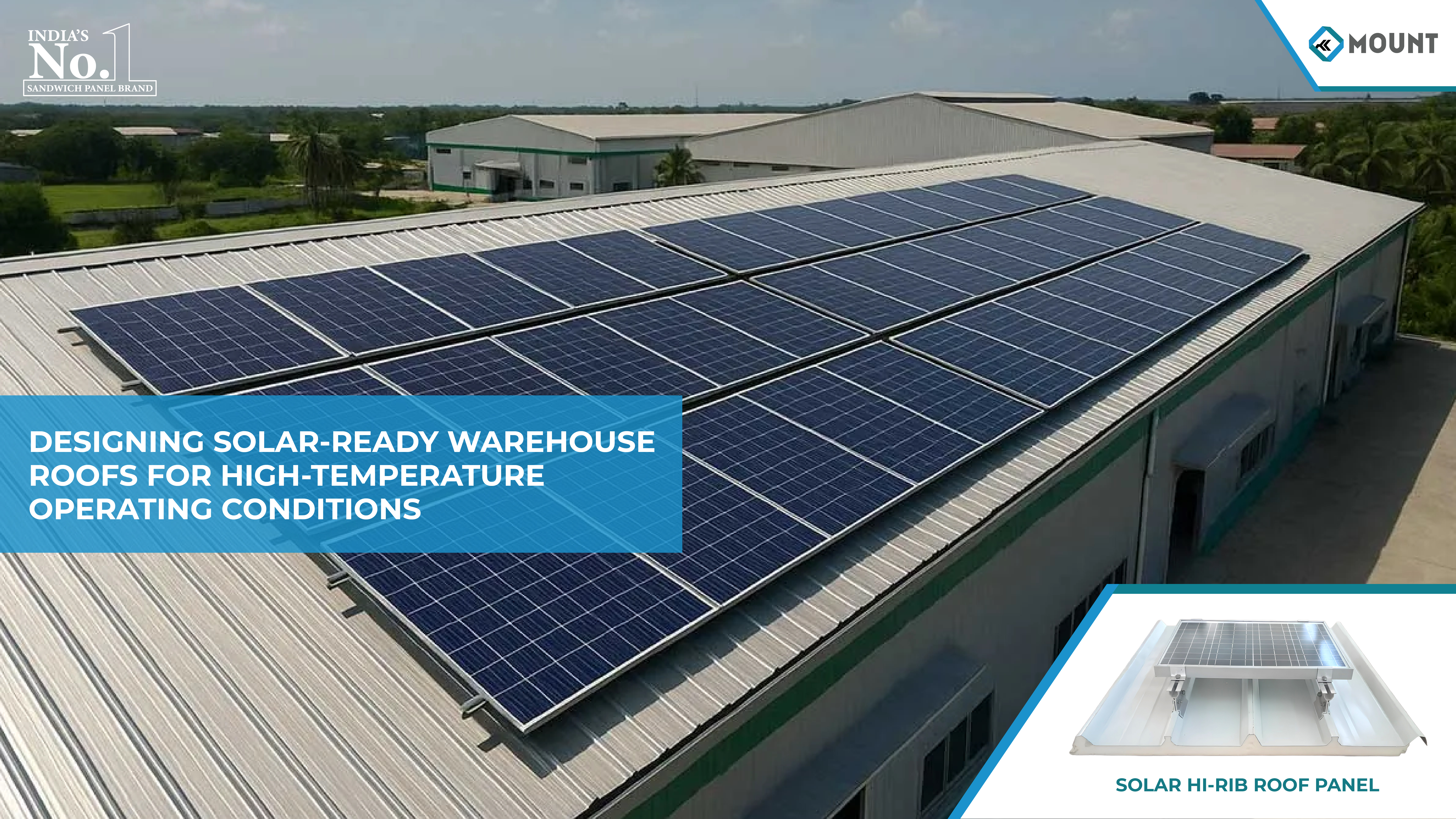
Designing Solar-Ready Warehouse Roofs for High-Temperature Operating Conditions
With the changing nature of industrial infrastructure towards carbon neutrality, the warehouse roof has transformed from a mere protective structure to a power-generating facility. Nevertheless, the incorporation of solar photovoltaic systems in the Indian subcontinent is a complex engineering task, which involves the handling of sustained thermal stress. This is because high temperatures not only reduce the efficiency of solar cells but also cause substantial expansion and contraction of roofing materials.
Designing a solar-ready facility requires moving beyond “add-on” mentalities. It demands a holistic approach to the building envelope where the roof system is engineered to thrive under the dual load of structural weight and extreme heat.
Thermal Dynamics and the Photovoltaic Penalty
A standard rooftop in peak summer can reach surface temperatures exceeding 70°C. For solar modules, this is a critical threshold; most silicon-based PV cells experience a drop in efficiency for every degree rise above 25°C. When a roof lacks adequate thermal management, the trapped heat between the panel and the roof surface creates a “heat pocket” that accelerates equipment degradation.
Mount’s approach utilizes Solar PUF Roof Panels to mitigate this effect. By employing a high-reflectivity outer skin and a dense insulating core, our panels prevent the roof from becoming a massive heat sink. This keeps the immediate microclimate beneath the solar modules cooler, helping maintain the voltage output of the system and extending the lifespan of both the PV hardware and the roof’s coating.
Structural Integrity: Managing Load and Expansion
Introducing a solar array adds a permanent dead load to the structure, but the more volatile factor is wind uplift. Solar panels alter the aerodynamics of a roof, creating turbulence that can stress traditional fastening systems. Furthermore, the thermal expansion of metal sheets, if not accounted for, can lead to fastener “slotting,” where the movement of the sheet creates elongated holes that compromise waterproofing.
As a leading sandwich panel manufacturer, Mount Roofing & Structures utilizes h-rib sandwich panels specifically designed for high-load industrial applications. The “H-Rib” geometry provides superior sectional modulus, allowing the roof to resist deflection under the weight of the glass and mounting rails. Our Solar Roof Sandwich Panel systems are engineered with precision-aligned ribs that facilitate penetration-free mounting clamps. This ensures that the primary waterproofing membrane remains intact while allowing the metal skin to expand and contract independently of the solar racking.
Heat Gain Management and Internal Stability
A warehouse’s operational efficiency is inextricably linked to its internal thermal stability. In high-temperature zones, the heat radiated from the ceiling can increase cooling costs and impact the shelf life of temperature-sensitive inventory. While the solar panels themselves provide a degree of passive shading, they cannot replace a high-performance thermal break.
The integration of Solar Sandwich Panels provides a continuous insulation barrier that effectively decouples the external environment from the internal workspace. At Mount, we emphasize core density and manufacturing precision to ensure that there are no gaps in the insulation. This strategy reduces the building’s overall energy footprint, allowing the energy generated by the solar system to be used for operational needs rather than fighting excessive heat gain.
Long-Term Performance Factors Beyond Installation
- Coating Performance Under UV and Shading Patterns
Alternating shaded and exposed zones beneath solar arrays can accelerate uneven coating wear. High-grade coated steel ensures consistent durability despite differential UV exposure.
- Cable Tray Heat Accumulation
Electrical routing beneath panels can trap heat and create localized hotspots. Proper airflow planning and insulation control mitigate thermal concentration.
- Fire Compartmentation Beneath PV Installations
Rooftop solar adds electrical complexity. Roof assemblies must preserve fire integrity and prevent flame spread across large spans through controlled detailing and fire-rated systems.
- Deflection Tolerance and Panel Alignment
Structural deflection under load must remain within predictable limits to avoid stress on rigid photovoltaic frames and maintain long-term mounting stability.
Future-Proofing: Designing for Phased Expansion
Many developers opt for a “solar-ready” design to allow for phased capital expenditure. A truly solar-ready roof must be capable of supporting future arrays without requiring structural retrofits. This involves:
- Enhanced Purlin Spacing: Calibrating the PEB frame to handle future point loads.
- Drainage Detailing: Ensuring that solar rails do not obstruct the flow of rainwater or create debris traps.
- Maintenance Access: Designing walkways and lifelines into the initial roof layout to prevent damage from foot traffic during solar cleaning.
By choosing a Solar Sandwich Panel for Warehouse Roof applications from the design phase, stakeholders avoid the costly “retrofit tax” associated with reinforcing old structures.
Your Technical Partner in Solar Integration
Mount Roofing & Structures positions itself as more than a supplier; we are a design-led engineering partner. As one of the top PUF panels manufacturer and suppliers in India, we coordinate directly with solar EPC (Engineering, Procurement, and Construction) firms to ensure that our warehouse sandwich panels are perfectly matched to the mounting technology being deployed. Our execution planning covers everything from wind-tunnel-verified uplift resistance to NBC-compliant fire safety, ensuring your renewable energy investment is built on a foundation of structural excellence.
FAQ
Q : How do Solar Sandwich Panels affect the Fire Rating of a warehouse?
A : Mount utilizes PIR (Polyisocyanurate) and fire-retardant PUF cores that meet stringent NBC 2016 norms. These materials are self-extinguishing and do not contribute to flame spread, which is a critical safety requirement when installing high-voltage electrical equipment like solar arrays on a roof.
Q : Can H-Rib sandwich panels be used with all types of solar mounting systems?
A : Our h-rib sandwich panels are optimized for “mini-rail” and clamp-based systems that grip the rib crest. This avoids through-roof penetrations, significantly reducing the risk of long-term leaks and maintaining the structural integrity of the composite panel.
Q : Does the weight of the solar panels affect the span of the PUF panels?
A : Yes. When designing a Solar Sandwich Panel for Building Roof, we recalculate the allowable span between purlins. Typically, we increase the thickness of the top metal skin or shorten the purlin spacing to ensure that deflection limits are not exceeded under the combined load of the PV system and maintenance personnel.
Q : How does the “Cool Roof” coating on Mount panels impact solar efficiency?
A : Mount’s specialized coatings have a high Solar Reflectance Index (SRI). By reflecting more sunlight and emitting absorbed heat more effectively, the surface temperature of the roof stays lower. This reduces the radiant heat transfer to the back of the solar panels, helping them operate closer to their peak efficiency.
Similar Events