 Feb 28, 2026
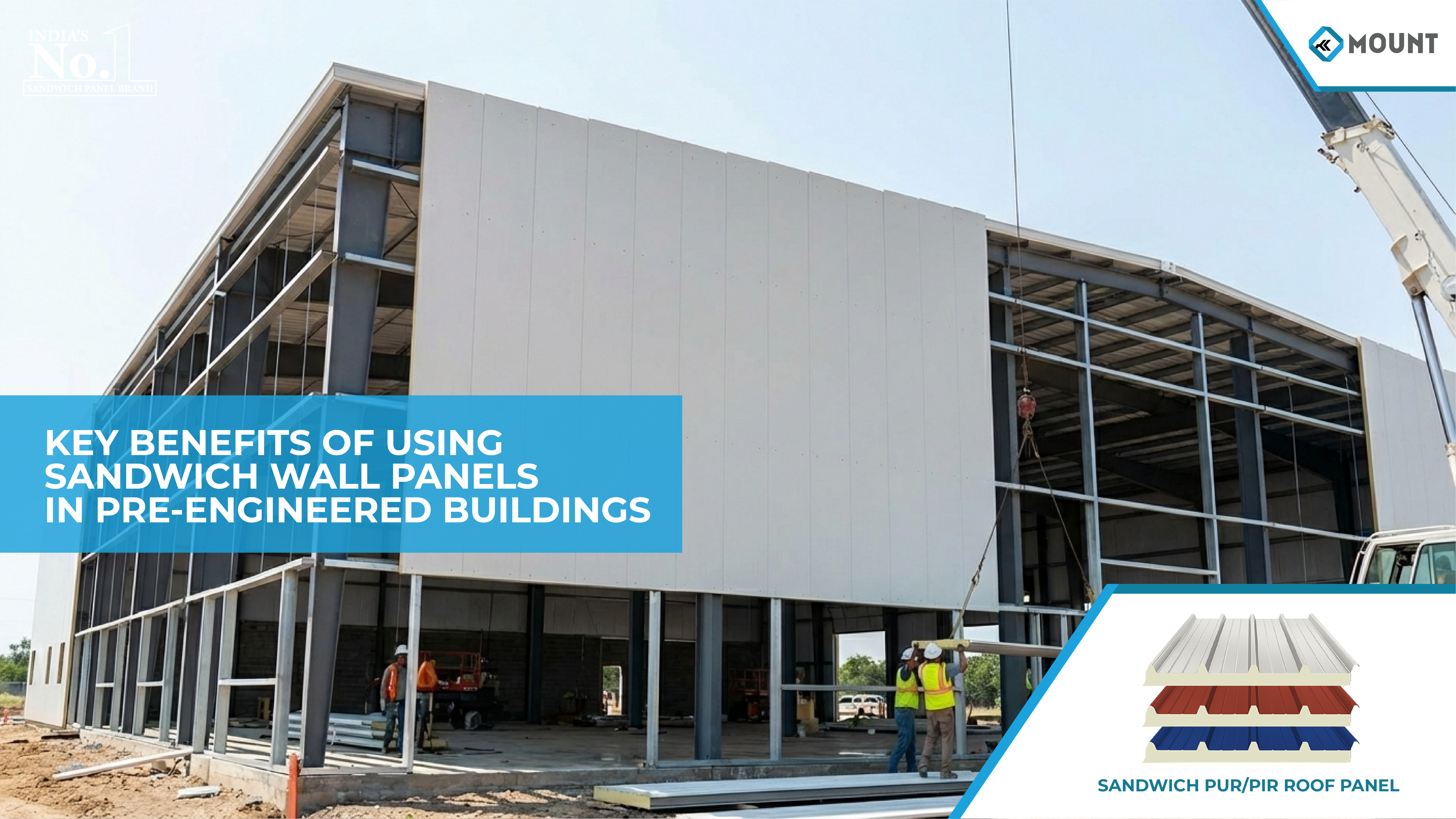
Key Benefits of Using Sandwich Wall Panels in Pre-Engineered Buildings
In industrial pre-engineered buildings, envelope decisions directly affect structural behavior, energy consumption, compliance risk, and asset life. Treating wall panels as interchangeable cladding elements is one of the most common, and costly, mistakes in PEB execution. In reality, sandwich wall panels function as engineered components within the overall building system. Their interaction with the steel frame, insulation continuity, joint detailing, and load transfer logic determines whether a facility performs as designed or underdelivers from day one.
At Mount Roofing & Structures, wall panels are approached as part of an integrated envelope strategy, aligned with frame design, service requirements, and long-term operational intent. This distinction is what separates engineered pre-engineered building panels from commodity products.
Panel Composition and Structural Integration
A sandwich wall panel is a composite assembly comprising profiled metal facings bonded to an insulated core. While the materials are familiar, performance is governed by how the panel is engineered into the PEB system. Panel stiffness, effective span, fastener pull-out capacity, and joint behavior influence load distribution under wind pressure and suction.
In properly designed systems, sandwich panels for walls contribute to envelope rigidity and reduce secondary steel dependency. Conversely, panels selected without reference to frame spacing or movement tolerances introduce stress concentrations, leading to joint failure and premature leakage. Structural integration, not panel thickness alone, defines reliability.
Thermal Continuity and Energy Discipline
Industrial buildings increasingly operate under controlled internal conditions. Thermal leakage through poorly detailed walls increases HVAC demand and destabilizes internal environments. Continuous insulation across the façade is where insulated panels for steel buildings outperform layered construction methods.
Effective U-values depend on joint integrity, fastener detailing, and column interface treatment. When insulation continuity is broken at girts or penetrations, theoretical thermal values lose relevance. Mount’s envelope engineering resolves these interfaces early, ensuring that calculated performance aligns with on-site reality and long-term energy outcomes.
Fire Behavior as a System Attribute
Fire performance in PEBs is often misunderstood as a material selection exercise. In practice, it is a system attribute. Core composition, metal facing thickness, joint geometry, and installation discipline collectively influence flame spread and heat transmission.
Panels supplied by an experienced sandwich panel manufacturer are tested as assemblies, not individual components. This distinction matters in industrial occupancies where steel frames are sensitive to temperature escalation. Correctly specified wall systems slow heat ingress, preserving structural stability during critical response windows.
Acoustic Control in Industrial Facilities
Noise reduction is no longer the concern of commercial structures alone. Manufacturing facilities, storage warehouses, and processing plants are also turning to acoustic moderation. Sandwich wall panels offer natural sound reduction by virtue of mass density and insulation, but the effectiveness is highly dependent on details.
Gaps at joints, inconsistent fastener spacing, or mismatched panel thickness compromise acoustic performance. A capable insulation panel supplier addresses sound control during envelope design rather than treating it as an afterthought.
Construction Speed and Interface Accuracy
Time compression is a defining advantage of PEB construction. Factory-finished panels enable rapid enclosure, provided dimensional coordination is maintained. Misalignment between panels and frame members results in site modifications that erode schedule and quality.
When wall panels are designed alongside steel building roofing panels, the building achieves early weather-tightness, allowing interior trades to progress without delay. This sequencing advantage is only realized when envelope tolerances are engineered, not assumed.
Durability and Life Cycle Economics
Industrial envelopes are exposed to thermal cycling, moisture, contaminants, and mechanical stress. Metal-faced sandwich panels provide durability, but only if coating systems, core density, and joint protection are designed for the operating environment.
Over the asset lifecycle, reduced maintenance, stable insulation values, and predictable performance deliver measurable cost advantages. This is particularly relevant for facilities using roofing panels for steel structures and wall systems as long-term operational assets rather than short-term enclosures.
Where Projects Commonly Fail
Most performance issues trace back to design-stage oversights: panels specified without structural coordination, fasteners chosen without load validation, or joints detailed without allowance for thermal movement. These failures are rarely visible at handover but emerge under service conditions.
A Top PUF Panels Manufacturer And Suppliers In India with PEB expertise mitigates these risks by engineering panels as part of the building, not as independent products.
Integrated Solutions as a Differentiator
Sandwich wall panels deliver consistent results only when envelope engineering, structural design, and installation methodology are aligned. Mount Roofing & Structures operates at this intersection, coordinating panel design with frame behavior, service integration, and lifecycle expectations.
By treating peb roofing panels and wall systems as a unified envelope, Mount enables industrial clients to achieve compliance, efficiency, and durability without corrective interventions post-completion.
Technical FAQs
Q: How do sandwich wall panels influence PEB structural behavior?
A: They transfer wind and service loads to secondary members and can enhance envelope stiffness when engineered with the frame.
Q: Is thermal performance dependent only on core thickness?
A: Joint detailing, fastener placement, and interface treatment largely determine real-world thermal efficiency.
Q: Why are fire ratings of panel assemblies more critical than core material alone?
A: Because joint geometry and facings influence flame spread and heat transmission under actual fire conditions.
Q: Can sandwich panels address acoustic requirements in industrial plants?
A: Yes, provided insulation density and joint sealing are designed specifically for noise attenuation.
Q: Why should wall panels be designed with the PEB system rather than selected from catalogues?
A: Catalogue panels ignore project-specific loads, movements, and interfaces, increasing performance and maintenance risks.
Similar Events