 Feb 23, 2026
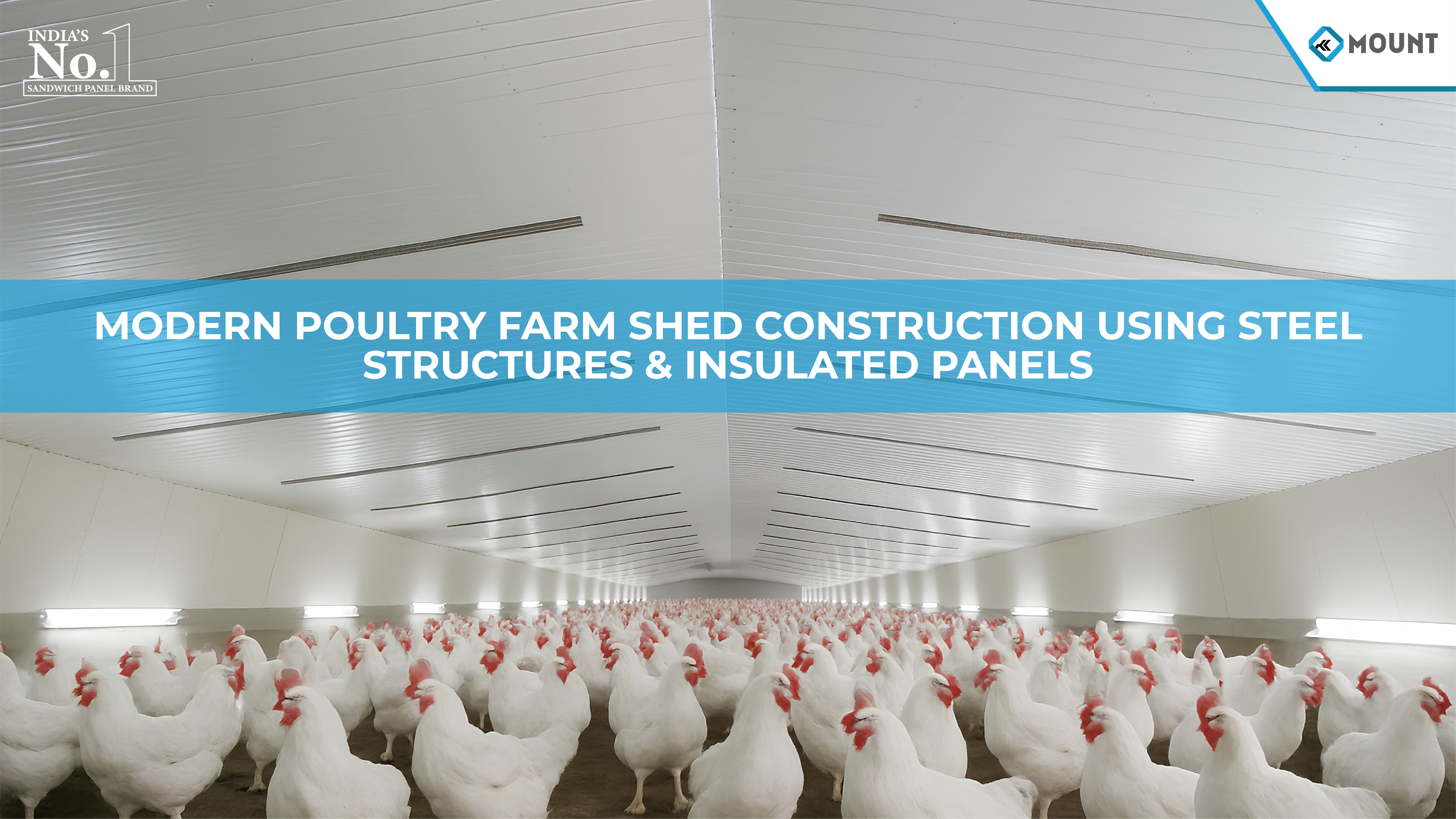
Modern Poultry Farm Shed Construction Using Steel Structures & Insulated Panels
The shift from traditional open-air farming to high-precision, climate-controlled poultry production has fundamentally changed the requirements for agricultural buildings. A poultry house is no longer viewed as a simple shed; it is a high-performance, biological production vessel. Mount Roofing & Structures treats the building envelope as a critical component of the farm’s mechanical system. By moving away from restrictive masonry and toward engineered steel frames, we provide producers with a foundation that supports bird health and operational longevity during every poultry farm shed construction project we undertake.
The primary engineering advantage of structural steel lies in its ability to provide massive, clear-span interiors without the need for intrusive support columns. For industrial-scale operations, especially in layer poultry farm shed construction, an unobstructed floor plan is mandatory to house complex, multi-tier battery or cage-free systems and automated collection lines. Our steel structures are designed to support large collateral loads, like overhead silos and industrial ventilation fans. We use high tensile steel that is galvanised and coated with special anti-corrosive materials to withstand the high-ammonia environment that comes with intensive farming.
Thermal Control and Airtightness as Core Design Parameters
Thermal stability is the absolute cornerstone of modern avian management, as even minor temperature swings can trigger flock stress and tank feed conversion ratios. When executing broiler poultry farm shed construction, the building must act as a hermetic seal against the elements. We utilise high-density polyurethane (PUF) cores injected between steel skins to create a superior thermal break. This prevents external solar heat from penetrating the facility during the summer, which significantly lowers the workload on cooling pads and extraction fans. In winter, this insulation retains the metabolic heat generated by the birds themselves, reducing supplemental heating costs.
As a leading poultry shed construction company, our technical edge comes from the precision of our joinery. We use industrial-grade sealants at all points where the walls meet the roof and the foundation to ensure that the building is completely airtight. This is important because if a building is not airtight, the static pressure required by the tunnel ventilation system cannot be maintained. This results in poor air distribution, where the oxygen level is low in the center of the house, creating “dead zones” that affect bird weight uniformity and farm productivity.
Disease Risk Mitigation and Moisture Control
Biosecurity is perhaps the most significant operational risk factor in modern poultry farming. When investors look for professional poultry shed construction services, they are buying a defence mechanism against disease. Unlike wood or brick, which are porous and harbour pathogens, our steel and insulated panel systems feature non-porous, micro-ribbed surfaces. These surfaces are designed to withstand the rigours of high-pressure chemical wash-downs between every flock cycle. By eliminating cracks where bacteria and pests can hide, our structures help producers maintain the high health status required by international food safety standards and supply chains.
Condensation management is another area where our engineering prevents long-term losses. Utilizing specialized puf panel roofing for poultry sheds is the most effective method to stop internal moisture dripping. When warm, humid air inside the house hits a cold, uninsulated roof, it creates “rain” inside the shed, leading to wet litter, a primary cause of footpad lesions and respiratory distress. Our panels move the dew point to the exterior of the building. This ensures the litter stays dry and friable, which improves bird welfare and drastically cuts the labor needed for bedding management.
Long-Term Asset Performance Through Integrated Shed Design
When calculating the ROI of a new project, the construction of poultry shed units must be viewed as a long-term asset play. A building that lacks thermal integrity will cost a fortune in energy and medication over its lifespan. Mount Roofing & Structures provides an engineered solution where the structure and the envelope function as one unit. Our design philosophy accounts for extreme wind loads and regional environmental stresses, ensuring the shed remains stable for decades. This approach protects your automated feeding and drinking lines from the degrading effects of the outside environment.
Finally, while the initial poultry shed construction cost may be higher than a makeshift shed, the savings found in feed conversion and energy efficiency are massive. A precision-engineered steel building is a scalable asset that can be easily extended as your business grows. Mount delivers the design-led expertise needed to build a facility that is not just a building, but a high-performance agricultural tool. Our commitment to using superior materials and rigorous engineering standards makes us the preferred partner for large-scale producers seeking reliability, biosecurity, and high-yield operational performance.
FAQ:
Q: Why are steel structures used for modern poultry sheds?
A: Because current poultry sheds carry a lot more than birds. Fans, silos, cages, pipelines, and service lines all hang from the structure. Steel handles this cleanly without pillars getting in the way.
Q: Why are insulated panels preferred over single-sheet roofing?
A: Temperature inside a poultry shed changes fast if the roof and walls are thin. Insulated panels slow that down. The shed doesn’t heat up or cool down as sharply throughout the day.
Q: What happens if a poultry shed is not airtight?
A: Air starts entering from random gaps instead of through the cooling pads. Fans still run, but airflow inside becomes uneven. Birds in the middle usually suffer first.
Q: How do steel and panel sheds help with disease control?
A: They don’t absorb moisture and they don’t crack like brickwork. After a flock cycle, the shed can be washed properly without material damage, which reduces leftover contamination.
Q: Why do large farms treat poultry sheds as long-term assets?
A: Because operating costs keep adding up every cycle. Power bills, medicine, repairs, and equipment damage matter more over time than saving a little during construction.
Similar Events