 Mar 16, 2026
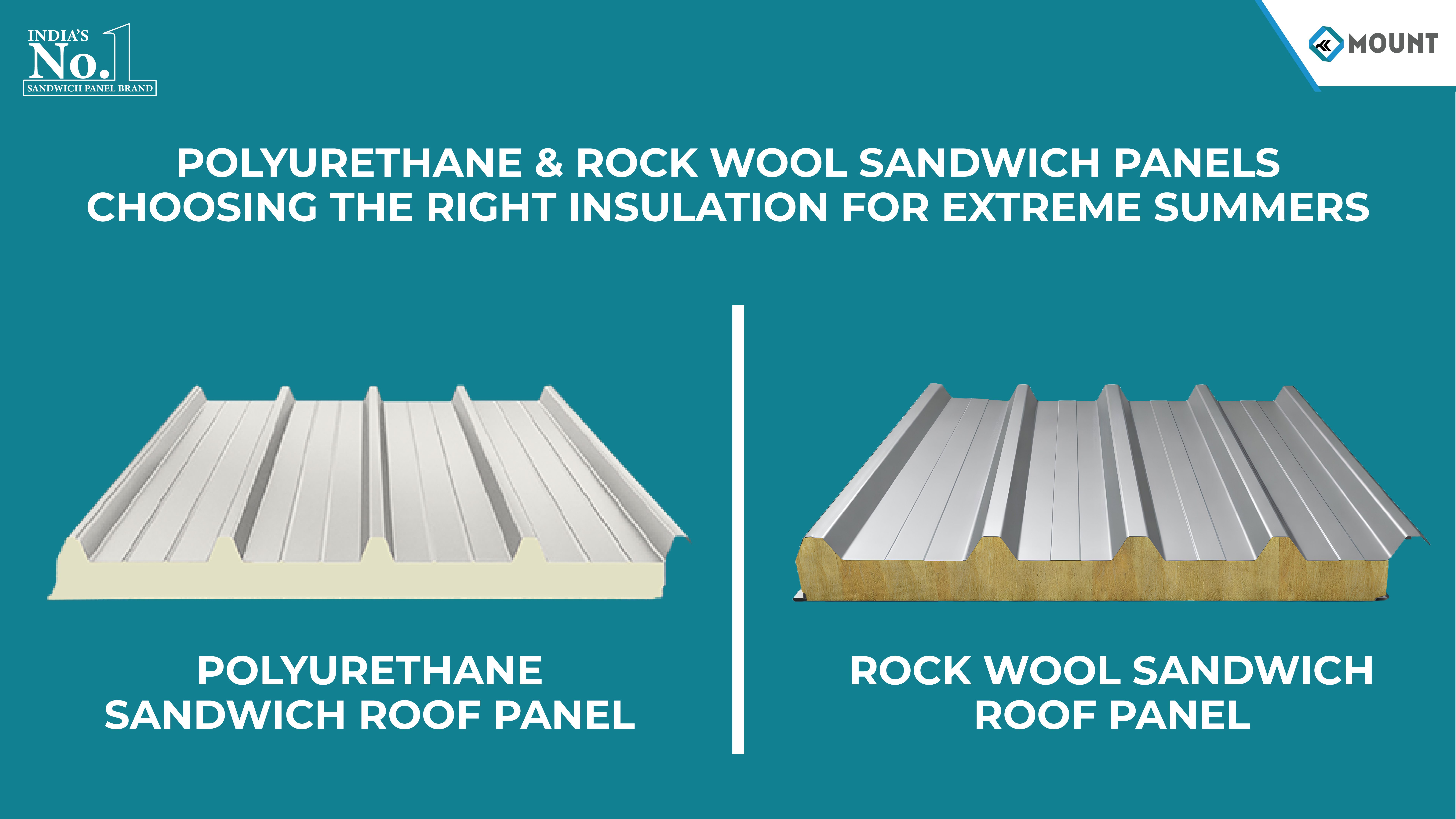
Polyurethane & Rock Wool Sandwich Panels: Choosing the Right Insulation for Extreme Summers
As global temperatures continue to climb, the pressure on industrial buildings has reached a breaking point. In regions facing extreme heat, a building’s shell is no longer just a cover; it is a thermal shield that determines whether a business stays profitable or drowns in cooling costs. For project consultants and contractors, choosing between sandwich panels for manufacturing plants and fire-safe mineral cores is a decision that affects everything from the size of the AC units to the long-term safety of the structure.
At Mount Roofing and Structures, we know that “extreme summer performance” is about more than just thickness. It’s about how materials handle heat flux, fire risks, and humidity over a twenty-year lifespan.
The Core Comparison: Thermal vs. Safety
To make the right call for large-scale facilities like warehouse sandwich panels, you have to look at how the core material actually behaves when the sun is at its peak.
- Staying Cool Without the Bulk When the main goal is blocking out the summer heat, the efficiency of the core is the most important factor. Polyurethane (PUR) panels are the leaders in slim-line insulation solutions. They provide the best heat resistance in the most compact form factor, making them the best choice for energy-efficient designs. This enables developers to create thinner panels while still realizing enormous energy savings.
On the other hand, Rock Wool panels are more dense and heavier in weighRock Wool provides a degree of heat resistance and fire safety that is simply not possible with chemical-based foams.
- Fire Safety Protocols In sectors where safety regulations are non-negotiable, fire performance often makes the choice for you. As a leading sandwich panel manufacturer, Mount provides Rock Wool solutions that are essentially fireproof. These cores are made from volcanic rock and can withstand intense heat without melting or releasing toxic smoke.
While our sandwich panels for roofing made with polyurethane are treated with high-quality flame retardants, they are still organic materials. For high-risk zones like chemical storage or textile factories, the “non-burnable” nature of Rock Wool is usually the safer bet for insurance and peace of mind.
- Humidity and Noise Control
In most cases, extreme summers are associated with high humidity. The polyurethane panels have a “closed-cell” configuration. This means that they behave like a solid water-repellent material. They will not absorb water, which will prevent the insulation from decaying and losing its effectiveness with time.
But if your facility is noisy, say due to heavy machinery or production lines, then Rock Wool is the best option. The fiberous nature of the rock fibers makes them a natural sound absorber, which reduces the “drumming” effect of rain and echoes. It is also effective in containment, insulation, and fire resistance.
Finding the Right Fit
At Mount Roofing and Structures, we match the material to your specific operation:
- Cold Storage: For temperature-sensitive goods, the high-efficiency insulation of PUR is the undisputed leader. It keeps the cold in and the heat out with minimal effort.
- Power Plants & Foundries: In places where internal heat is extreme or fire risk is high, warehouse sandwich panels with Rock Wool cores provide the necessary safety buffer.
- Fast-Track Construction: Both systems are designed to fit perfectly with modern steel buildings. Mount’s precision joints ensure an airtight seal, stopping the “leaks” that usually kill energy efficiency in big warehouses.
Engineering for the Long Haul
Buying a panel is easy; ensuring it lasts thirty years is the hard part. Mount Roofing and Structures stands apart because of how we bond our materials. Whether you choose Rock Wool or polyurethane, our panels are built to resist peeling and warping, even under the intense expansion and contraction cycles of a desert summer.
Why Choose Mount?
With Mount, you are getting a team that is familiar with local building regulations and the fine line between fire safety and electricity bills. Our factory employs state-of-the-art production lines to ensure that every panel is flat and the insulation is consistent end to end.
FAQ
Q: How do I choose between polyurethane and Rock Wool panels for my application?
A: It is based on your facility’s main operating environment. If your facility mainly operates in a thermal environment, polyurethane panels are the best choice for their high insulation factor and compact design. If your facility mainly operates in a fire and sound environment, Rock Wool panels are the best choice because of their fire-resistant and sound-absorbing properties.
Q: Will both panels work well in high summer temperatures?
A: Yes. Both panels are designed to work well in high temperatures. Polyurethane panels work well because they have low thermal conductivity, which reduces heat gain. Rock Wool panels work well because they maintain their thermal stability even at high surface temperatures.
Q: How does humidity impact polyurethane and Rock Wool cores?
A: Polyurethane panels have a closed-cell structure that prevents moisture absorption ensuring consistent insulation performance even in humid conditions. Rock Wool panels, when properly integrated into a sandwich panel design, also provide consistent performance and contribute to fire protection and sound reduction. Performance integrity is essential in both instances.
Q: Does insulation selection impact long-term energy consumption?
A: Yes. The insulation core has a direct impact on the internal temperature stability of a facility. A facility that maintains a controlled internal environment with little temperature variation will experience reduced cooling loads and more stable energy consumption patterns. Proper selection of panel thickness and core type ensures consistent performance throughout the year.
Similar Events