 Feb 13, 2026
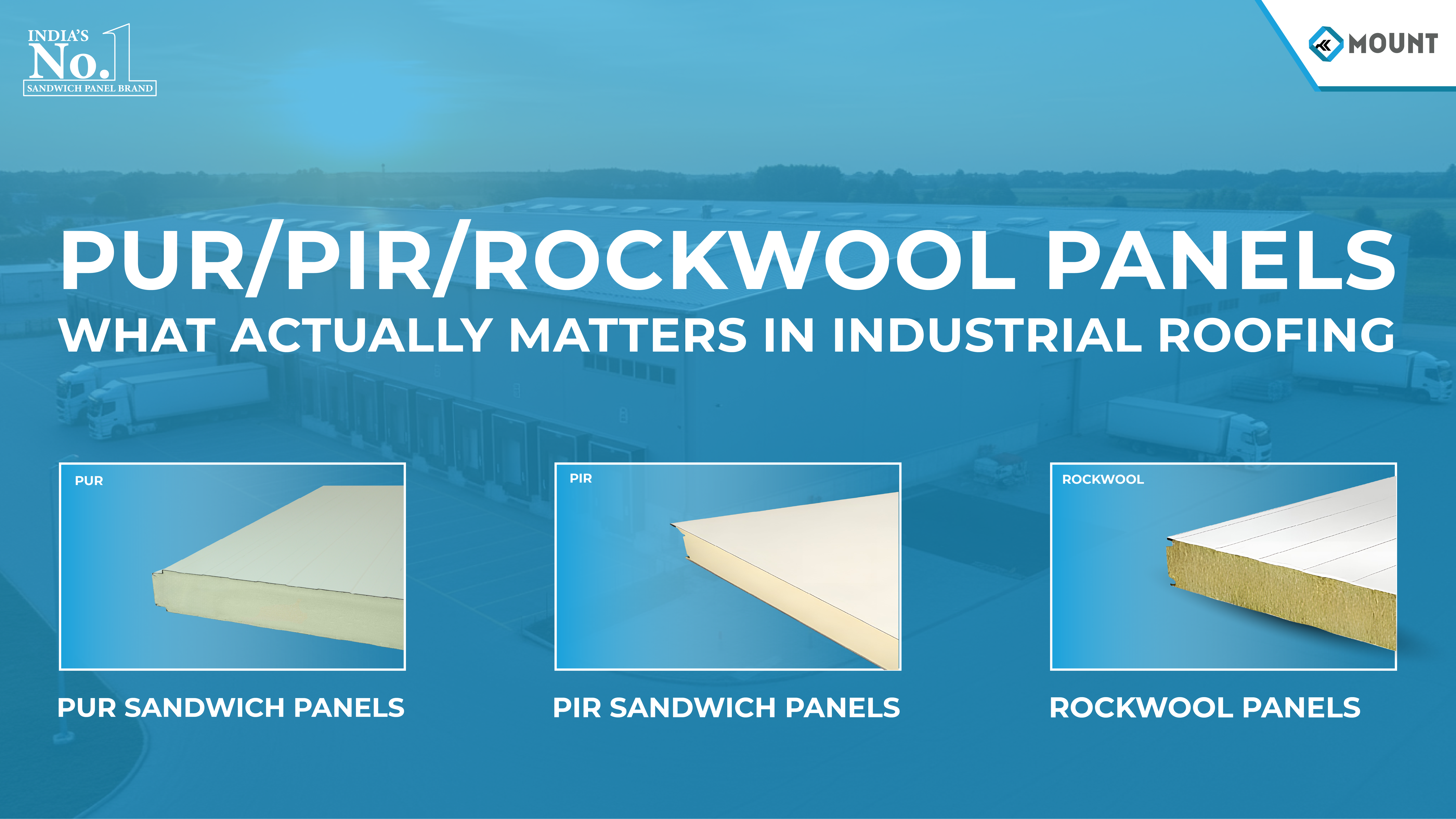
PUR / PIR / Rockwool Panels: What Actually Matters in Industrial Roofing
When industrial clients compare PUR, PIR, and Rockwool Panels, the conversation usually starts with insulation value. It shouldn’t.
A roofing system is not just insulation sandwiched between two metal sheets. It’s a structural element. It reacts to load. It expands and contracts. It ages. It behaves differently under fire. And once it’s installed over thousands of square meters, replacing it is not a small decision.
That’s why the choice between Polyurethane Panels, PIR systems, and mineral wool panels needs to be based on application, not just a line in a specification sheet.
Let’s look at how these systems actually perform in real projects.
Structural Behaviour: Span, Weight, and Practical Design
Polyurethane Panels are built with a closed-cell foam core that bonds tightly to metal facings. This bonding gives the panel stiffness relative to its weight. For designers, that translates into efficient spans and reduced secondary steel.
In practical terms, PUR Panel systems work well in:
- Cold storage buildings
- Logistics warehouses
- Pre-engineered factory sheds
- Temperature-controlled production units
They are lightweight, easy to lift, and fast to install. On large roofing areas, the installation speed matters.
PIR panels look similar at first glance, but chemically they’re different. The enhanced cross-linking improves how the core behaves at higher temperatures. That’s why Fire Rated PIR Panels are often selected when projects require better fire classification without switching to mineral wool.
You’ll typically see PIR Thermal Insulation Panels used in:
- Pharmaceutical plants
- Electronics manufacturing
- Commercial-industrial complexes
- Export-oriented production facilities
They provide a middle ground better fire reaction than PUR, but without the weight penalty of mineral cores.
Rockwool panels are a different category altogether. They rely on compressed mineral fibre. The stiffness depends more on density and thickness than on chemical bonding. Because of that, weight increases.
But that weight brings stability.
Rockwool systems are common in:
- Battery energy storage units
- Petrochemical facilities
- Chemical processing plants
- High-risk manufacturing zones
Where fire containment and non-combustibility are critical, Rockwool fireproof panels become a technical requirement rather than an option.
Thermal Performance: Thickness vs Efficiency
If you’re optimizing for insulation efficiency per millimetre, foam cores win.
PUR Panels and PIR Thermal Insulation Panels achieve the required U-values at thinner sections. That becomes important in retrofit projects where internal height cannot be compromised.
Applications where this matters include:
- Cold chain warehouses
- Refrigerated distribution hubs
- Clean production environments
- Facilities with crane systems needing clear vertical space
Rockwool requires greater thickness for similar thermal performance. However, it maintains consistency across a wide temperature band. It does not degrade thermally in the same way foam can over time under certain conditions.
For facilities operating at elevated internal temperatures, such as steel fabrication plants or process industries, long-term stability can be more important than panel thickness.
Fire Considerations: Beyond the Rating
This is where many specifications go wrong. People assume “fire-rated” means interchangeable. Fire Rated PIR Panels improve reaction-to-fire behaviour compared to PUR. They resist ignition longer and generate less smoke. For many commercial and moderate-risk industrial buildings, that level of performance is sufficient. But PIR is still combustible.
When insurers or authorities demand non-combustible systems, only mineral cores qualify. That’s where Rockwool Panels for Building Insulation come in.
Because Rockwool fireproof panels are non-combustible, they do not contribute to the fire load. In sectors like:
- Hazardous goods storage
- Paint manufacturing
- Oil and gas processing
- Regulated government infrastructure
They are often mandatory.
The important point is this: fire performance is not just about the core. Joint detailing, fasteners, penetrations, and integration with structural steel all influence system behaviour during an event.
Acoustic and Operational Conditions
Most people forget acoustics when specifying roofing. Until the plant becomes operational.Foam-core panels , whether Polyurethane Insulated Panels or PIR , primarily block sound transmission. They do not absorb vibration well.
That’s acceptable for:
- Standard warehousing
- Automated distribution centres
- Facilities without heavy rotating machinery
Mineral fibre behaves differently. It absorbs sound energy. The Rockwool sandwich panel thickness can be adjusted depending on acoustic requirements.
That’s why Rockwool systems are frequently used in:
- Textile mills
- Compressor rooms
- Fabrication workshops
- Industrial units near residential zones
Noise control becomes a functional requirement, not a comfort feature.
Moisture and Long-Term Performance
Closed-cell foam cores resist water absorption when installed correctly. That makes Polyurethane Insulated Panels and PIR systems suitable for:
- Food processing
- Dairy production
- Pharmaceutical storage
- Climate-controlled environments
But detailing matters. Poor joint sealing will compromise any system.
Rockwool is vapour permeable but treated to repel water. It does not structurally fail when wet, but prolonged moisture exposure can reduce insulation efficiency. Roof slope, vapour barriers, and flashing design become critical in these installations.
In coastal zones or heavy rainfall regions, the engineering approach matters more than the material alone.
Installation Speed and Load Handling
Construction timelines often drive decisions.
Foam panels are lighter. PIR Sandwich Panels and PUR systems can be installed quickly over large spans. For EPC projects where commissioning dates are fixed, that speed is a real advantage.
Rockwool panels take longer to handle due to their higher weight. However, they distribute concentrated loads more effectively.
For roofs carrying:
- Solar arrays
- Large HVAC systems
- Maintenance walkways
Mineral cores can offer better resistance when properly engineered.
Choosing the Right System
There is no universal best option. If the priority is thermal efficiency and lightweight construction, PUR Panel systems are practical.
If improved fire classification is needed without switching to mineral wool, Fire Rated PIR Panels provide a balance.
If non-combustibility, acoustic control, and fire compartmentation are critical, Rockwool Panels for Building Insulation become the logical choice.
The mistake is selecting based on insulation value alone. Industrial roofing is a systems decision. Core type, structure, service loads, fire exposure, and long-term maintenance all need to align.
That’s how roofs perform well, not just on paper, but ten years after installation.
FAQs
Q: When should PUR panels be preferred over PIR or Rockwool?
A: PUR panels are suitable where thermal efficiency, weight reduction, and fast installation are priorities, and fire exposure risk is moderate.
Q: Are PIR panels a direct replacement for Rockwool in fire-rated roofs?
A: No. PIR improves fire performance compared to PUR but does not replace non-combustible requirements where mineral wool is mandated.
Q: How does panel core affect rooftop solar installation?
A: Panel stiffness and load distribution vary by core type. Rockwool panels often handle concentrated service loads better, while PIR and PUR require coordinated mounting design.
Q: Does Rockwool thickness impact structural span?
A: Yes. Increased Rockwool sandwich panel thickness improves stiffness but also adds weight, influencing purlin design.
Q: What is the biggest mistake in insulated panel specification?
A: Selecting based on insulation value alone without considering fire behaviour, moisture response, and service load integration.
Similar Events