 Mar 3, 2026
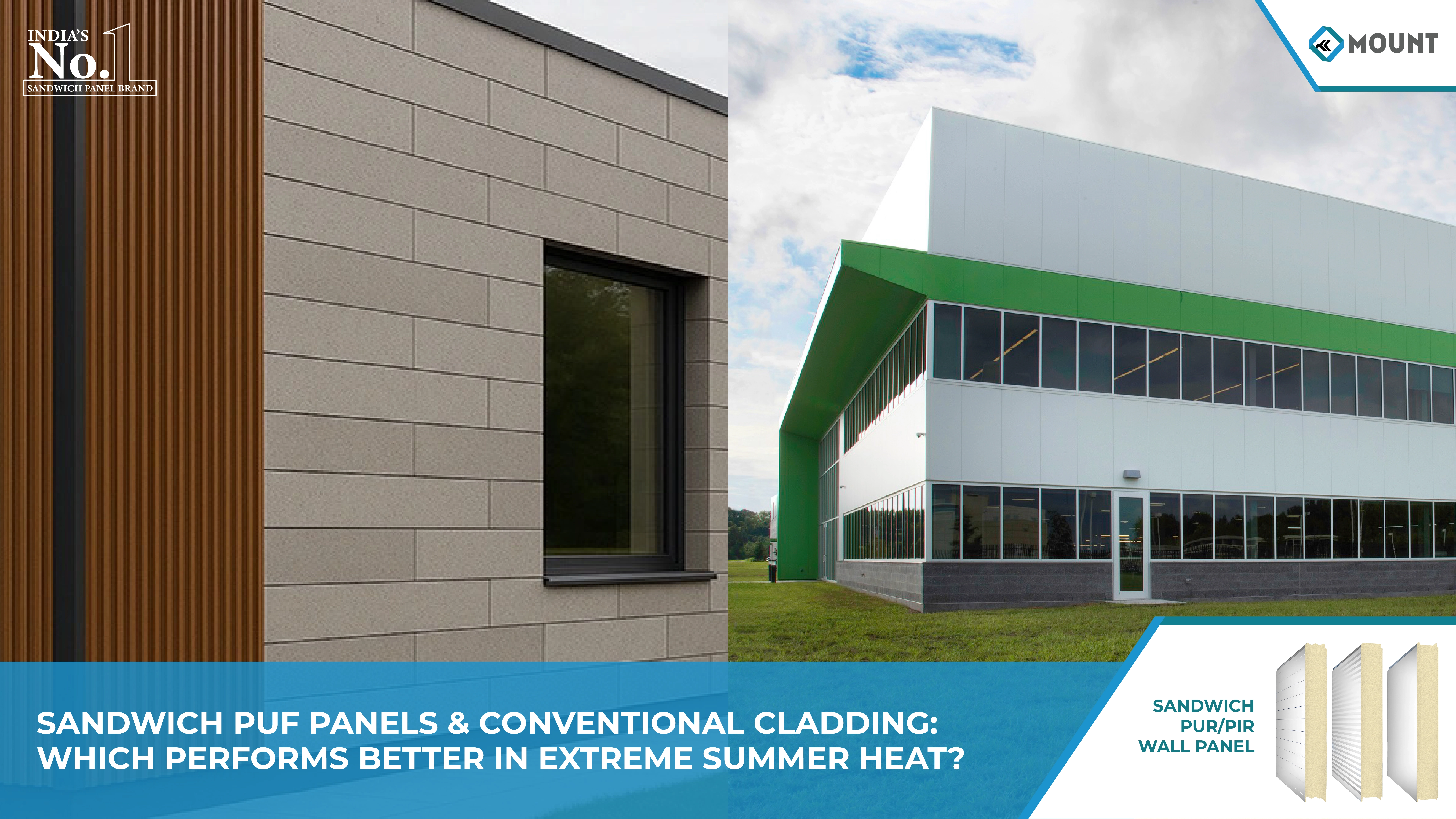
Sandwich PUF Panels & Conventional Cladding: Which Performs Better in Extreme Summer Heat?
Within the framework of the increasing cooling days in the Indian subcontinent, the building envelope of a warehouse or a manufacturing plant is no longer merely a physical boundary; it is a key thermal control mechanism. For the industrial sector, the decision between the use of traditional single-skin metal sheets and the latest insulated panels for steel buildings is a determinant of the future viability of the facility. With temperatures often breaking record highs, the traditional metal-clad building envelope functions as a high-conductivity radiator, dumping massive solar loads directly into the manufacturing environment. In contrast, engineered sandwich systems provide a managed thermal break that stabilises internal environments.
The Physics of Heat Transfer: Resistance and Thermal Integrity
The primary differentiator between these two systems lies in the rate of heat transfer through the structure. Conventional cladding possesses negligible thermal resistance. Without a robust core, these sheets rely entirely on secondary glass wool or rock wool insulation, which often sags over time, creating gaps in the thermal envelope and allowing heat to bypass the insulation layer entirely.
Mount’s sandwich panels for roofing utilise a high-density Polyurethane Foam core that offers superior resistance to heat flow.In doing so, the system prevents the conduction of absorbed heat from the outer surface to the inner space by integrating a dense, closed-cell core between two metal skins. By collaborating with a sandwich panel manufacturer who focuses on core consistency, developers can create a near-hermetic seal that drastically reduces the HVAC load and satisfies the Energy Conservation Building Code (ECBC).
Mitigating Thermal Bridging and Structural Stress
Extreme summer heat induces significant linear expansion in metal. In conventional screw-down systems, this thermal stress leads to elongated fastener holes, eventually compromising the building’s water-tightness and structural longevity. Mount Roofing & Structures addresses this through precision-engineered joint locking mechanisms. Our sandwich panels for walls and roofs feature tongue-and-groove joints that allow for microscopic thermal movement without breaching the envelope’s integrity.
Furthermore, thermal bridging, where heat bypasses insulation through structural steel members, is a silent killer of efficiency. As a top PUF panels manufacturer and suppliers in India, Mount designs systems where the insulation is continuous. By eliminating the direct metal-to-metal contact between the outer weather face and the inner liner, we effectively “break” the bridge, maintaining internal temperature stability even during peak solar radiation.
Beyond Insulation: Durability and NBC Compliance
The National Building Code (NBC) places heavy emphasis on fire safety and structural stability. Mount’s cores are formulated to be self-extinguishing and fire-retardant, meeting stringent safety requirements. Whether you are seeking a sandwich panel for cold storage or large-scale warehouse sandwich panels, the structural rigidity of the sandwich composite allows for wider purlin spacing. This reduces the overall steel tonnage required for the Pre-Engineered Building (PEB) frame, optimizing the total cost of ownership.
As a leading insulation panel supplier, we understand that performance is dictated by manufacturing precision. Our panels feature a high closed-cell content, preventing moisture ingress and internal condensation, a common failure point in conventional cladding that leads to hidden corrosion and indoor air quality issues.
The Mount Advantage: Engineering the Total Envelope
At Mount Roofing & Structures, we do not simply supply materials; we engineer solutions. Our role as a roofing panels for steel structures expert involves a comprehensive analysis of the building’s orientation, local wind loads, and projected thermal cycles. By integrating our panels into the initial design phase of a PEB, we ensure that the transition points, ridges, valleys, and corners are as thermally efficient as the panels themselves.
By partnering with us, you are selecting a design-driven collaboration. We offer a vertically integrated solution in which core density, skin thickness, and joint design are optimized for your unique industrial use. Our dedication to high-performance envelopes ensures that your plant remains a productive and efficient space for generations to come. For your project requiring a reliable sandwich panel manufacturer, Mount offers the technical advantage needed for today’s infrastructure.
FAQ
Q: Can Mount’s PUF panels be integrated into existing PEB structures during a retrofit?
A: Yes. Our panels are designed for compatibility with standard purlin and girt spacings. We conduct structural audits to ensure the existing frame is optimised for the transition from lighter single-skin sheets to composite panels.
Q: What is the impact of a high Solar Reflectance Index (SRI) when used with these panels?
A: The PUF core manages conductive heat, the outer skin’s SRI manages radiant heat. Mount offers specialised coatings that reflect a high percentage of solar radiation, working in tandem with the core to keep the outer surface temperature manageable.
Q: How does the joint mechanism improve performance in cold storage applications?
A: Our precision locking systems ensure a high-pressure seal between adjacent panels. This prevents “thermal leaks” at the joints, which is the most common cause of ice formation and energy loss in sandwich panels for cold storage.
Q: Do these panels meet the fire safety norms specified for industrial buildings?
A: Absolutely. Mount’s chemistry is engineered to be fire-retardant, ensuring low smoke emission and high resistance to flame spread, fully aligning with modern industrial safety mandates and building codes.
Similar Events