 Apr 3, 2026
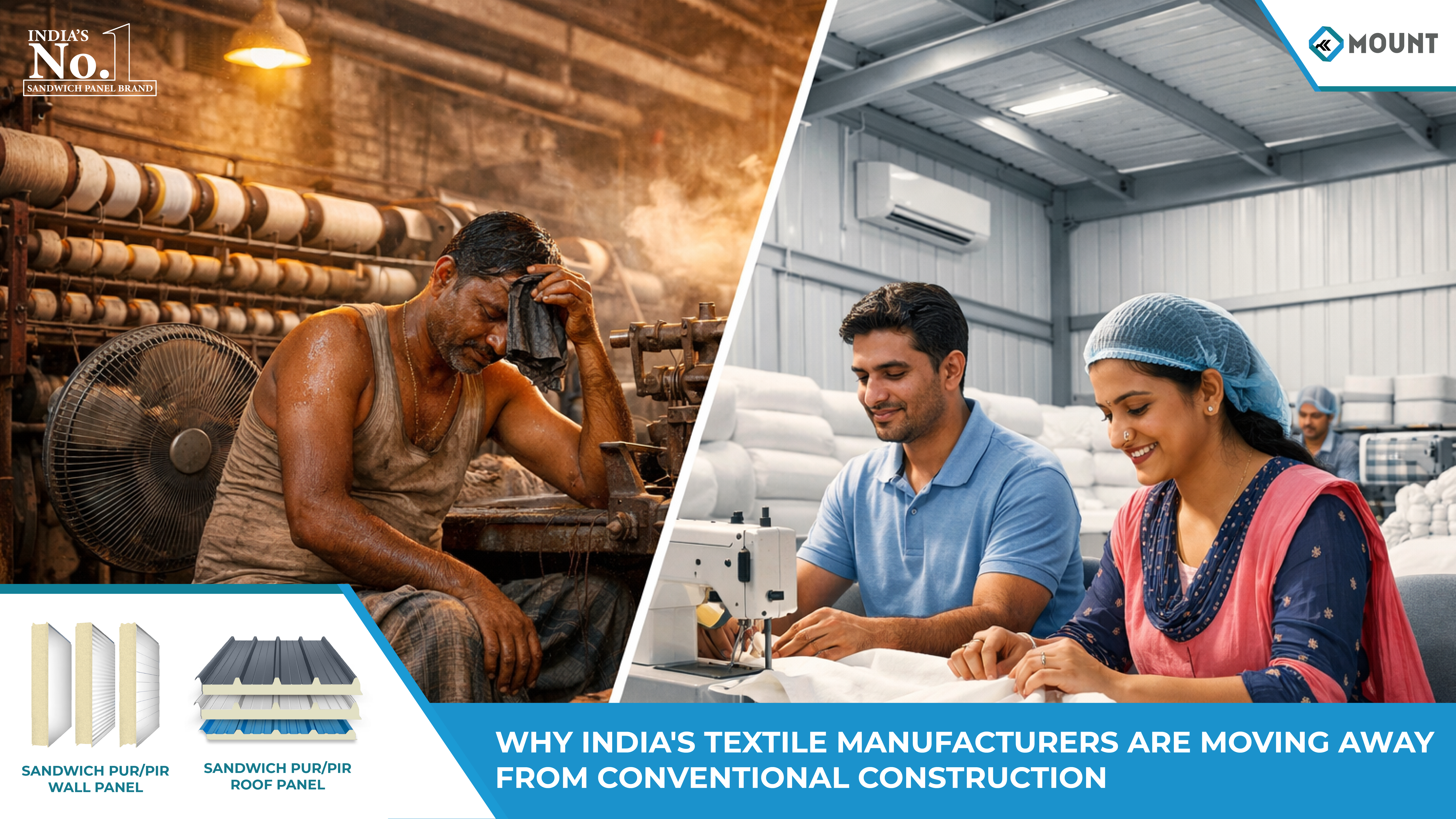
Why India’s Textile Manufacturers Are Moving Away From Conventional Construction
The Indian textile industry is witnessing a huge transformation, not just in terms of technology but also in terms of physical infrastructure. For decades, the industry has been relying on traditional forms of RCC and masonry to design factory layouts. However, as fast fashion trends are reducing their cycles in the global apparel industry and energy costs are rising, it has become apparent that traditional forms of building are a bottleneck to growth. Today’s textile industry leaders are looking at speed, precision, and fire safety, which has led to a definitive rise in Pre Engineered Buildings.
The move to abandon traditional bricks and mortar has to do with the requirement to achieve column-free spaces as well as airtight buildings. Traditional buildings often require addressing issues related to moisture as well as poor insulation, which can affect yarn quality as well as expensive humidity control solutions. By opting to use insulated panel solutions to steel buildings, manufacturers are ensuring a controlled internal climate that can directly impact their bottom lines as a result.
The Technical Limitation of Traditional Masonry
Conventional construction is inherently heavy and slow. In the textile sector, where “Time to Market” is a critical KPI, waiting 18 to 24 months for a facility to become operational is no longer viable. Beyond the timeline, concrete structures possess high thermal mass, meaning they absorb and retain heat. This makes maintaining the precise temperature and 65-70% humidity levels required for spinning nearly impossible without excessive power consumption.
In contrast, insulated panels for manufacturing plants provide a high R-value thermal envelope. These systems decouple the external weather conditions from the internal production floor. Mount Roofing and Structures has observed that by utilizing puf panels for manufacturing plants, facilities can reduce their HVAC energy expenditure by up to 25% compared to uninsulated or traditionally built counterparts.
Engineered Efficiency: PEB and Modular Integration
The integration of pre-engineered building panels offers a certain precision that masonry cannot achieve. In a textile mill, there is a need to design a floor plan to accommodate rows of ring frames or weaving machines. Conventional pillars interfere with these layouts. Modern steel structures provide the necessary clear spans, while Modular PUR Panels serve as the high-performance skin of the building.
Key advantages of this modular approach include:
- Rapid Deployment: Factory-made components are bolted together on-site, slashing construction time by nearly 50%.
- Structural Versatility: Steel frames paired with PIR Sandwich Panels are lightweight, reducing the cost of heavy foundation work.
- Cleanliness: Unlike concrete, which can shed dust over time, sandwich panels provide a “clean-room” finish essential for high-end fabric production.
Prioritising Risk Management with Advanced Materials
Fire safety is perhaps the most significant catalyst for the move away from basic metal sheets toward sophisticated panelling. Textile units are high-risk environments due to the presence of lint and volatile organic compounds. Global buyers now demand stringent safety compliance before placing orders. This has made the installation of Fire Rated Sandwich Panels a mandatory requirement for many export-oriented units.
At Mount, we emphasise the use of Polyisocyanurate (PIR) cores over standard foam. PIR Sandwich Panels offer superior charring properties, ensuring that the structural integrity of the facility remains intact during thermal stress. This technical superiority not only protects the inventory but also reduces insurance premiums, providing a long-term financial edge to the manufacturer.
Why the Industry is Choosing Mount Roofing and Structures
Transitioning to modern building systems is a complex engineering task that requires a partner, not just a supplier. Mount Roofing and Structures stands at the forefront of this evolution, providing end-to-end technical consultation. While others simply provide materials, we analyse your specific textile process, whether it is technical textiles, spinning, or garmenting, to recommend the exact density of insulated panels for manufacturing plants required for your climate zone.
Our solutions are engineered for longevity. By focusing on precision-locking mechanisms and high-grade coatings, Mount ensures that your facility remains airtight and corrosion-resistant for decades. We don’t just build sheds; we engineer high-performance industrial assets that scale with your business.
FAQ
Q: How do PIR panels differ from standard PUF panels in a textile fire-safety context?
A: While both provide excellent insulation, PIR Sandwich Panels feature a higher percentage of isocyanurate, which creates a more stable chemical bond. In a fire, PIR forms a protective char layer that inhibits flame spread, whereas standard PUF can be more combustible. This distinction is vital for meeting international FM Global safety standards.
Q: Can modular panels be integrated into an existing RCC textile mill?
A: Yes. Many manufacturers use Modular PUR Panels to create “internal partitions” or to retrofit existing roofs. This allows for the creation of temperature-controlled zones within an older building, though a full PEB transition offers the best structural ROI.
Q: What is the expected lifespan of pre-engineered building panels in high-humidity environments?
A: When treated with specialized anti-corrosive coatings (like PVDF or RMP), these panels can last 25-30 years with minimal maintenance. This is superior to traditional corrugated sheets which often succumb to rust in the humidified atmosphere of a spinning mill.
Q: How does the “Span-to-Weight” ratio of a PEB benefit large-scale weaving units?
A: Pre Engineered Buildings utilize high-strength steel that allows for wider clear spans (up to 60m-90m) without center columns. This provides an unobstructed floor for weaving machines, significantly improving material handling and logistical flow compared to cluttered RCC structures.
Q: Are insulated panels effective for sound dampening in loud loom rooms?
A: Absolutely. The composite structure of puf panels for manufacturing plants provides significant acoustic insulation. This helps in dampening the high-decibel noise generated by shuttleless looms, contributing to a better working environment and compliance with industrial noise pollution norms.
Similar Events