 Apr 6, 2026
Why PEB Erection Quality Matters as Much as PEB Design Quality
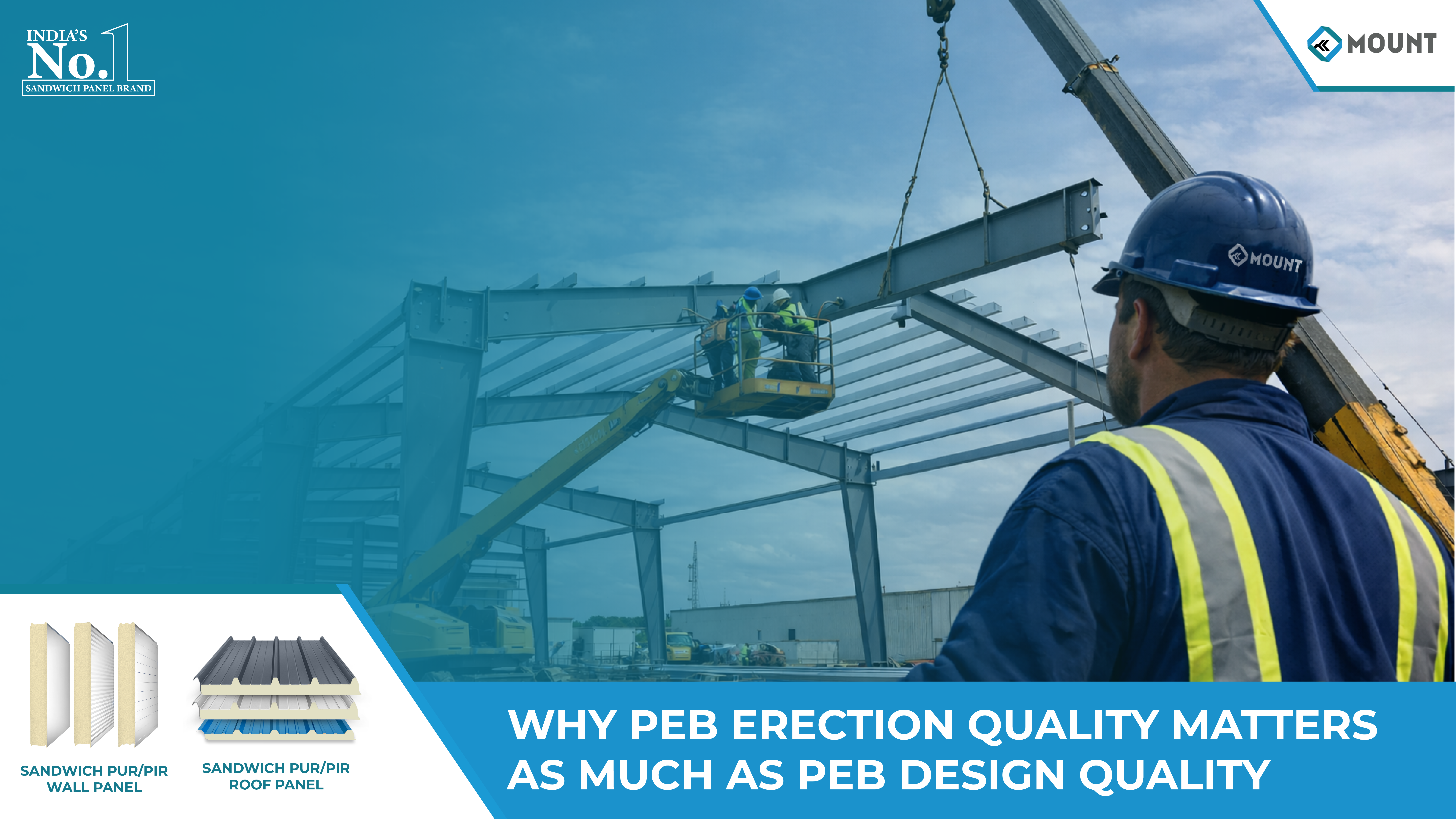
In the industrial construction sector, a common misconception exists that a superior structural design automatically guarantees a high-performing facility. While advanced engineering is the bedrock of a pre engineered building, the transition from a digital blueprint to a physical asset is where most long-term risks reside. A flawed erection process can compromise the most sophisticated design, leading to a cascading series of structural and operational failures.
At Mount, we maintain that a building is only as robust as its weakest joint. As a leader in the building envelope space, we understand that precision on-site is the final and most critical step in ensuring that peb construction meets the rigorous standards required for modern industrial applications.
The Gap Between Engineering and Execution
The design of a peb structure involves complex calculations regarding wind loads, seismic activity, and dead-weight distribution. However, these calculations assume a “perfect installation.” When the on-site erection team deviates from specified tolerances, the physics of the building changes.
- Structural Misalignment: Even a few millimetres of deviation in column verticality or rafter alignment can redistribute stresses in ways the design never intended. This can lead to premature fatigue in connections and fasteners.
- Tensioning and Torque: Improperly torqued bolts are a silent hazard. Over-tightening can strip threads, while under-tightening leads to structural vibration and potential instability during high-wind events.
- Thermal Movement Issues: Steel expands and contracts. If the roofing panels for steel structures are not installed with the correct thermal expansion allowance, the panels can buckle or “oil-can,” leading to aesthetic and functional failure.
Protecting the Envelope: The Precision of Panel Integration
The building envelope,comprised of walls and roofing,is the primary shield against environmental degradation. High-quality pre-engineered building panels require sophisticated handling. If panels are damaged during unloading or incorrectly overlapped during fixing, the thermal and moisture-protection integrity is lost.
For instance, the installation of peb roofing panels requires a strict adherence to mastic tape application and fastener patterns. A single missed seal or a misaligned lap joint creates a capillary path for water. In industrial settings where sensitive machinery or inventory is housed, a “minor” leak is a major operational catastrophe. By utilizing insulated panels for steel buildings, developers can achieve superior thermal breaks, but only if the joints are hermetically sealed during the erection phase.
The Hidden Risks of Substandard Erection Practices
The market is often saturated with low-cost erection crews who prioritize speed over technical accuracy. However, the secondary costs of poor installation far outweigh any initial savings in labor.
- Water Ingress: Most leaks in a pre engineered building are not due to material failure but due to poor flashing details and incorrect screw placement.
- Reduced Load Capacity: If steel building roofing panels are not seated correctly on the purlins, their ability to support live loads,such as maintenance teams or solar arrays,is significantly diminished.
- Aesthetic Degradation: Scratches on the protective coating of panels during rough handling lead to localized corrosion, shortening the lifespan of the building significantly.
Working with Top PEB Companies in India ensures that project supervision is handled by engineers who understand these nuances, rather than just laborers.
Quality Control: The Mount Approach to Reliability
At Mount, we don’t just supply materials; we provide the technical oversight necessary to ensure those materials perform. Our approach to peb construction involves rigorous check-lists that cover everything from base-plate leveling to the final ridge-cap sealing.
We emphasize the use of high-performance pre-engineered building panels that are designed for ease of precision. Our systems are engineered to minimize human error on-site, featuring interlocking geometries that ensure perfect alignment. When a project is executed with this level of detail, the result is a structure that operates at peak efficiency for decades, not just years.
Why Mount is the Strategic Choice for Precise PEB Execution
Success in industrial infrastructure requires a partner who bridges the gap between the factory and the field. Mount offers the technical depth to support complex projects, ensuring that the high-specification peb roofing panels we manufacture are installed to maximize their design life. Our expertise helps clients avoid the “hidden costs” of poor erection, providing a building that is structurally sound, thermally efficient, and ready for future expansion.
FAQ
Q: How does improper bolt torque affect the long-term safety of a peb structure?
A: Bolts in a peb structure are designed to work under specific tension to create friction between steel plates. If the torque is inconsistent, the load distribution becomes uneven. Over time, dynamic loads (like wind or crane movement) can cause these joints to slip, leading to structural misalignment and potential safety hazards.
Q: Why is the “thermal break” often compromised during the installation of insulated panels for steel buildings?
A: A thermal break is only effective if it is continuous. During erection, if the insulation at the panel joints is compressed or if there are gaps in the sealant, “thermal bridging” occurs. This allows heat to bypass the insulation, leading to internal condensation and higher cooling costs.
Q: What role does “purlin stay” installation play in the stability of peb roofing panels?
A: Purlin stays are critical for preventing the rotation of purlins under load. If an erection team skips or incorrectly installs these stays, the roofing panels for steel structures may lose their secondary support, causing the roof to sag or vibrate excessively during heavy weather.
Q: Can minor scratches during the erection of steel building roofing panels be ignored?
A: No. Most high-quality panels use a multi-layer coating (like Galvalume). Scratches that penetrate the sacrificial layer expose the core steel to oxygen and moisture. Mount recommends immediate touch-up with specialised cold-galvanising compounds to prevent the onset of “edge creep” corrosion.
Q: How do Top PEB Companies in India ensure the waterproofing of large-span ridge caps?
A: Waterproofing a ridge is a multi-step process. It requires the use of contoured closures that match the profile of the peb roofing panels, followed by heavy-duty mastic sealants and wide-coverage flashing. Experienced teams ensure these components are installed in a “weather-lap” fashion to ensure gravity works with the seal, not against it.
Similar Events