 Feb 17, 2026
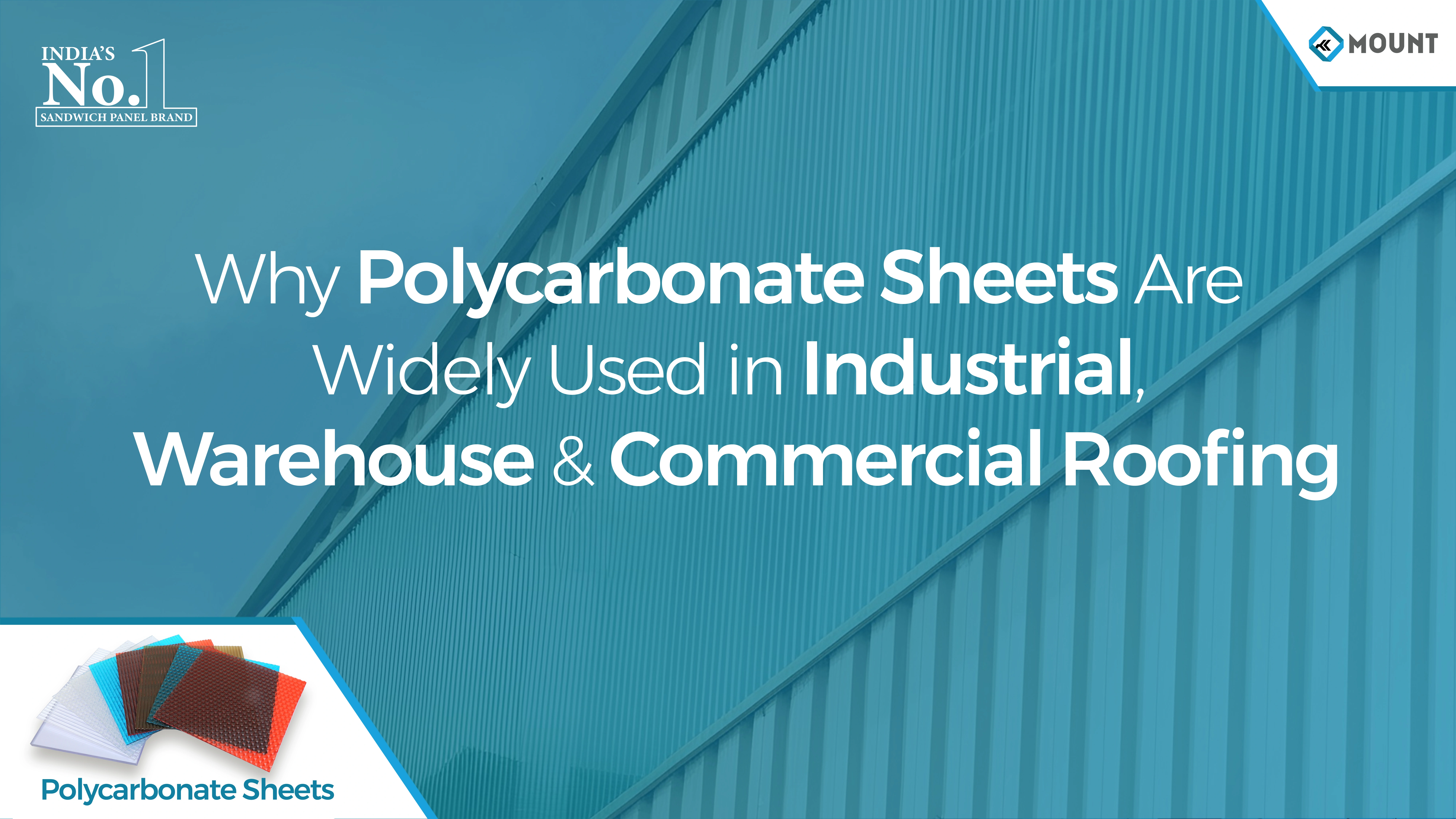
Why Polycarbonate Sheets Are Widely Used in Industrial, Warehouse & Commercial Roofing
The demands on roofing in factories, logistics buildings, and warehouses are complex, going well beyond the simple provision of weather protection.In industrial and commercial buildings, the roof is rarely discussed until performance issues appear. Roof movement, internal visibility, energy consumption, safety, and maintenance access are all affected by roof decisions made during the planning phase.
This is where polycarbonate sheets have become widely adopted. Polycarbonate sheets are high-performance thermoplastic panels used as translucent roof and skylight elements, designed to transmit daylight while withstanding structural movement and impact loads.Their value lies not in appearance, but in function. When engineered correctly, polycarbonate sheets act as controlled daylighting elements that support building performance. When treated as a generic roofing material, they often become failure points. The difference is not the product; it is the system thinking behind it.
Polycarbonate Sheets as Daylighting Components
In industrial buildings, polycarbonate sheets are installed to manage daylight, not to replace metal roofing. Effective daylighting is never accidental. It depends on skylight ratios, spacing aligned with structural bays, orientation to sun movement, and internal lux requirements tied to actual operations.
As a polycarbonate sheet manufacturer involved in early-stage coordination, Mount Roofing & Structures treats daylighting as a design parameter. Skylight layouts are developed alongside production layouts and structural grids to achieve uniform light distribution. This avoids glare near roof openings and dark zones between bays, improving visual clarity and reducing reliance on artificial lighting during operational hours.
Structural Behaviour in Working Roof Systems
The roofs of industrial buildings are not static structures. The action of wind, thermal expansion, crane vibration, and maintenance loads are always present throughout the life of the structure. The behavior of polycarbonate is not like brittle translucent materials since it can deform before failure.
As a polycarbonate sheet manufacturing company, Mount evaluates purlin spacing, allowable deflection, and fixing locations so that sheets are not forced to restrain steel movement. In long-span warehouses, where secondary members experience measurable deflection, this coordination prevents delayed failures such as stress cracking and edge damage that typically appear well after project completion.
Impact Resistance and Safety Performance
Maintenance activity, windborne debris, and hail exposure create real impact risks on industrial roofs. Polycarbonate’s impact resistance reduces the likelihood of sudden panel failure, which is why polycarbonate sheets for industrial use are specified in manufacturing plants and logistics facilities where roof integrity directly affects personnel safety.
However, impact resistance only delivers value when combined with correct sheet thickness, support spacing, and fixing methodology. Overspanned sheets or incompatible fasteners negate the material’s inherent strength and compromise long-term performance.
UV Protection and Indian Climate Exposure
The climatic factors in India tend to accelerate the degradation of materials. The intensity of UV radiation, dust accumulation, and temperature variations tend to subject roofing materials to constant stress. Polycarbonate, if not UV-stabilized, will tend to degrade its optical and mechanical properties prematurely.
For polycarbonate sheets used in warehouses, this ensures that daylight levels are consistent, thus facilitating safe material handling, picking accuracy, and automation without frequent replacement or maintenance.
Thermal Movement and Fixing Design
Polycarbonate Sheets have a higher thermal expansion coefficient compared to metal roofing materials, and their performance is directly related to the detailing of thermal movement. Fixing design needs to allow for controlled expansion and contraction while providing continuous weather tightness.
In polycarbonate sheets for commercial roofing applications, slotted fixing systems, calibrated overlaps, and matching fasteners are recommended to provide for thermal movement without compromising waterproof continuity. This is to ensure dimensional stability and waterproof performance within operating temperature ranges, with observed failures being more related to detailing than material performance.
Integration with Metal Roofing and PEB Structures
Polycarbonate sheets only perform as well as the system they are integrated into. Their interfaces with metal roofing profiles, flashings, and secondary steel members determine whether water is managed correctly or trapped at junctions.
Polycarbonate sheets for industrial buildings are engineered as part of a coordinated roofing assembly. Support spacing, crest fixing alignment, flashing transitions, and sealant compatibility are resolved during design, ensuring that load transfer occurs through the structure and not through the sheet itself.
Industry-Specific Applications
Manufacturing plants benefit from improved visual accuracy and reduced operator fatigue.
Warehouses and logistics parks gain safer aisle visibility and reduced daytime lighting loads.
Commercial and industrial facilities meet sustainability targets without compromising roof durability, making polycarbonate suitable for polycarbonate sheets for commercial projects.
Lifecycle Cost Perspective
Material price alone does not define value. When daylighting systems are engineered properly, benefits are realised through reduced lighting energy, lower maintenance frequency, and longer service life. For polycarbonate sheets for large projects, Mount evaluates performance across the building lifecycle rather than limiting decisions to procurement stage comparisons.
With more than thirty years of experience in industrial roofing solutions, Mount Roofing & Structures views polycarbonate not as a material in its own right but as a material whose performance is dependent on structure, detail, and operating conditions. This depth of field experience informs design decisions that prioritise long-term roof behaviour, consistent daylight performance, and operational reliability across industrial and commercial buildings.
Frequently Asked Questions
Q: Can polycarbonate sheets be used as complete roofing sheets for industrial buildings?
A: No. Polycarbonate sheets are meant for daylighting of areas, not complete roofs. Their performance is dependent on integration with metal roofing and proper load transfer to the supporting structure.
Q: How is support spacing determined for polycarbonate sheets?
A: Support spacing is determined depending on sheet thickness, wind load, deflection limits, and structural movement. Inappropriately spaced supports are a common cause of cracking and leaks.
Q: Are polycarbonate sheets effective in the Indian climate?
A: Yes, depending on the specification of UV-stabilised materials and proper provision for thermal movement.
Q: What is the role of Mount Roofing & Structures beyond material supply?
A: Mount Roofing & Structures can coordinate daylighting layouts, structural integration, fixing design, and waterproofing interfaces.
Similar Events