 Mar 9, 2026
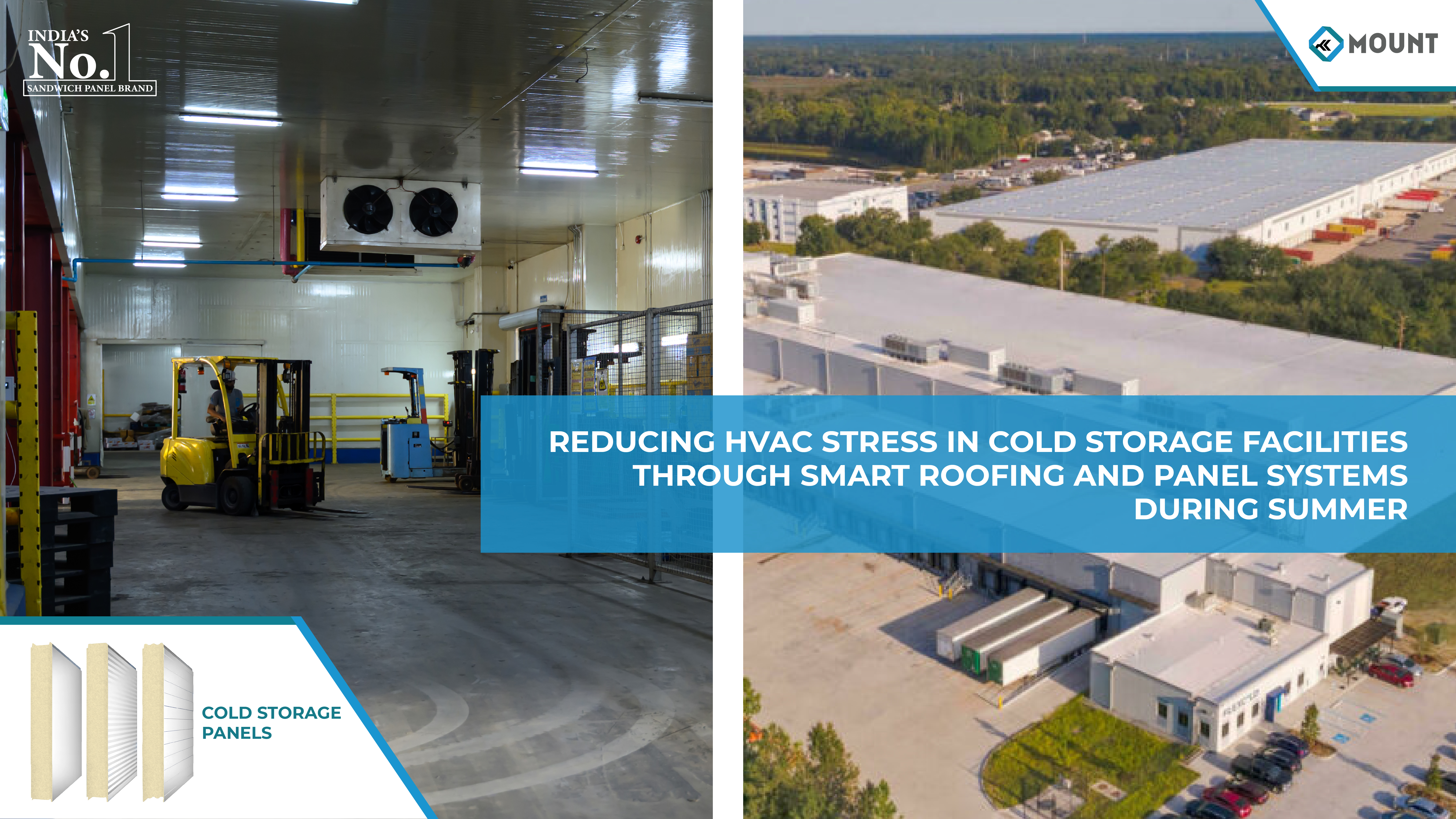
Reducing HVAC Stress in Cold Storage Facilities Through Smart Roofing and Panel Systems During Summer
In the cold chain industry, the arrival of peak summer is the ultimate performance test for any facility. While most operators look toward their refrigeration compressors and cooling coils to handle the rising temperatures, the true secret to efficiency lies in the building’s structural shell. A cold storage unit is essentially a high-tech thermal box.If the walls and roof of that box allow heat to enter, then the systems inside have to work twice as hard to keep up. This leads to sky-high energy bills and a much shorter life for the costly cooling equipment.
At Mount, we specialize in creating a high-performance thermal envelope. By integrating advanced roofing designs with precision-engineered Cold Storage Puf Sandwich Panels, we provide a solution that treats the building as a single, protected environment. This integrated approach is the most effective way to reduce HVAC stress and ensure that your cooling systems operate at peak efficiency even during the hottest months of the year.
The Hidden Impact of Heat Ingress on Refrigeration
During the summer, solar radiation turns a building’s roof into a massive heat conductor. This heat energy naturally tries to move from the hot exterior to the cold interior. This movement is called heat ingress. If a facility uses low-quality insulation or has inconsistent core density in its walls, the heat finds”thermal bridges” pathways that allow warmth to bypass the barrier.
When heat enters the cold room, the HVAC system experiences what we call load instability.The sensors detect a rise in temperature and force the compressors into a state of constant operation. This leads to short-cycling, where the machines turn on and off rapidly to fight the incoming heat. This constant mechanical strain leads to motor burnouts, refrigerant leaks, and high maintenance costs. By using insulated panels for cold storage with a uniform, high-density polyurethane core, Mount creates a wall that blocks heat at the source. This stability allows your refrigeration units to run at a steady, efficient pace, protecting the machinery from unnecessary wear and tear.
Solving the Humidity and Condensation Challenge
Heat isn’t the only enemy during the summer; humidity is equally dangerous. Warm summer air carries a large amount of moisture. In a cold storage environment, if there is even a tiny gap in a joint or a seal, that moist air will be sucked into the building. When this warm air hits the freezing interior surfaces, it immediately turns into ice or condensation.
This moisture buildup is a major problem for HVAC systems. Ice on the evaporator coils blocks airflow, making the cooling process much less effective. Mount addresses this by focusing on joint integrity. Our Cold storage panels for food industry feature a sophisticated interlocking system that creates a continuous, airtight vapor barrier. By preventing air leakage, we stop the moisture from ever entering the room. This keeps your cooling coils clear and your floors dry, ensuring that the HVAC system only has to cool the air, not freeze the humidity leaking in from outside.
The Power of Reflectivity and Integrated Design
A smart roofing system acts as the first line of defense. Rather than allowing the roof to absorb the solar energy much like a sponge, Mount uses reflective roofing materials that reflect the solar load away from the building. This significantly reduces the roof surface temperature before the heat can even reach the insulation layer.
By combining this reflective technology with thick cold storage roofing panels, we create a multi-layered defense. The roof reflects the energy, and the panels block any remaining heat. This “integrated engineering” approach ensures that the interior temperature remains rock-solid. For cold chain developers, this means lower operational risks and a building that performs better for decades, not just a few seasons.
A Practical Perspective on Envelope Responsibility
In cold storage facilities, rising energy use and frequent maintenance are often attributed to refrigeration equipment. In most cases, the mechanical system is reacting to excess thermal load entering through the building envelope.
At Mount Roofing & Structures, the priority is controlling that load at its source. Cold chain insulation panels are manufactured with consistent core density to ensure dimensional stability and reliable insulation performance. Installation is executed as a technical process, with precise joint alignment, vapor sealing, and roof-to-wall detailing to prevent hidden thermal inconsistencies.
When the envelope performs predictably, refrigeration cycles stabilize, compressor stress reduces, and maintenance shifts from reactive to planned. The outcome is controlled energy consumption and dependable operation across peak summer conditions protecting both stored goods and long-term infrastructure investment.
Frequently Asked Questions
Q: Why should I be concerned about the building envelope if my refrigeration capacity is sufficient?
A: A calculated heat load is taken into account when designing refrigeration capacity. The system runs longer than its intended duty cycle when the walls and roof permit more heat to enter. This eventually lengthens compressor runtime, speeds up component wear, and increases energy consumption. The thermal load is kept within predictable bounds by a stable envelope.
Q: What impact does uneven insulation have on the efficiency of cold storage?
A: Localized heat gain points are caused by poorly sealed joints or variations in core density. Temperature variations in these regions force the refrigeration system to make uneven adjustments. Consistent interior conditions are maintained by airtight detailing and uniform insulation.
Q: What makes joint integrity just as crucial as panel thickness?
A: If warm air gets through joints, even high-density insulation becomes less effective. Increased defrost cycles, airflow obstruction, and ice formation are all caused by moisture intrusion. The continuity of the thermal barrier is guaranteed by a well-designed locking system.
Q: Does reflective roofing have a big impact on the temperature inside?
A: Indeed, the highest solar load is absorbed by roof surfaces. Before heat reaches the insulating layer, reflective coatings lower the surface temperature. The need for internal cooling is directly decreased by less external heat absorption.
Q: How does the building envelope affect the lifespan of refrigeration equipment?
A: Systems for refrigeration are made to function within specific temperature ranges. Compressors operate in stable cycles as opposed to constant overload when the roof and wall assembly successfully regulate heat infiltration and moisture infiltration. This prolongs the life of vital cooling components, lessens mechanical strain, and minimizes emergency breakdowns.
Similar Events