 Jun 17, 2026
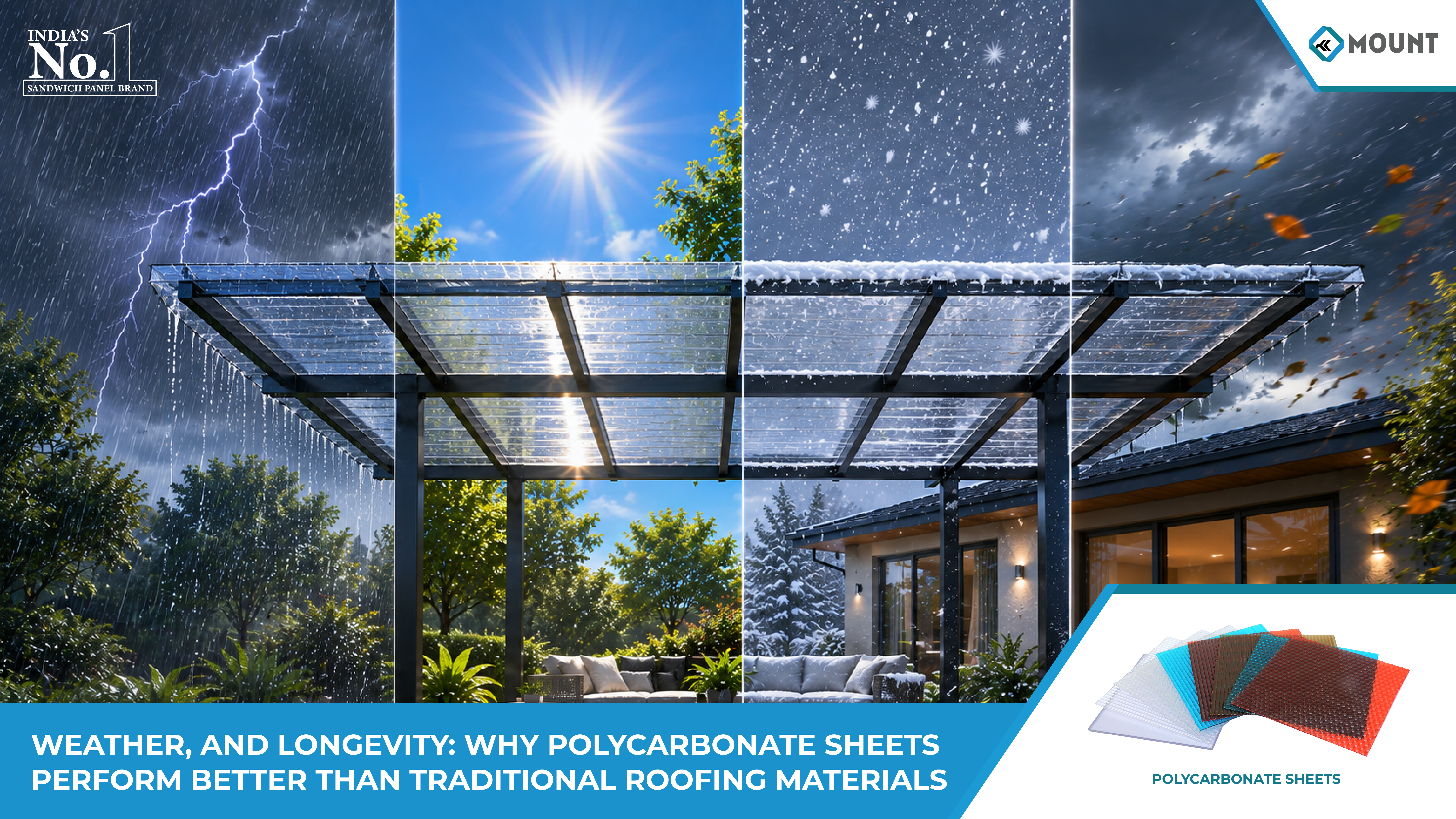
Weather, and Longevity: Why Polycarbonate Sheets Perform Better Than Traditional Roofing Materials
Roofing in industrial and commercial environments is no longer evaluated on weather exclusion alone. Procurement managers, project engineers, and facility heads are now specifying roofing systems against measurable criteria, structural load tolerance, thermal cycling resistance, UV degradation rates, and long-term lifecycle costs. Against that backdrop, conventional materials like fibre cement, metal sheeting, and glass are showing consistent field failures. Polycarbonate sheets, engineered for the demands of modern construction, are increasingly the specified material of choice across warehouses, factories, skylights, and large-scale commercial builds.
Where Traditional Roofing Sheets Fall Short
Conventional roofing materials carry well-documented performance limitations. Metal sheets are prone to thermal expansion and contraction cycles, leading to fastener fatigue and progressive joint failure. Fibre cement becomes brittle under repeated impact or freeze-thaw loading. Glass introduces fragility risk and excessive dead weight into structural calculations.
UV degradation accelerates these problems further. Many standard transparent roofing sheets yellow, chalk, or craze within five to seven years under sustained solar exposure, reducing light transmission and creating an ongoing maintenance liability. For facilities running continuous operations or maintaining strict lux-level requirements on production floors, degraded roofing directly affects operational output, a cost that rarely appears in the initial material comparison.
Impact Resistance: A Measurable Performance Gap
One of the most quantifiable differences between legacy materials and solid polycarbonate sheets lies in impact resistance. Polycarbonate absorbs kinetic energy through micro-level deformation rather than fracturing, with notched Izod impact strength rated at approximately 600–850 J/m depending on grade and thickness.
For polycarbonate sheets for warehouses and polycarbonate sheets for industrial buildings, this translates directly into resilience against hail events, accidental contact at roof level, and debris loading during storm conditions, scenarios where glass or corrugated fibre cement would require immediate replacement and operational shutdown.
Thermal and UV Performance
Sustained temperature extremes accelerate failure in most conventional roofing systems. Multiwall polycarbonate sheets, by contrast, manage thermal performance through their chambered cross-section architecture. The air columns trapped between walls act as passive insulation layers, stabilising internal temperature variation and reducing thermal conductivity.
Quality-grade polycarbonate incorporates co-extruded UV-protective layers bonded directly to the sheet surface during manufacture, not applied as a coating that degrades over time. This ensures UV blocking performance, typically rated above 99% UVB filtration, remains consistent across the product’s full service life. For polycarbonate sheets for commercial roofing, this dual thermal and UV performance reduces both HVAC operating load and roof replacement frequency, a direct impact on lifecycle cost modelling.
Controlled Light Transmission
A key advantage of polycarbonate over opaque metal alternatives is engineered light transmission. Multiwall polycarbonate sheets in standard clear grades achieve 82–86% visible light transmission, with diffused surface options available to eliminate direct glare while maintaining consistent ambient lighting across work areas.
For polycarbonate sheets for skylights, this enables meaningful natural daylighting without the thermal gain penalties associated with glass. Tint selection, wall configuration, and surface treatment give specifiers precise control over light and heat management , directly supporting green building compliance targets.
Durability and Lifecycle Cost
On a lifecycle analysis, polycarbonate roofing consistently outperforms traditional alternatives. Design service lives of 10 to 25 years are achievable depending on grade and application conditions, with minimal maintenance beyond periodic cleaning. Metal roofing in coastal or chemically aggressive environments typically requires recoating within five to eight years. Fibre cement panels need periodic inspection and replacement where brittle fracture has occurred.
For polycarbonate sheets for large projects , logistics parks, manufacturing campuses, or aviation maintenance facilities , the cumulative maintenance differential represents a substantial cost saving over a 20-year asset horizon.
Why Choose Mount
Mount Roofing and Structures engineers and supplies polycarbonate sheets for industrial buildings, commercial facilities, and architectural applications against verified performance specifications , not generic catalogues. Whether the requirement is multiwall polycarbonate sheets for thermally regulated environments, solid polycarbonate sheets for impact-critical canopy zones, or precision-fabricated panels from a dedicated polycarbonate sheets for skylights manufacturer, Mount brings both material expertise and system-level design capability to every project. That combination of technical depth and large-project execution experience is what separates a roofing material supplier from a roofing solutions partner.
FAQs
Q1. Why are Polycarbonate Sheets better than traditional roofing materials?
They offer better impact resistance, weather durability, UV protection, and longer service life compared to metal, fibre cement, and standard plastic roofing sheets.
Q2. Are Multiwall Polycarbonate Sheets suitable for hot industrial environments?
Yes. Their multi-layer structure helps reduce heat transfer and improves indoor temperature control in industrial and commercial buildings.
Q3. Can Transparent Roofing sheets handle heavy rainfall and storms?
Yes. Polycarbonate roofing sheets are designed to withstand harsh weather conditions, including heavy rain, wind pressure, and impact from debris.
Q4. Why are industries using polycarbonate sheets for warehouses?
Warehouses benefit from natural daylight, reduced maintenance, better durability, and lower long-term roofing replacement costs.
Q5. What makes Mount a reliable polycarbonate sheets for skylights manufacturer?
Mount provides technically engineered roofing solutions designed for UV resistance, impact strength, weather protection, and long-term industrial performance.
Similar Events
 23 October, 2026