 Jun 8, 2026
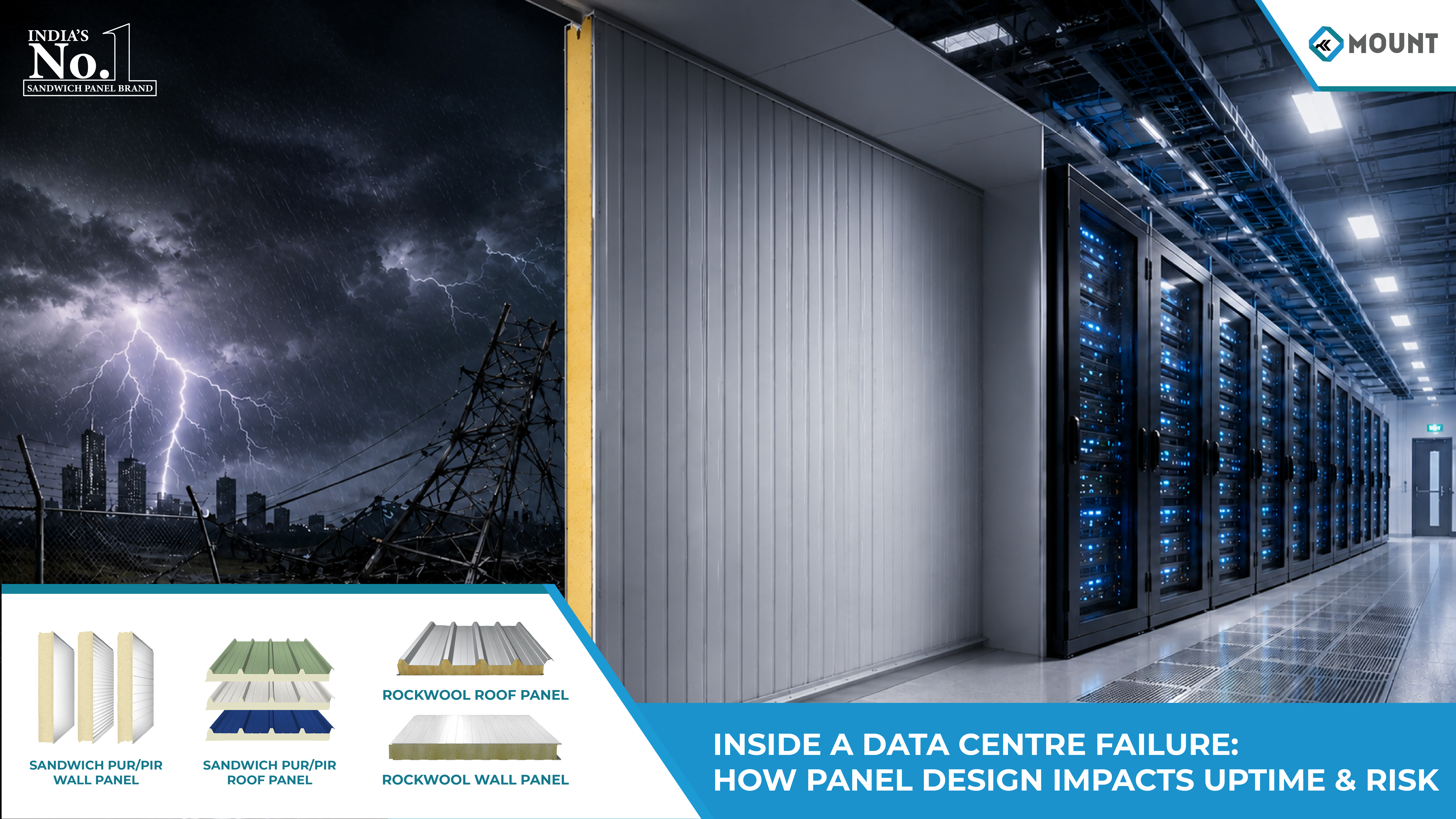
Inside a Data Centre Failure: How Panel Design Impacts Uptime and Risk
When a data centre goes offline even briefly the financial and operational consequences extend well beyond the server room. Infrastructure consultants and facility planners invest heavily in redundant power systems, cooling architecture, and network resilience. Yet one of the most performance-critical layers is consistently under-specified: the building envelope specifically, the roofing and wall panel assembly.
The building skin is not a passive construction element. It is the primary barrier against solar heat gain, monsoon-driven moisture, condensation, and structural stress. In mission-critical environments, that distinction matters enormously.
What Actually Causes Data Centre Failures?
Most operational failures trace back to three vectors: power events, cooling breakdowns, and physical infrastructure compromise. The third category, though under-reported, is frequently rooted in envelope failure not internal mechanical systems.
Common risks triggered by inadequate panel design include uncontrolled heat ingress forcing CRAC units beyond rated capacity, moisture infiltration near live equipment, condensation forming on cold surfaces in high-humidity conditions, and water seepage through degraded roof joints during sustained rainfall. These failures rarely announce themselves. They accumulate,a marginal rise in return-air temperature, a slow uptick in compressor runtime , until a critical threshold is breached.
How Roofing and Wall Panels Directly Affect Performance
Thermal Gain A bare metal roof in a tropical climate can reach surface temperatures exceeding 65°C under peak solar radiation. Without effective insulation, that heat transfers inward, raising ambient temperatures across the server aisle. Even a 3°C rise in return-air temperature forces cooling systems to work significantly harder, increasing PUE and energy consumption. Insulated panels for data center buildings with a 100mm PIR or PUF core can deliver U-values as low as 0.18 W/m²K, decoupling the indoor climate from external solar load.
Moisture and Water Intrusion A single pinhole leak above an active server rack carries the same operational consequence as a hardware failure. Data center wall panels and roofing assemblies dependent on site-applied membranes or single-skin sheets are vulnerable at lap joints, particularly under thermal cycling. Factory-formed interlocking panel joints with continuous EPDM gaskets perform measurably better than field-assembled alternatives, especially in rainfall zones exceeding 1,200mm annually.
Condensation Data centres maintain indoor temperatures of 18–27°C while external ambient temperatures in many Indian locations exceed 40°C in summer. Where insulation continuity is compromised at structural penetrations or panel junctions, warm humid air contacts cold surfaces and condensation forms. The consequences , moisture accumulation in cable voids, elevated relative humidity in white space, accelerated corrosion on exposed metal contacts , are slow-building but operationally serious. PUF panels for data centers with continuous vapour-barrier facings eliminate the primary condensation pathways.
Structural Reliability Cyclonic wind events and heavy rainfall impose dynamic loads that standard commercial roofing often cannot adequately resist. Sandwich panels for data centers with tested uplift resistance and floating-clip fixing systems accommodate thermal movement without concentrating stress at fastener points , maintaining weather integrity across a 25–30-year design horizon.
Why Traditional Roofing Systems Fall Short
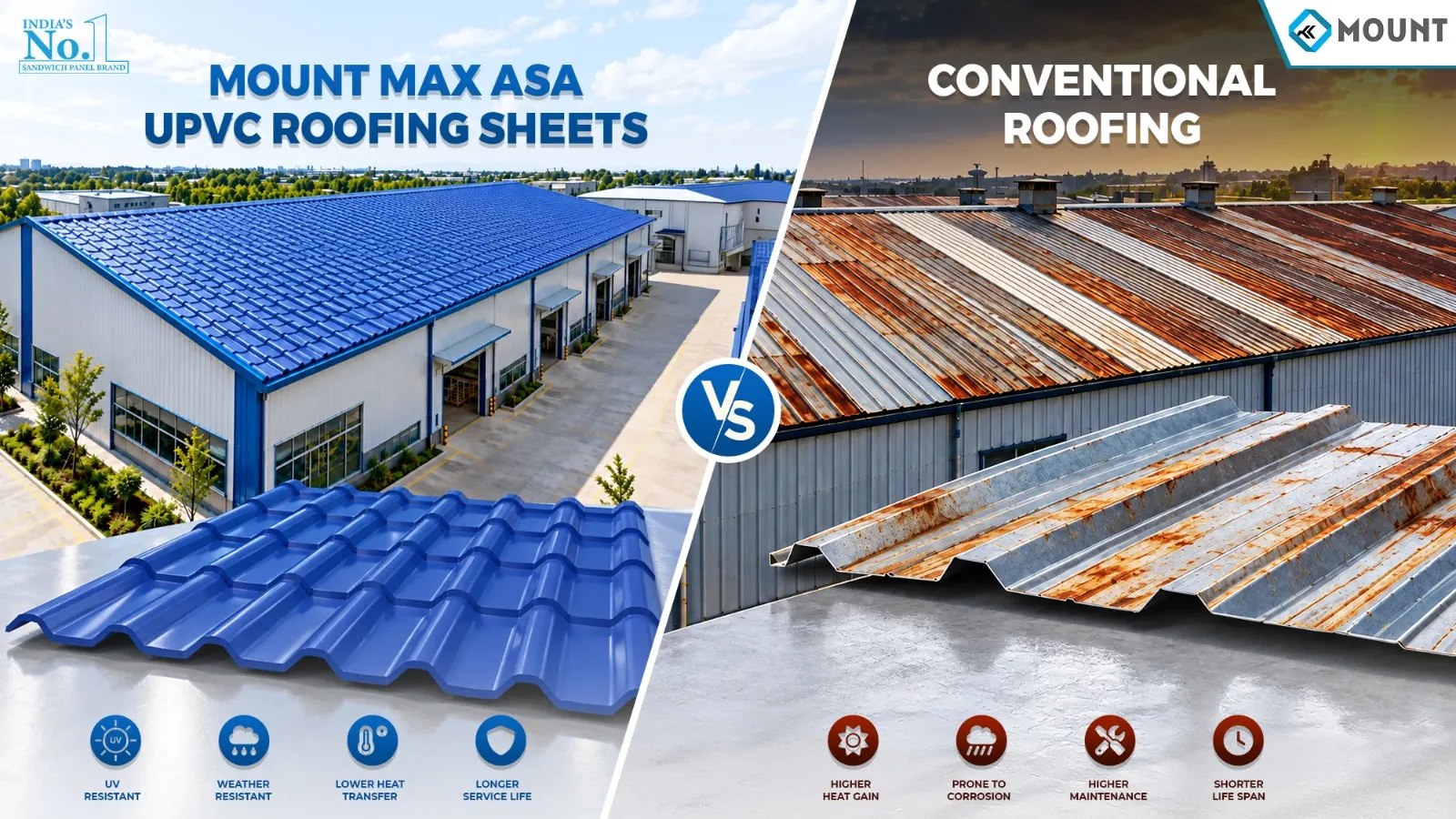
Conventional single-skin profiled metal sheets, bitumen membrane systems, and built-up RCC terraces share limitations that become critical in mission-critical environments: thermal conductivity 8–12x higher than insulated panels, quality variability at site-assembled joints, no inherent vapour control, and re-waterproofing cycles as short as five to seven years. For a facility with maintenance windows measured in minutes annually, this is an operational liability.
Why Sandwich Panels Are the Right Specification
Data center construction panels built on sandwich technology are factory-engineered composite elements , two high-tensile steel facings bonded to a rigid insulation core. Unlike site-built assemblies, their thermal and structural properties are tested, certified, and traceable before installation. For data centre applications, this translates to lower steady-state heat transfer, factory-sealed weatherproof joints, integrated vapour control, and predictable long-term performance.
Certified fire-rated PIR panels meeting Euroclass B classification support compliance with NFPA 75 equipment protection requirements. Where insurance underwriting or fire engineering mandates non-combustible performance, Rockwool panels for building insulation provide Class A2 mineral fibre cores alongside acoustic attenuation for server hall environments.
How Mount Supports Mission-Critical Envelope Performance
Mount Roofing and Structures engineers panel systems specifically for controlled-environment infrastructure. The product range , spanning data center roofing panels, wall cladding, and internal partition systems , is available in PIR, PUF, and rockwool core configurations across 50–200mm thickness ranges, allowing thermal specifications to be matched to site-specific heat-load models rather than generic standards.
Warning Signs Your Envelope May Be Increasing Risk
- Cooling plant utilisation consistently above 85% during peak ambient periods
- Indoor temperature variance exceeding ±1.5°C from setpoint during cloud-cover changes
- Condensation on supply diffusers or cold-aisle containment surfaces
- Water staining near roof penetrations or perimeter flashings
- Humidity readings above 55% RH despite active humidity control
- Rising HVAC maintenance frequency without changes in server density
Any two or more of these indicators warrant a formal envelope performance audit.
Data centre reliability is the product of every system operating within its design parameters simultaneously. The building envelope mediates the thermal, moisture, and structural environment in which every other system operates. A roof that admits heat raises PUE. A wall assembly that admits moisture raises hardware failure risk. A failed panel joint during monsoon is an unplanned downtime event waiting to happen.
Why Choose Mount?
Mount Roofing & Structures delivers engineered panel solutions designed for industrial and mission-critical environments where thermal performance, durability, moisture control, and lifecycle efficiency are essential. With advanced manufacturing capabilities, insulated roofing and wall systems, and application-focused technical expertise, Mount supports infrastructure projects that demand dependable environmental control and long-term operational reliability.
FAQs
1. Why are roofing systems important in data centre risk management?
A: Roofing systems influence heat transfer, moisture protection, structural reliability, and energy efficiency. Any compromise in these areas can affect uptime, cooling performance, and equipment safety.
2. How do insulated panels reduce cooling costs in data centres?
A: Insulated panel systems reduce external heat gain, allowing HVAC equipment to operate more efficiently and maintain stable indoor temperatures with lower energy consumption.
3. Can condensation inside a data centre be caused by the building envelope?
A: Yes. Inadequate insulation and thermal bridging can create surface temperature differences that encourage condensation formation within controlled environments.
4. Are sandwich panels suitable for large-scale hyperscale data centre projects?
A: Sandwich panels are widely used in industrial and technology infrastructure due to their combination of thermal insulation, structural performance, installation efficiency, and environmental control capabilities.
5. What panel characteristics should architects evaluate for data centre projects?
A: Key considerations include thermal conductivity, moisture resistance, fire performance, structural load capacity, weather resistance, durability, and long-term maintenance requirements.
Similar Events

 21 October, 2026