 Jun 11, 2026
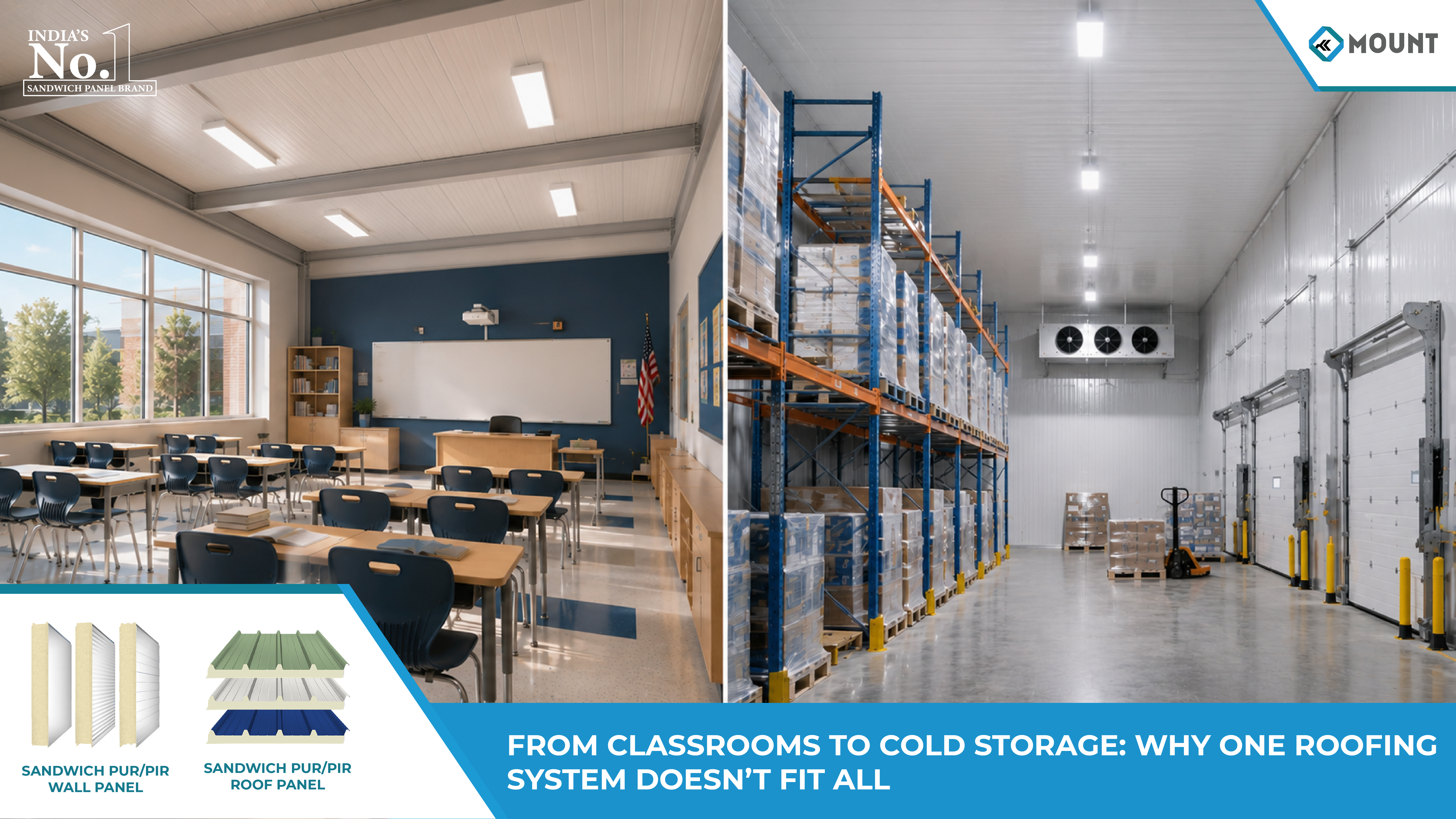
From Classrooms to Cold Storage: Why One Panel System Doesn’t Fit All
A primary school in Pune and a cold storage facility in Nhava Sheva share one thing: both have walls. Beyond that, their enclosure requirements have almost nothing in common. One needs acoustic control and comfortable indoor temperatures for learning. The other needs continuous thermal containment at -18°C or below, hygienic surfaces that can be sanitised daily, and zero tolerance for temperature leakage. Specifying the same wall panel system for both is not a cost-saving decision , it is an operational failure waiting to happen.
Modern buildings are not generic enclosures. They are engineered environments. The wall system is not a partition. It is an active performance layer that governs thermal behaviour, indoor air quality, hygiene, acoustic comfort, moisture management, and long-term energy consumption. Treating it as a commodity specification is how buildings end up underperforming from day one.
Different Buildings, Different Wall Panel Challenges
Educational Institutions and Classrooms
Research consistently links indoor thermal comfort and acoustic conditions to learning outcomes. A classroom with walls that conduct external heat creates fluctuating indoor temperatures, forcing HVAC systems to compensate continuously , raising energy consumption while still failing to maintain stable conditions. Wall systems for educational buildings need to deliver effective thermal resistance across the full operating day, control reverberation through adequate acoustic absorption, and resist surface deterioration through years of low-maintenance service. A wall panel that cannot hold a stable indoor environment is not a neutral choice. It actively disrupts concentration and occupant wellbeing.
Warehouses and Industrial Buildings
Large-span warehouse enclosures face a different set of demands. Internal temperature management across volumes exceeding 10,000 m³ requires wall systems with sufficient thermal resistance to reduce solar gain through the building skin. Impact resistance matters at loading bays and forklift operating zones. Dust ingress and moisture protection become maintenance-critical in facilities operating continuous shifts. A wall assembly that absorbs moisture progressively loses insulation performance , a problem that compounds over time in coastal or high-humidity industrial locations.
Cold Storage and Temperature-Controlled Facilities
This is where wall panel specification becomes a precision engineering exercise. Cold storage puf panels are specified for their ability to maintain stable internal temperatures at setpoints ranging from +4°C (fresh produce) to -25°C (frozen goods) against external ambient conditions that may exceed 40°C in summer. The thermal gradient across the wall assembly is extreme, and any discontinuity in insulation , at joints, penetrations, or corners , creates a thermal bridge that drives both temperature leakage and condensation formation.
Cold chain insulation panels must also meet food-grade hygiene requirements. Internal facings need smooth, non-porous surfaces resistant to cleaning chemicals and moisture. Bacterial growth on wall surfaces in a food storage environment is not an aesthetic concern , it is a regulatory and liability issue. Cold storage construction panels are therefore specified not just for R-value, but for joint seal integrity, facing material food-safety compliance, and long-term resistance to thermal cycling fatigue.
Energy conservation is directly tied to panel specification in cold storage. Every 0.1 W/m²K increase in wall U-value translates to measurable additional refrigeration plant load across a 24×7 operating cycle. At scale, across a 5,000 m² cold store, that difference runs to significant annual energy cost.
Commercial Buildings and Prefabricated Structures
Prefabricated commercial construction demands faster project execution without compromising envelope performance. Lightweight wall panel systems enable structural steel frames to be sized for panel loads rather than masonry dead loads , reducing foundation requirements and overall material cost. Modern panel finishes deliver the aesthetic outputs commercial clients expect, while factory-engineered insulation cores ensure energy efficiency compliance under ECBC (Energy Conservation Building Code) norms.
Why Traditional Wall Construction Falls Short
Conventional brick-and-mortar or hollow block masonry carries thermal conductivity values of 0.6–1.0 W/m·K , orders of magnitude higher than engineered insulated panels. Heat transfer through masonry walls is continuous and largely uncontrolled. Moisture absorption in high-rainfall or high-humidity environments causes progressive degradation of thermal performance, increases maintenance frequency, and creates persistent condensation risk at internal surfaces.
Construction timelines for masonry are significantly longer than panel-based systems, delaying project commissioning. For cold storage facilities specifically, masonry cannot deliver the continuous vapour barrier or the joint-sealing integrity required to maintain controlled internal environments without supplementary systems that add both cost and maintenance complexity.
What Makes Sandwich Wall Panels a Versatile Solution
A sandwich wall panel is a factory-engineered composite: two high-tensile steel facings bonded to a rigid insulation core , PUF (polyurethane foam), PIR (polyisocyanurate), or mineral wool depending on the application. The bond is structural, meaning the panel performs as a composite section with defined, testable thermal and mechanical properties.
For educational buildings, mineral wool cores provide acoustic performance alongside thermal resistance. For warehouses, 60–80mm PUF panels deliver adequate thermal separation with structural spanning capability. For cold storage panel manufacturers supplying project-specific solutions, 100–200mm PUF or PIR cores achieve the U-values required for temperature-controlled environments at setpoints down to -30°C. For commercial and prefabricated structures, the lightweight profile and PVDF-coated facades deliver modern aesthetics with long-term colour stability.
Factory production eliminates site workmanship variability , the primary failure point of built-up insulation systems. Panel joint profiles are precision-formed, gasket-sealed, and consistent across every interface.
How Mount Sandwich Wall Panels Serve Multiple Industries
Mount Roofing and Structures manufactures wall panel systems across the full application spectrum , from institutional buildings to controlled-environment facilities. The product range is specified around building purpose, not generalised standards.
For temperature-controlled facilities, Mount supplies cold storage puf panels with PUF cores from 80–200mm thickness, internal food-grade steel facings, and interlocking joint systems designed for continuous vapour barrier performance. Thermal bridging at joints and corners is addressed through factory-formed edge details and site-applied thermal break provisions , the specification details that determine whether a cold store actually holds temperature under sustained operating conditions.
For educational and commercial applications, Mount’s wall panel range delivers thermal insulation, acoustic control, and surface durability appropriate to occupant-facing environments. For industrial and warehouse clients, structural panel configurations are load-table verified for wind and spanning requirements.
Mount’s technical team engages at specification stage , providing U-value calculations, condensation risk analysis, and panel selection guidance referenced to the building’s actual operating parameters. That is the level of envelope engineering that complex projects require, and it is where cold storage panels suppliers with genuine technical capability are distinguished from catalogue vendors.
Key Factors to Consider Before Choosing Wall Panels
Before specifying any wall panel system, the following parameters should be treated as mandatory inputs , not post-design decisions:
- Building purpose and internal environment: A classroom tolerates temperature variation that would cause a cold store to fail regulatory audit within hours.
- Required U-value: Derive from cooling or heating load model, not from a generic specification table.
- Hygiene requirements: Food-grade and pharmaceutical facilities require smooth, chemical-resistant internal facings , not standard painted steel.
- Moisture and vapour control: Assess whether a continuous vapour barrier is required, and verify panel joint system vapour resistance accordingly.
- Fire performance: Specify PIR or mineral wool panels where fire engineering or insurance mandates limited-combustibility or non-combustible classification.
- Acoustic performance: Quantify target Rw values before selecting core material and thickness.
- Lifecycle cost: Factor in energy savings from improved insulation against upfront panel cost. For cold storage, the payback period on correct panel specification is typically 2–4 years through reduced refrigeration energy.
Signs You May Be Using the Wrong Wall Panel System
- Internal temperatures fluctuating beyond ±1°C from setpoint in a controlled-environment facility
- Refrigeration or HVAC plant running at sustained high capacity without corresponding changes in load
- Visible condensation on internal wall surfaces, particularly at joints and corners
- Moisture ingress at panel laps or base details
- Surface deterioration , corrosion, delamination, or coating breakdown , ahead of specified service life
- Increasing frequency of panel joint maintenance or re-sealing
- Poor indoor comfort in occupant-facing spaces despite active climate control
Any two or more of these in an operational facility indicate an envelope specification problem, not an equipment problem.
Conclusion
A classroom, a warehouse, a food processing plant, and a cold storage unit are four entirely different operating environments. Specifying the same wall panel system across all four is an engineering error , one that shows up as energy waste, equipment overload, regulatory risk, or occupant discomfort depending on the application.
Application-specific insulated wall panels , correctly specified for thermal performance, vapour control, hygiene, acoustic behaviour, and structural requirements , enable buildings to function as they were designed to. Mount Sandwich Wall Panels are engineered for exactly this range of requirements, with technical specification support that matches panel selection to building performance targets rather than budget defaults.
Why Specify Mount?
Modern infrastructure cannot rely on a single wall panel specification for every application. A classroom, warehouse, commercial facility, and cold storage unit operate under entirely different environmental conditions, each requiring a tailored approach to insulation and enclosure design.
Selecting the appropriate insulated wall panel system supports thermal efficiency, operational performance, occupant comfort, and long-term asset protection. As expectations around energy efficiency and controlled environments continue to evolve, application-driven design decisions become increasingly important.
With engineered solutions from Mount Sandwich Panels, project stakeholders can create building environments designed around performance, durability, and operational efficiency rather than compromise.
Why Choose Mount?
Mount Roofing & Structures combines engineering expertise, manufacturing precision, and application-focused design to deliver insulated wall panel systems for demanding infrastructure projects. From educational campuses to temperature-controlled facilities, Mount provides solutions developed around thermal performance, moisture management, durability, and lifecycle value,helping businesses build facilities that perform consistently for years to come.
FAQs
1. Why can’t the same insulated wall panel be used across all building types?
A: Different facilities operate under different environmental conditions. A classroom prioritises comfort and acoustics, while a cold storage facility focuses on thermal containment and condensation control. Panel specifications must align with operational requirements.
2. How do insulated wall panels contribute to energy efficiency?
A: Insulated wall panels reduce heat transfer through the building envelope, helping maintain stable indoor conditions and reducing the workload on HVAC or refrigeration systems.
3. What factors influence cold storage panels price during project planning?
A: Panel thickness, insulation type, thermal performance requirements, facing material specifications, project scale, and installation requirements all influence cold storage panels price.
4. How should project teams evaluate cold storage puf panels cost beyond initial procurement?
A: Decision-makers should assess lifecycle energy savings, maintenance requirements, operational efficiency, temperature retention performance, and long-term durability when evaluating cold storage puf panels cost.
5. What are the most important performance criteria for temperature-controlled facilities?
A: Thermal conductivity, vapour resistance, joint integrity, condensation control, hygiene compliance, and long-term insulation performance are among the most important considerations for temperature-controlled environments.
Similar Events
 25 September, 2026