 Apr 24, 2026
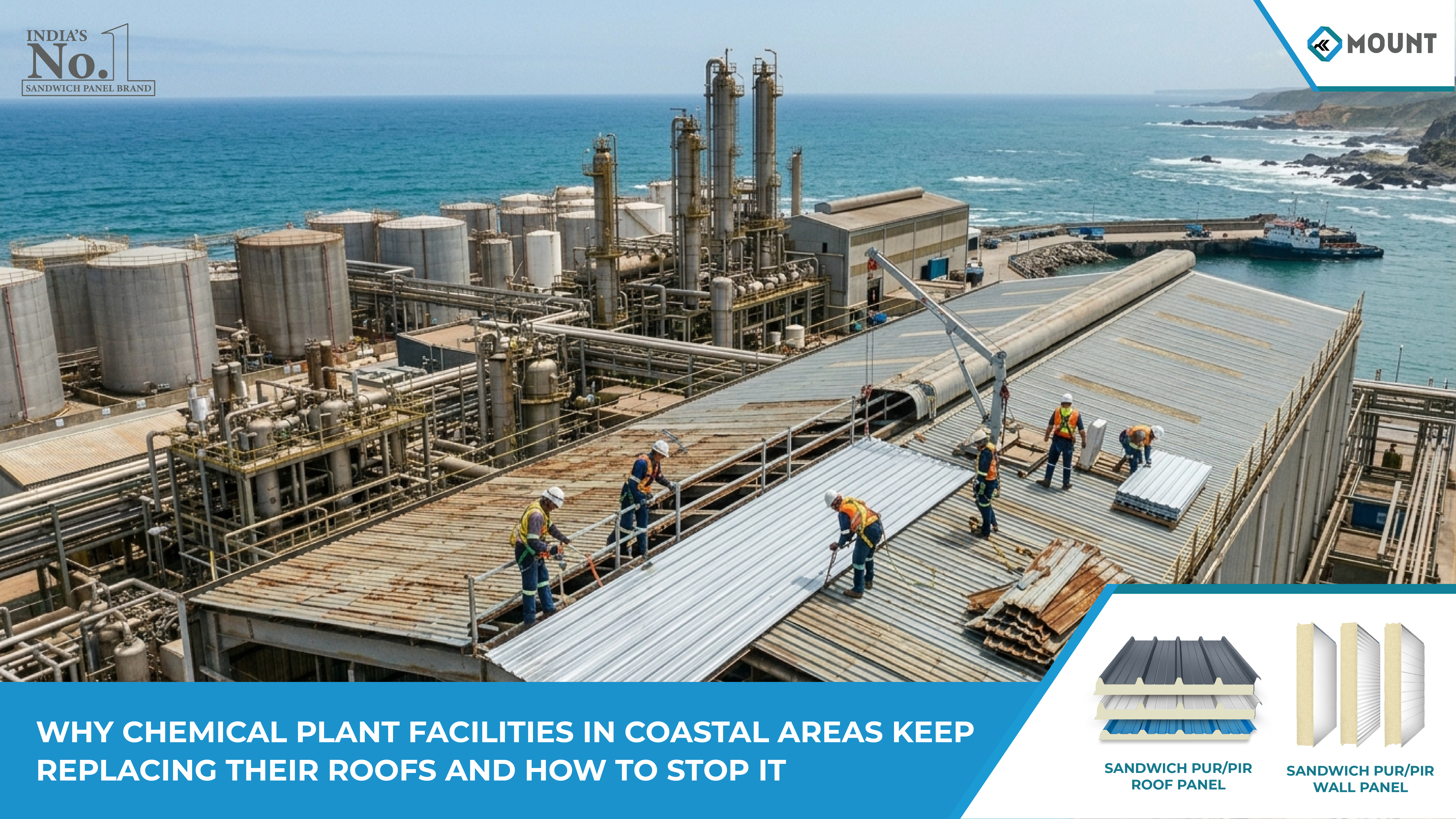
Why Chemical Plant Facilities in coastal areas keep replacing their Roofs and How to Stop it
If you operate a facility near the coast or inside a chemical processing zone, the “roof replacement cycle” feels like a permanent line item in your budget. You install a standard metal roof, and five years later, you are dealing with rust, pinholes, and coating failure. It is a grind that kills maintenance budgets and creates constant risk for the equipment stored below. Truth is, conventional metal roofing isn’t built for the “aggressive” chemistry of a salty breeze or acidic fumes. If you are replacing your roof more than once every two decades, you are fighting a losing battle with the environment, not a construction problem.
Why Your Roof is Turning into a Battery
The failure here is actually an electrochemical one. In coastal zones, salt air acts as an electrolyte, turning your roof into a giant, rusting battery. When humidity hits, that process isn’t just happening,it is sprinting. In chemical plants, it is even worse. Acidic mists, sulfur, and ammonia eat through standard zinc galvanization the moment they touch the surface.
Once that zinc layer is gone, the steel underneath doesn’t just rust; it suffers structural thinning. By the time you see red streaks on your industrial roofing panels, the fastener holes are already enlarged and the connection strength of your roof is compromised.
Stopping the Replacement Loop
If you’re sitting by the ocean or handling process chemicals, standard “off-the-shelf” steel is a liability. You need corrosion-resistant industrial roofing built on high-grade alloy substrates or aluminum, finished with a fluoropolymer coating. These coatings aren’t just “paint”; they are inert barriers. They don’t react with the salt or the acid fumes. When we talk about roofing solutions for chemical plants, we aren’t talking about aesthetics,we are talking about chemistry. If you aren’t specifying these specialized materials, you are essentially buying a product that is designed to fail in your specific climate.
Why the “Panel” Matters More Than the Skin
Choosing a sandwich panel manufacturer is the first step in ending the replacement cycle. In humid zones, a poorly sealed panel is a disaster waiting to happen. Moisture gets trapped between the metal skin and the foam core, causing “hidden” corrosion that works from the inside out. You won’t see it until a sheet eventually detaches.
A pro-grade system uses sandwich panels for walls and roofing that are factory-sealed to create a hermetic barrier. This keeps the environment away from the vulnerable underside of the metal. This is the difference between a roof that serves a generation and one that needs a patch-work crew every spring.
Mount’s Approach to Asset Longevity
At Mount, we don’t look at the building envelope as a commodity you replace every five years. We look at it as an asset that needs to work for twenty. We analyze the proximity to the coast, the ventilation stack emissions, and the local humidity before we ever write a spec. We don’t just “supply” roofing; we engineer a defense against your specific environment. Choosing a partner who understands the difference between a dry inland warehouse and a high-exposure production facility is the only way to stop the replacement loop.
FAQ
- PVDF vs. Polyester coatings: What’s the real-world difference?
Polyester coatings are for office parks and inland sheds. In a chemical environment, they break down. PVDF coatings are chemically inert. They don’t react to acid rain or salt, which is why they are the only option for heavy industrial or coastal exposure. - Why do my fasteners always rust first?
Fasteners are the “weak point.” They break the protective skin of the panel, creating a direct path to the raw metal. We use stainless steel fasteners with vulcanized EPDM washers that seal the hole entirely, preventing the “galvanic corrosion” that happens between the screw and the panel. - Is steel substrate thickness the key to stopping rust?
Not really. If the barrier is breached by salt or acid, even thick steel will eventually fail. You have to focus on the coating compatibility first. Get the chemistry right; the thickness is secondary. - Can I put these panels over my current failing roof?
Yes. In many cases, we can install a new, corrosion-resistant envelope over an old, failing structure. It stops the leak immediately and provides a secondary, sealed barrier that protects your inner structure from the environment. - How does Mount actually pick the right spec for my plant?
We don’t guess. We look at your facility’s wind direction, distance from the shore, and the chemical composition of your exhaust fumes. Then, we select the specific alloy substrate and coating thickness that meets the actual exposure category of your site
Similar Events
 23 October, 2026