 Apr 20, 2026
The Summer Construction Window: Why Institutional Projects Have Zero Room for Vendor Coordination Failures
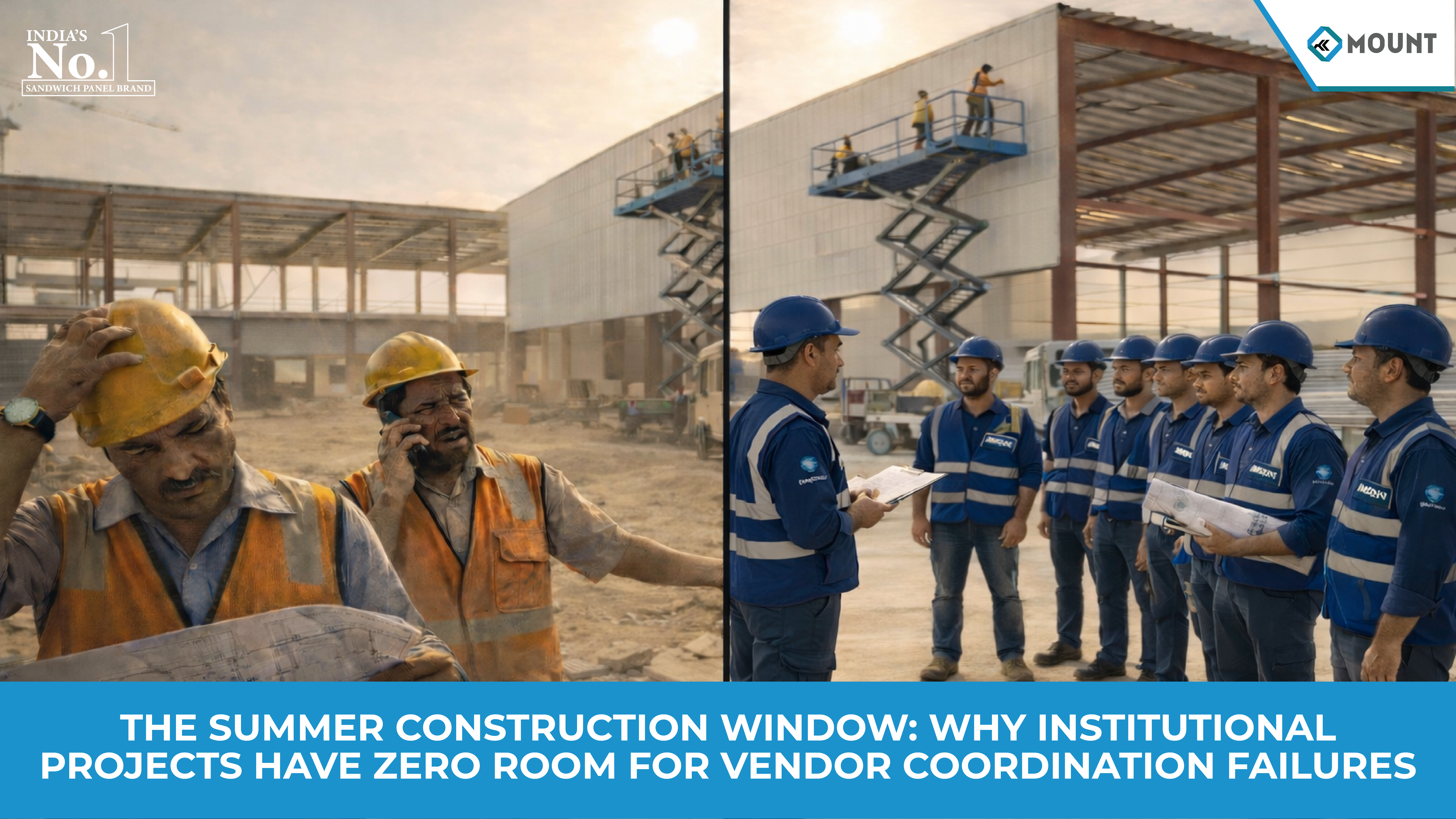
In the world of institutional development, spanning schools, university campuses, and large-scale research centers, the calendar is the most rigid constraint of all. Unlike a private commercial park that can push a “Go-Live” date by a few weeks with minimal fallout, an academic facility must be fully operational by the first day of the new term. This creates a high-pressure “Summer Window,” typically a 60-to-75-day period where major building work must happen while students are off-campus. In this environment, the traditional model of juggling multiple vendors is no longer a viable strategy; it is a liability.
The Breakdown of Multiple-Vendor Dependency
The primary risk in fast-track institutional work is the “Coordination Lag.” When a project relies on separate vendors for the steel frame, the insulation, and the roofing sheets, the timeline is only as fast as the slowest supplier. A three-day delay in receiving specialized fasteners can stall the entire installation crew, eating up 5% of the total summer window in a single weekend.
Institutions are increasingly shifting toward turnkey building solutions for institutions to bypass this mess. By consolidating the building envelope under one engineering partner, the risk of “finger-pointing” between different contractors is eliminated. When the design, manufacturing of the PUF Sandwich Panel, and the logistics are handled by a single entity, the workflow moves from a series of disjointed steps to a synchronized assembly line.
Technical Speed: From Masonry to Prefabricated Envelopes
Traditional construction methods, like brick-and-mortar or onsite built-up roofing, simply cannot fit into a summer schedule. They involve too many “wet” processes and curing times that are vulnerable to monsoon delays. Modern institutional specifications are now built around the PUF Panel because it moves the most time-consuming work into a controlled factory environment.
For large-scale university halls or gymnasiums, the use of h-rib sandwich panels is a strategic choice. These panels offer the structural rigidity needed for long spans while providing an exterior finish that is site-ready the moment it is hoisted into place. Because these panels arrive pre-engineered, the onsite crew spends their time assembling rather than fabricating. This shift in labor dynamics is what allows a campus to complete a multi-story addition or a massive roof replacement between the graduation ceremony in May and the orientation in August.
Integrating Sustainability within Tight Timelines
Institutions are under increasing pressure to hit “Green Campus” targets, but solar integration often feels like another layer of coordination that could slow down a project. This is where specialized engineering comes in. The Solar Roof puf Panel is designed to solve this by integrating the mounting hardware and the thermal insulation into the roofing system itself.
Instead of finishing a roof and then hiring a second vendor to drill holes for solar racks,which risks leaks and adds weeks to the schedule,the roof is “solar-ready” from day one. This integrated approach is a hallmark of turnkey construction solutions. It allows a school to upgrade its energy efficiency and its structural envelope simultaneously, fitting a year’s worth of infrastructure upgrades into a single summer break.
Why Reliability is the Only Metric that Matters
For a project manager at a university, the “cheapest” quote often becomes the most expensive mistake if the vendor misses the mid-summer delivery slot. The market is full of suppliers, but only the Best PUF Sandwich Panel Manufacturers have the logistical infrastructure to guarantee that materials arrive in the exact sequence the site crew needs them.
This is where Mount differentiates itself. We don’t just act as a source of material; we act as a logistics and engineering hub. We understand that in institutional work, “almost on time” is a failure. By providing high-quality PUF Panel systems and managing the technical coordination in-house, we ensure that the building envelope is closed long before the first bell rings.
Choosing Mount means opting for a partner that respects the rigidity of the academic calendar. We bring the technical precision and the vertical integration required to turn a complex campus renovation into a predictable, fast-track success.
FAQ
- How do turnkey solutions reduce the “on-site footprint” during summer renovations?
By using turnkey building solutions for institutions, the amount of raw material storage and onsite fabrication is cut by nearly 70%. Since panels are delivered pre-cut, the site stays cleaner and safer, which is vital for campuses that might still have staff or summer programs running. - What makes the H-Rib design better for large institutional roofs?
The h-rib sandwich panels are specifically engineered for superior load-bearing capacity over wider purlin spacings. This means you need less secondary steel, which speeds up the structural phase and reduces the overall material cost of the project. - Can solar-ready panels be installed on existing campus buildings?
Yes. Our Solar Roof PUF Panel systems can be used for retrofitting older buildings. They provide a new, highly-insulated weather seal while providing the built-in structural points needed for a rapid solar roll-out without the need for additional roof penetrations.
- How does Mount handle the logistics of a high-speed summer delivery?
We use a staggered delivery system. Instead of dumping all the materials at once, we coordinate with the site manager to deliver PUF Sandwich Panel loads in the exact order of installation. This prevents site congestion and keeps the installation team moving at peak speed. - Is the fire rating of these panels sufficient for school buildings?
Absolutely. We prioritize safety by manufacturing panels that meet strict fire-retardant standards. This ensures the building complies with all institutional safety codes, providing peace of mind for both the administration and the insurers.
Similar Events
 23 October, 2026