 Jul 22, 2026
Your Roof Survived the Monsoon. Did Your Fasteners?
When a roof starts leaking during the monsoon, the roofing sheet usually gets the blame.
The assumption feels logical. Water is entering the building, so the roof sheet must have failed.
In many cases, that’s not what happened.
Roofing consultants and maintenance teams often discover that the problem began somewhere much smaller, a fastening point no larger than a few millimetres in diameter.
A roof may contain thousands of fasteners. Each one creates a connection between the roofing system and the supporting structure beneath it. When those connections weaken, corrode, loosen, or lose their sealing ability, water finds a way in.
The result looks like a roofing problem.
The root cause often isn’t.
The Monsoon Tests More Than Roofing Sheets
A roofing system experiences different stresses throughout the year.
During summer, thermal expansion and contraction occur daily. During monsoon months, the roof faces a different challenge altogether.
Heavy rainfall, wind uplift, standing moisture, fluctuating temperatures, and repeated wet-dry cycles place constant stress on fastening points.
A roofing sheet may be capable of withstanding these conditions, but the overall system is only as reliable as the components holding it in place.
That’s why experienced contractors rarely evaluate roofing sheets in isolation. They look at the complete assembly.
Including the screws.
Most Roofing Failures Start Small
Very few roofs fail overnight.
The process is usually gradual.
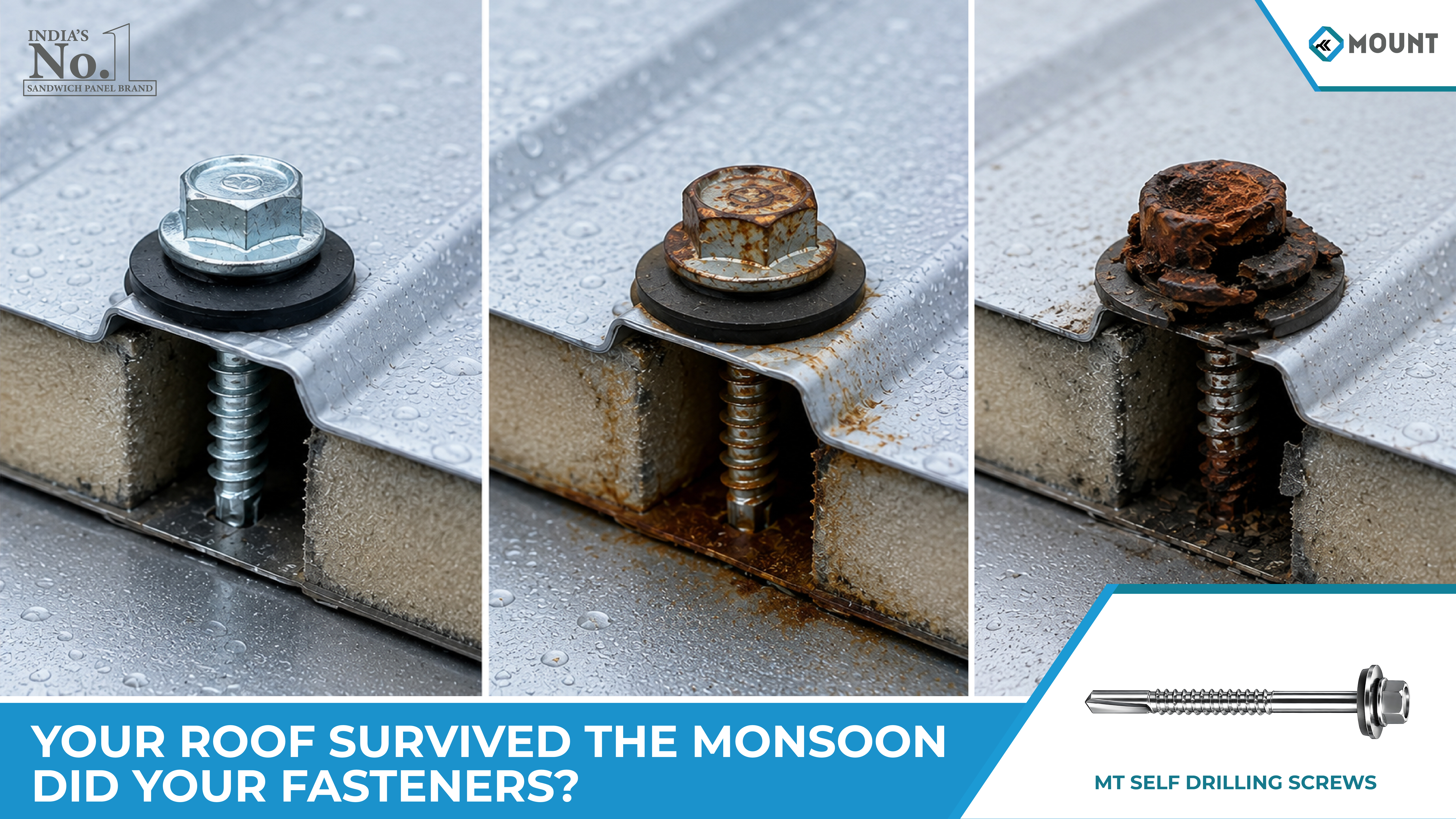
A washer begins losing its sealing capability.
A low-quality screw starts corroding.
Wind movement causes slight loosening over time.
Water begins entering through microscopic gaps.
For months, the problem may go unnoticed.
Then the first leak appears. By that stage, the issue has often spread beyond a single fastening point. This is why roofing professionals place significant emphasis on selecting self-drilling fasteners designed specifically for long-term exposure to demanding environmental conditions. The goal isn’t simply securing the roof during installation. The goal is maintaining that connection year after year.
Wind Uplift Is Often Underestimated
Rainfall receives most of the attention during monsoon discussions.
Wind deserves just as much. Strong winds create uplift forces across roof surfaces. These forces attempt to separate roofing sheets from the supporting structure beneath them. The effect becomes more pronounced in large-span industrial buildings, warehouses, manufacturing facilities, logistics parks, and coastal infrastructure projects.
If fastening systems are not designed to withstand these loads, movement can occur over time. Even minor movement affects sealing performance. This is one reason project consultants increasingly evaluate industrial self-drilling screws based on pull-out performance, material strength, and long-term reliability rather than simply comparing procurement costs.
Corrosion Rarely Stops Once It Starts
Fasteners operate in one of the harshest environments in the building.
They’re exposed to moisture, humidity, pollutants, temperature fluctuations, and in some regions, salt-laden air. When corrosion begins affecting a fastener, it creates two problems simultaneously. The mechanical connection weakens & sealing performance deteriorates. Both issues can eventually lead to water ingress.
For facilities located in coastal regions, industrial zones, or high-humidity environments, specifying Corrosion Resistant Screws becomes an important part of protecting the roofing system over the long term.
A roofing sheet may last for decades. The fastener needs to keep pace.
The Washer Is More Important Than Many Realise
Ask most people about roofing screws, and they’ll focus on the metal fastener itself.
Roofing installers often pay equal attention to the washer.
The sealing washer creates the weather-tight barrier that prevents water penetration around the fastening point. If the washer deteriorates, cracks, compresses incorrectly, or loses elasticity over time, leakage can occur even when the screw remains structurally intact.
This is one reason quality fastening systems are engineered as complete assemblies rather than individual components. The screw, washer, coating, and installation method all contribute to overall performance. Ignoring any one of them creates risk.
Compatibility Matters
Not every fastener performs equally across every roofing application. Different roofing materials, support structures, environmental conditions, and installation requirements influence fastener selection.
A screw specified for one application may not be the best choice for another. This is why contractors increasingly work with specialised suppliers rather than treating fasteners as generic hardware products. The roofing industry has become far more technical than it was a decade ago. Small details have larger consequences.
Why Roofing Professionals Focus on Fastener Quality
When evaluating lifecycle costs, fasteners rarely represent a significant portion of project expenditure.Yet they influence some of the most expensive problems a building can experience: Leaks, Maintenance interventions, Roof repairs, Operational disruptions, & Product damage.
The financial impact of these issues can quickly exceed the savings achieved through lower-cost fastening systems.
This explains why developers, consultants, and contractors increasingly prioritize high-performance self-drilling screws when designing roofing systems expected to withstand challenging weather conditions.
The conversation is less about purchase price and more about long-term reliability.
Why Mount Self-Drilling Screws Are Built for Indian Conditions
India’s climate places unique demands on roofing systems. A fastening solution performing well in one region may face completely different challenges elsewhere.
Mount Roofing & Structures addresses these requirements through fastening systems engineered for durability, secure installation, and long-term weather resistance. Manufactured using quality raw materials, protective coatings, and reliable sealing components, Mount’s roofing screws are designed to support roofing systems across industrial, commercial, and infrastructure projects.
As one of the recognized Self Drilling Screw Manufacturers in India, Mount understands that roofing performance depends on every component working together, not only the visible ones.
Because a roof doesn’t fail at its strongest point. It usually fails at its weakest one & more often than many people realize, that point is the fastener.
FAQs
1. Why do roof leaks often occur around fastening points?
Fastening points penetrate the roofing surface. If sealing performance deteriorates due to corrosion, washer failure, or improper installation, water can enter through these locations.
2. How do self-drilling screws improve roofing performance?
They create secure mechanical connections while reducing installation complexity and helping maintain roof integrity when specified correctly.
3. Why are corrosion-resistant fasteners important in industrial roofing?
Corrosion can weaken structural connections and compromise sealing performance, increasing the risk of leaks and maintenance issues over time.
4. What role do sealing washers play in roofing systems?
Sealing washers create a weather-tight barrier around fastening points, helping prevent water penetration during rainfall and changing weather conditions.
5. What should contractors consider when selecting roofing fasteners?
Material quality, coating protection, washer performance, pull-out strength, environmental exposure, and compatibility with the roofing system should all be evaluated before specification.
Similar Events