 May 15, 2026
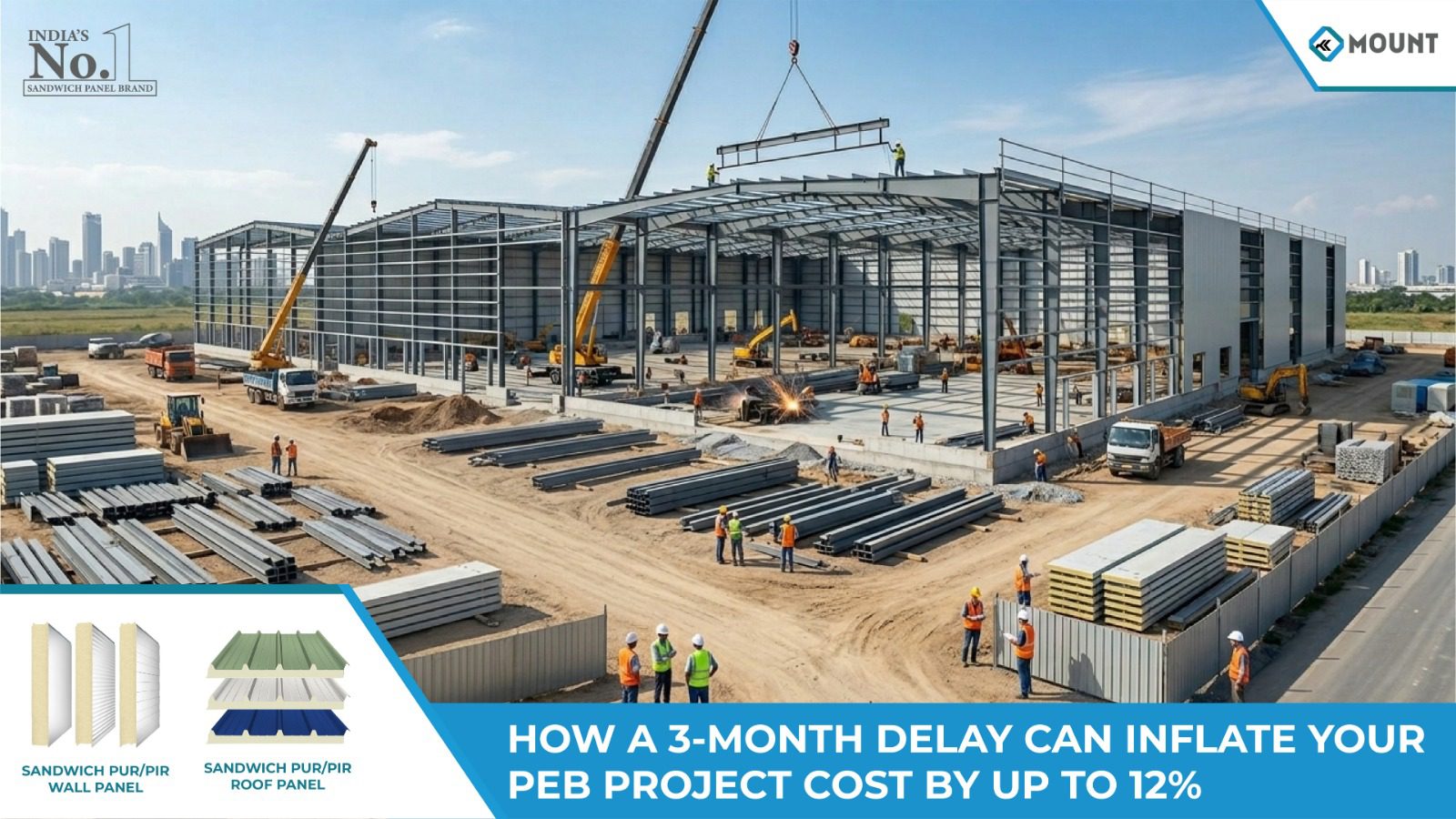
How a 3-Month Delay Can Inflate Your PEB Project Cost by Up to 12%
In Pre Engineered Buildings, timelines are tightly linked to cost behaviour. Unlike conventional construction, where delays may be absorbed across multiple parallel activities, PEB projects follow a sequential dependency , civil readiness, structural erection, and envelope completion. Any disruption in this chain directly affects cost efficiency.
A delay of three months, particularly during the monsoon period, introduces compounding inefficiencies across execution, logistics, and financial planning. In practical scenarios, this often results in a 10–12% escalation in total project cost.
Sequencing Sensitivity in PEB Execution
PEB systems are engineered for speed, but only when sequencing remains intact.
The civil phase including excavation, PCC, foundation casting, and anchor bolt placement , forms the base for structural erection. Delays at this stage create a mismatch between factory production and site readiness.For projects involving pre-engineered building panels, fabrication timelines are typically fixed once drawings are approved. If the site is not ready when materials arrive, storage, handling, and re-mobilisation costs begin to accumulate.
Additionally, anchor bolt misalignment due to unstable soil conditions can lead to rework during column erection, further increasing time and cost.
Geotechnical and Civil Impact During Monsoon
From a technical standpoint, soil behaviour changes significantly during monsoon.
Increased moisture content reduces soil bearing capacity, particularly in clayey and silty soils. This affects foundation stability and may require additional compaction, dewatering, or even redesign in extreme cases.
Curing of concrete also becomes inconsistent. Excess moisture interferes with controlled hydration, impacting strength development timelines.For a Peb Construction Company In India, this introduces variability in foundation performance, which directly affects structural alignment during erection.
Labour Productivity and Workfront Efficiency
Labour output is not linear under wet conditions.
Surface instability reduces mobility, increasing time per activity. Safety protocols limit simultaneous operations, especially during lifting and height work.
From an execution perspective, this reduces workfront availability , fewer parallel activities can be carried out.
In projects involving steel building roofing panels, erection accuracy is critical. Reduced efficiency during this phase can lead to alignment issues, requiring adjustments that extend timelines.To compensate, contractors often increase labour deployment or extend working hours, both of which increase cost per unit of work completed.
Equipment Utilisation and Lifting Constraints
Erection of PEB structures relies heavily on crane operations.
During the monsoon, ground conditions affect crane stability and movement. Load charts may need to be recalibrated based on soil conditions, reducing lifting capacity.
Wind and rain also introduce operational constraints, limiting working hours for safe lifting.
Idle crane time becomes a major cost driver. Equipment hired on a daily or monthly basis continues to incur cost even when utilisation drops.For installations involving roofing panels for steel structures, delays in lifting sequences can disrupt panel alignment and installation accuracy.
Material Exposure and Installation Integrity
Material performance can be affected before installation if handling conditions are compromised.
Moisture exposure impacts insulation properties, particularly in systems using insulated panels for steel buildings. Water ingress during storage can affect core density and bonding integrity.
Sealants and fastening systems also require controlled conditions for proper application. High humidity and wet surfaces reduce adhesion quality, increasing the risk of future leakage.Rework at this stage is not only time-consuming but also affects long-term performance of the building envelope.
Supply Chain and Logistics Disruptions
Monsoon affects not just the site, but also upstream logistics.
Transport delays occur due to road conditions and restricted movement of heavy vehicles. This disrupts just-in-time delivery schedules typically followed in PEB projects.
For Pre-engineered Steel Building Manufacturer Companies, this creates a challenge in synchronising dispatch with site readiness. Early dispatch leads to storage risks, while delayed dispatch affects erection schedules.Repeated handling of materials increases the probability of damage, further adding to cost.
Financial Impact: Beyond Execution Cost
The financial impact of delay extends beyond construction.
Extended project duration increases indirect costs ,site management, utilities, temporary facilities, and security. These costs are time-dependent and continue to accrue regardless of progress.
From a business standpoint, delayed commissioning affects revenue generation. For industrial facilities, this can mean postponed production cycles, delayed supply commitments, and reduced operational throughput.
Working with Largest Pre Engineered Metal Building Manufacturers ensures better planning integration, but timing remains a critical external variable.
Pre-Monsoon Execution Strategy
Starting the project before monsoon changes the execution profile significantly.Critical activities such as excavation, foundation casting, and structural erection are completed under stable conditions. This ensures proper alignment, accurate installation, and minimal rework.
Once the primary structure is erected, subsequent activities are less sensitive to weather disruptions.For systems using peb roofing panels, early installation ensures that the building envelope is secured before peak rainfall, reducing exposure of internal areas.
Mount Roofing & Structures: Engineering for Execution Certainty
Mount approaches PEB projects with a strong emphasis on execution sequencing and environmental conditions.
Their integrated model combining design, manufacturing, and installation ,allows better control over project timelines. By aligning production schedules with site readiness and seasonal factors, they reduce the risk of mismatch between fabrication and erection.As a Peb Construction Company In India, their focus is on maintaining continuity across all phases of the project, ensuring that engineered speed is not lost due to external disruptions.
Conclusion: Time as a Cost Multiplier
In PEB construction, time is not a neutral factor. It acts as a multiplier.
A delay of three months introduces inefficiencies across civil works, labour productivity, equipment utilisation, material handling, and financial planning. These inefficiencies compound, leading to measurable cost escalation.The difference between a controlled project and a cost-overrun project often comes down to when it starts.
FAQs
Q1: Why does soil condition during monsoon affect PEB projects significantly?
A: Because reduced bearing capacity impacts foundation stability and alignment of structural components.
Q2: How do delays affect installation accuracy in PEB structures?
A: Wet conditions reduce precision during erection, leading to alignment issues and potential rework.
Q3: Can insulation panels lose performance due to moisture exposure?
A: Yes, moisture can affect core integrity and bonding, reducing thermal efficiency and durability.
Q4: Why is crane utilisation critical in PEB projects?
A: Because structural erection depends on lifting operations, and reduced utilisation directly increases cost.
Q5: How does Mount Roofing & Structures minimise delay-related risks?
A: By integrating design, manufacturing, and execution planning with seasonal and site-specific conditions.
Similar Events
 10 October, 2026