 May 11, 2026
India’s Post-Harvest Loss Crisis: Why Storage Infrastructure Is the Fix the Agriculture Sector Needs
India produces more than enough Post Harvest. The issue has never been output , it’s what happens after.
A significant portion of agricultural produce never reaches the market in usable condition. Losses occur in the hours and days immediately after harvest, long before logistics or pricing even come into play. Moisture exposure, heat variation, and lack of proper storage environments begin affecting quality almost instantly.
For farmers and agri-businesses, this creates a recurring cycle , produce is sold quickly, often below value, simply because holding it safely isn’t an option. What gets overlooked is that this isn’t a farming problem. It’s an infrastructure gap.
Where the Loss Actually Begins
Post-harvest loss doesn’t happen at a single point. It starts the moment the produce leaves the field.
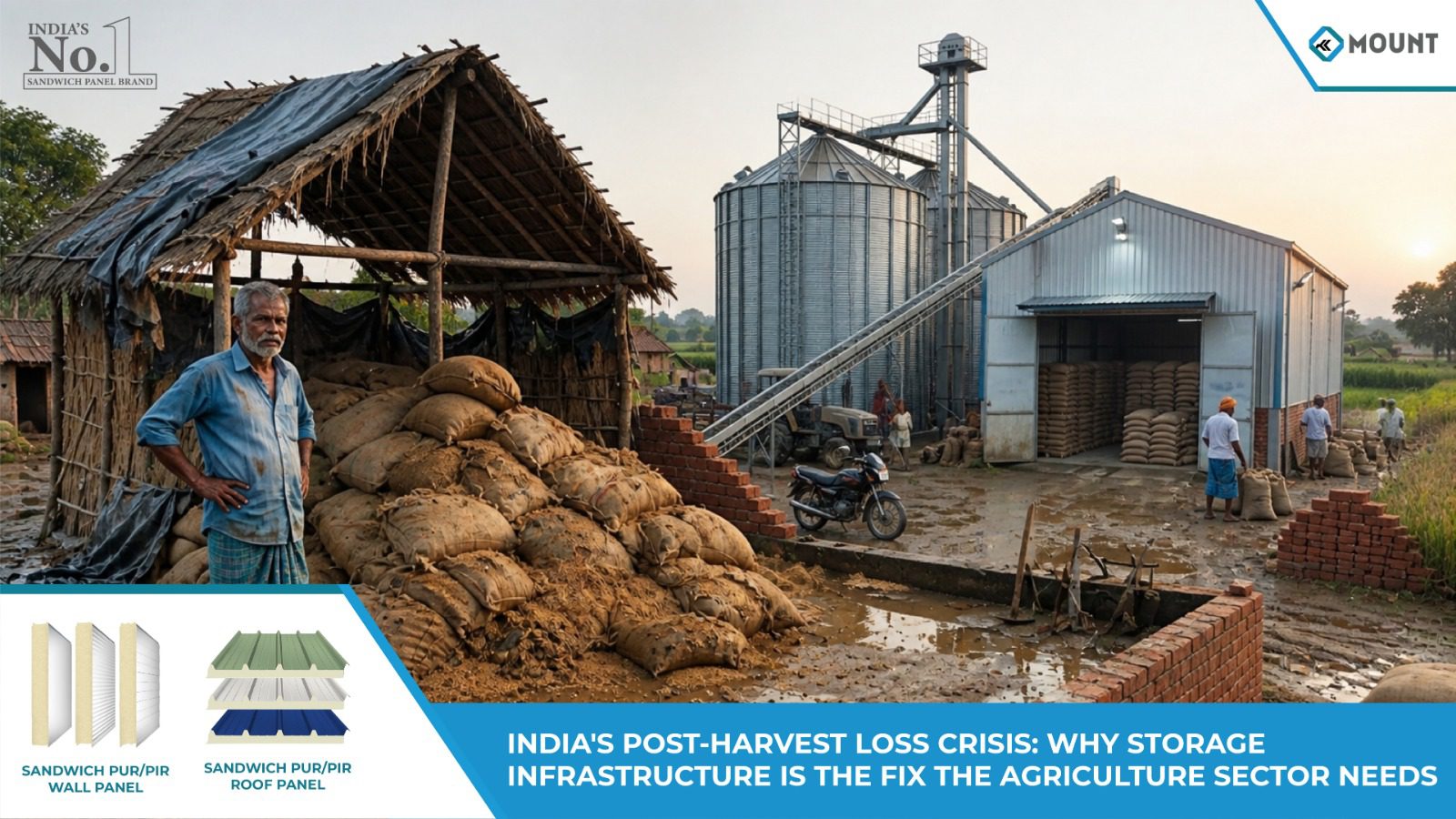
Grains stored in open yards absorb ambient moisture. Perishables begin deteriorating due to temperature fluctuations. In many regions, temporary sheds offer minimal protection against humidity or pests.
This is particularly visible in setups where basic storage replaces engineered systems. Without controlled conditions, even short-term exposure leads to quality degradation.
In such scenarios, reliance on traditional storage limits the effectiveness of the entire supply chain , regardless of how strong production levels are.
Why Conventional Storage Falls Short
Most existing storage setups were not designed for performance. They were designed for availability.Open sheds, poorly ventilated warehouses, and temporary structures provide space but no control. They do not regulate the internal temperature, inhibit condensation, or ensure cleanliness levels that are needed to store products for prolonged periods.
In perishable and temperature-sensitive goods, the need increases. The absence of any form of insulation leads to rapid fluctuations in the internal environment, thus increasing spoilage.When comparing different warehouse roofing options, the question is one of protecting versus merely covering the merchandise.
Moving Toward Engineered Storage Systems
The shift toward engineered infrastructure is less about scale and more about consistency.
Modern warehouses and storage facilities built using insulated systems create controlled internal environments. Materials like cold storage panels allow temperature stability, which is essential for preserving both quality and shelf life.
Similarly, Mount’s cold storage puf panels provide insulation that reduces thermal exchange, helping maintain uniform conditions across the storage space.
When storage becomes predictable, supply chains become more stable. Produce can be held longer, transported efficiently, and sold under better market conditions.
Speed Matters More Than It Seems
Agriculture operates in cycles. Harvest windows are short, and storage demand often appears suddenly.Traditional construction timelines don’t align well with this urgency. By the time a conventional warehouse is ready, the immediate need may have already passed.
This is where pre-engineered systems make a difference. Working with a sandwich panel manufacturer like Mount enables faster construction of storage facilities, allowing infrastructure to be deployed when it is actually needed.For large-scale applications, this speed directly impacts how much produce can be preserved within a given season.
Beyond Storage: Supporting the Entire Ecosystem
Improved storage doesn’t just reduce losses , it changes how the entire system functions.
Farmers gain flexibility. Instead of selling immediately after harvest, they can wait for favourable pricing. Aggregators can manage inventory better. Distributors experience fewer disruptions due to spoilage.
Even sectors like dairy and livestock benefit. Infrastructure such as prefabricated cattle shed construction ensures controlled environments that improve both productivity and animal health.
Similarly, working with a reliable shed construction company allows faster deployment of supporting infrastructure across rural and semi-urban regions.
Material Choice and Long-Term Performance
Not all storage structures perform the same over time. Material selection plays a direct role in durability, maintenance, and internal conditions.
With the use of insulated structures, there is a guarantee that performance will always be consistent irrespective of changing weather patterns. Consequently, such structures will require less maintenance. It therefore means that conditions for storage will also be stable for any business organization dealing with PUF Panel manufacturers.
Roofing also plays a role here. Using sandwich panels for roofing helps reduce heat gain and prevents moisture ingress, both of which are critical for preserving stored goods.
Mount : Enabling Scalable Storage Infrastructure
Mount works at the intersection of speed and performance in infrastructure development. Their approach focuses on delivering integrated solutions , combining panels, structural systems, and execution.
As a sandwich panel manufacturer, their capability extends beyond production. It includes application-specific design, ensuring that storage facilities are aligned with real-world agricultural conditions.
For clients, this translates into infrastructure that is not only quick to deploy but also consistent in performance over time.
Rethinking Storage as Core Infrastructure
Storage has traditionally been treated as a secondary investment , something to address after production.That approach no longer holds. As output increases, the gap between production and preservation becomes more visible.
Investing in engineered storage systems shifts the focus from reactive handling to proactive management. It reduces uncertainty, stabilises supply chains, and improves overall efficiency.In practical terms, the difference between losing produce and preserving it often comes down to infrastructure , not farming practices.
FAQs
Q1: What are the main causes of post-harvest losses in India?
A: Moisture exposure, temperature fluctuations, pest infestation, and lack of controlled storage environments are the primary factors.
Q2: How do cold storage panels improve agricultural storage?
A: They maintain stable internal temperatures, reducing spoilage and extending the shelf life of perishable goods.
Q3: Why are pre-engineered storage facilities preferred in agriculture?
A: They can be constructed quickly, allowing infrastructure to match seasonal demand without long delays.
Q4: What role do roofing systems play in storage efficiency?
A: Roofing impacts heat gain and moisture control, both of which directly affect storage conditions.
Q5: How does Mount Roofing & Structures support agricultural infrastructure?
A: By delivering integrated panel-based building systems that enable faster construction and consistent storage performance.
Similar Events