 Jun 5, 2026
Impact Resistance in Roofing Materials: Why It Matters More Than You Think
Most Roofing Problems Start Long Before the Leak Appears
A roof rarely fails in one day.In industrial projects, the damage usually starts quietly , a stress mark near a fastener, a weak corner section, a sheet that has started losing flexibility after years of heat and rain exposure. Nobody notices it initially because operations continue normally. Then one monsoon later, water starts entering through a tiny crack. A few months after that, corrosion appears underneath the sheet. Eventually, what looked like a small issue turns into recurring maintenance work.
This pattern is common across factories, warehouses, logistics parks, airport structures, commercial complexes, and industrial sheds. Roofing systems are under constant physical pressure throughout their life cycle. Heavy rainfall, airborne debris, maintenance traffic, equipment vibration, thermal movement, and UV exposure slowly wear materials down.
That is why many consultants today place more importance on impact resistance than they did a decade ago. Roofing is no longer viewed only as a covering layer. It has become part of the building’s long-term operational stability.
For projects where durability matters over years of use, many developers now prefer polycarbonate sheets for industrial buildings because of their ability to tolerate continuous environmental and physical stress without becoming brittle too early.
Impact Resistance Is About How a Roof Behaves Under Stress
Most people assume impact damage means a visible crack after something heavy falls on the roof. In reality, roofing materials fail much earlier than that.
Impact resistance simply means how well a material handles force over time without weakening. Some materials absorb pressure and redistribute it. Others become rigid and eventually crack under repeated stress.
This difference becomes obvious after years of exposure. A roof may still look intact from outside while internally the material has already started weakening near joints, overlaps, or fastening points. Once that happens, rainwater begins finding entry paths. After moisture enters the system, deterioration speeds up quickly.
Industrial roofs go through far more stress than residential structures. Maintenance teams walk across them regularly. Equipment servicing happens constantly. In manufacturing facilities, vibration from machinery affects structural sections over time. Add Indian monsoon conditions to that, and the roof faces continuous impact for months together.
Materials that cannot handle movement usually fail first around corners and fasteners.
Weather Causes More Structural Damage Than Most Owners Realize
Monsoon exposure changes how roofing behaves.During heavy rainfall, roofing surfaces absorb repeated force for hours continuously. Wind carries dust, loose particles, and debris against exposed sections. In some regions, sudden storms create sharp pressure changes that affect weaker roofing systems immediately.
Heat adds another layer of stress. Roofing sheets expand during daytime temperatures and contract rapidly once rain cools the surface. This movement repeats season after season. Lower-quality materials gradually lose flexibility because of it.
This explains why many roofs begin leaking “suddenly” during monsoon even though the actual weakening had already been happening for years underneath.
By the time leakage becomes visible inside a warehouse or factory, the roofing system has usually been under stress for much longer than expected.
Industrial Roofing Handles a Different Type of Pressure
Commercial roofing is not exposed only to weather.Factory roofs deal with maintenance movement almost every week. Technicians access roofing sections for ducting work, ventilation servicing, electrical repairs, and inspection activity. Warehouses with large spans also experience structural movement and vibration over long periods.
Even accidental impact becomes a real factor in industrial environments. Dropped tools, dragged equipment, temporary loading pressure, and foot traffic create localized stress points across the roof surface.
Materials with low flexibility tend to weaken quickly in these conditions. Cracks generally appear around fastening zones first because those areas absorb the most concentrated pressure.
That is one reason industrial consultants have started moving away from brittle roofing products for long-span structures.
What Happens When Roofing Materials Start Losing Strength
The first signs are usually small enough to ignore.
A chipped edge after a storm. Slight discoloration. Tiny cracks around screws. Minor leakage during heavy rain. Most facility owners patch these issues temporarily and move on.
The problem is that once water enters damaged roofing sections, deterioration accelerates. Corrosion spreads underneath. Insulation performance drops. Leakage starts affecting adjacent areas. Eventually maintenance becomes seasonal rather than occasional.
In industrial facilities, roofing failure creates operational problems as well. Water leakage can affect inventory storage, electrical systems, production areas, and equipment safety. Over a few years, repair expenditure often becomes much higher than the original material savings.
Why Polycarbonate Sheets Are Used in Commercial Roofing
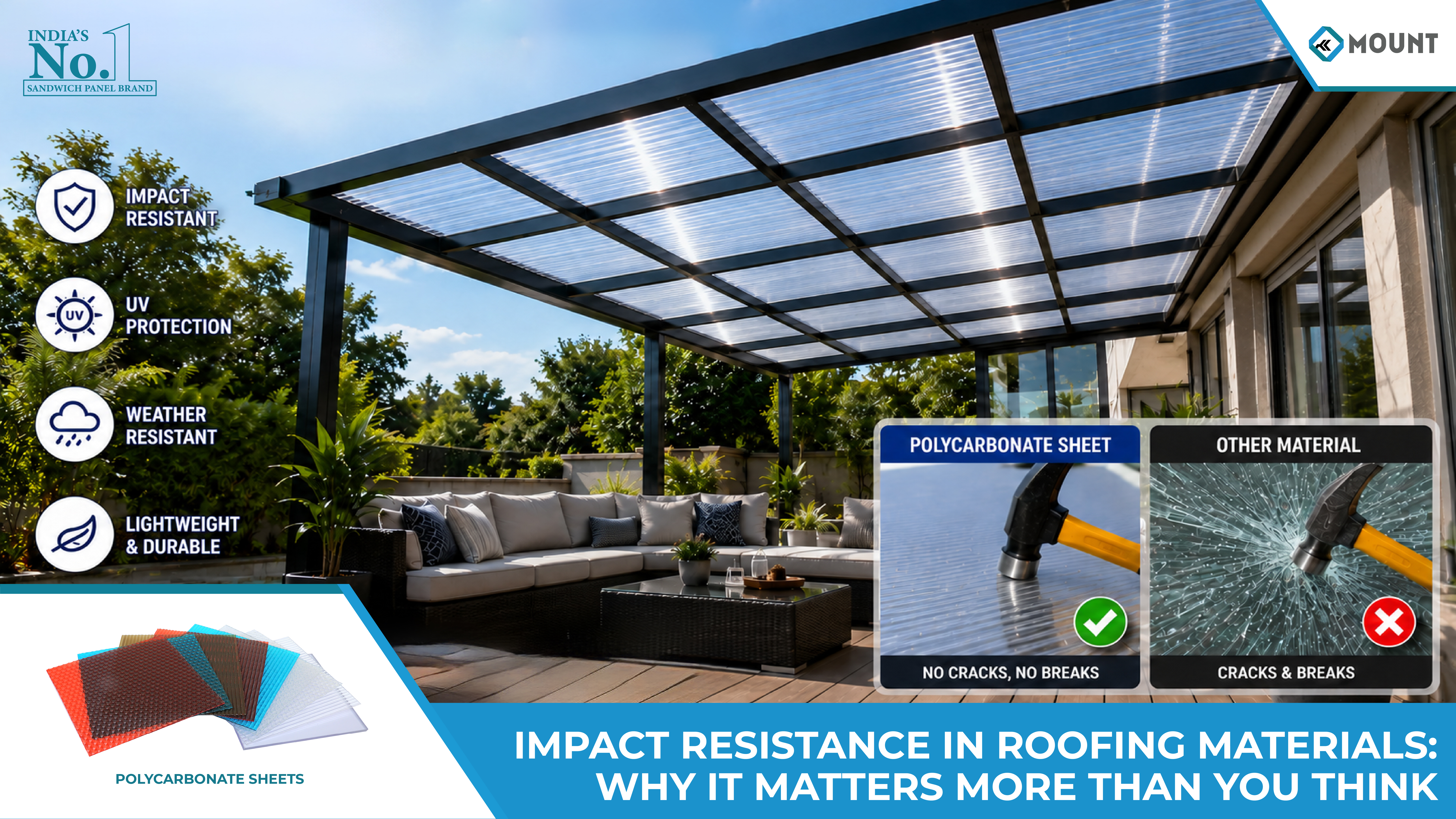
Polycarbonate roofing has become common in industrial and commercial projects because it combines flexibility with impact durability.
Unlike brittle conventional materials, polycarbonate sheets can absorb force without immediate cracking. That becomes useful in environments where roofing surfaces experience continuous environmental and operational pressure.
These sheets are widely used in:
- Warehouses
- Industrial sheds
- Skylights
- Parking structures
- Commercial walkways
- Covered public spaces
Another advantage is light transmission. Transparent polycarbonate sheets for skylight applications allow daylight inside large structures without compromising roofing strength.
Many modern infrastructure projects now use polycarbonate sheets for commercial roofing because the material performs consistently under long-term outdoor exposure while still maintaining appearance and structural stability.
How Mount Polycarbonate Sheets Are Designed for Long-Term Use
As a technically focused Mount Roofing and Structures, Mount develops roofing systems for industrial and commercial applications where long-term reliability matters more than short replacement cycles.
Mount Polycarbonate Sheets are designed for toughness against impact, protection from ultraviolet rays, exposure to the weather elements, and uniformity in structure under tough outdoor environments. They are often used in warehouse facilities, manufacturing plants, airport buildings, malls, parking garages, and industrial buildings where the roof is critical in determining business sustainability.They prevent cracks and leaks that may result in costly repairs and replacements over time.Mount Polycarbonate Sheets meet specifications for Polycarbonate sheets for malls roofing and Polycarbonate sheets for airports roofing.
As an experienced polycarbonate sheets manufacturer and polycarbonate sheets supplier, Mount focuses on long-term structural performance rather than short-term installation-driven solutions.
Conclusion
Roofing materials face continuous physical stress throughout their lifespan. Rainfall impact, debris movement, temperature fluctuation, maintenance traffic, and environmental aging gradually weaken materials that cannot absorb repeated force effectively.
That is why impact resistance has become an important part of commercial roofing selection today. In industrial projects especially, roofing systems are expected to maintain structural stability under years of environmental and operational exposure.
With engineered solutions such as Mount Polycarbonate Sheets, businesses can reduce maintenance frequency, improve roofing durability, and achieve more dependable long-term performance.
FAQs
Q1. Why does impact resistance matter in industrial roofing?
Industrial roofs experience constant exposure to weather, maintenance movement, debris impact, and vibration. Stronger impact resistance helps improve long-term durability.
Q2. Are polycarbonate sheets suitable for monsoon conditions?
Yes. Polycarbonate sheets handle repeated rainfall impact effectively and are less prone to cracking during heavy weather exposure.
Q3. Why do older roofs become brittle?
Years of UV exposure and thermal expansion gradually reduce flexibility in lower-grade roofing materials, making them more vulnerable to fractures.
Q4. Where are polycarbonate roofing sheets commonly installed?
They are widely used in warehouses, skylights, industrial buildings, malls, airports, parking sheds, and commercial roofing structures.
Q5. What should businesses evaluate before selecting roofing materials?
Impact strength, UV stability, weather durability, flexibility, maintenance requirements, installation quality, and expected service life should all be evaluated before selection.
Similar Events
 23 October, 2026