 May 31, 2026
Solving Campus Construction Challenges: Why Schools and Colleges Are Switching to Sandwich Panel Solutions
Changing Nature of Campus Infrastructure Development
Campus construction today doesn’t happen in isolation anymore. Most institutions are expanding while operations are already running, classes, hostels, admin blocks, everything active at the same time. That changes how projects need to be approached.
Earlier, timelines could stretch. Now they can’t. Buildings have to be ready before admissions or term start, and delays don’t just affect construction , they affect planning across the entire institution. This is where traditional methods start showing their limitations. Too many on-site dependencies, too many variables.
That’s why many institutions are gradually moving toward systems where more control is possible right from the start.
Timeline Certainty and Execution Efficiency
In campus projects, timing is not flexible. If a block is delayed, it creates a chain reaction: classrooms get reshuffled, hostels get over-allocated, schedules shift.Conventional construction depends on sequential progress. One delay pushes everything forward.
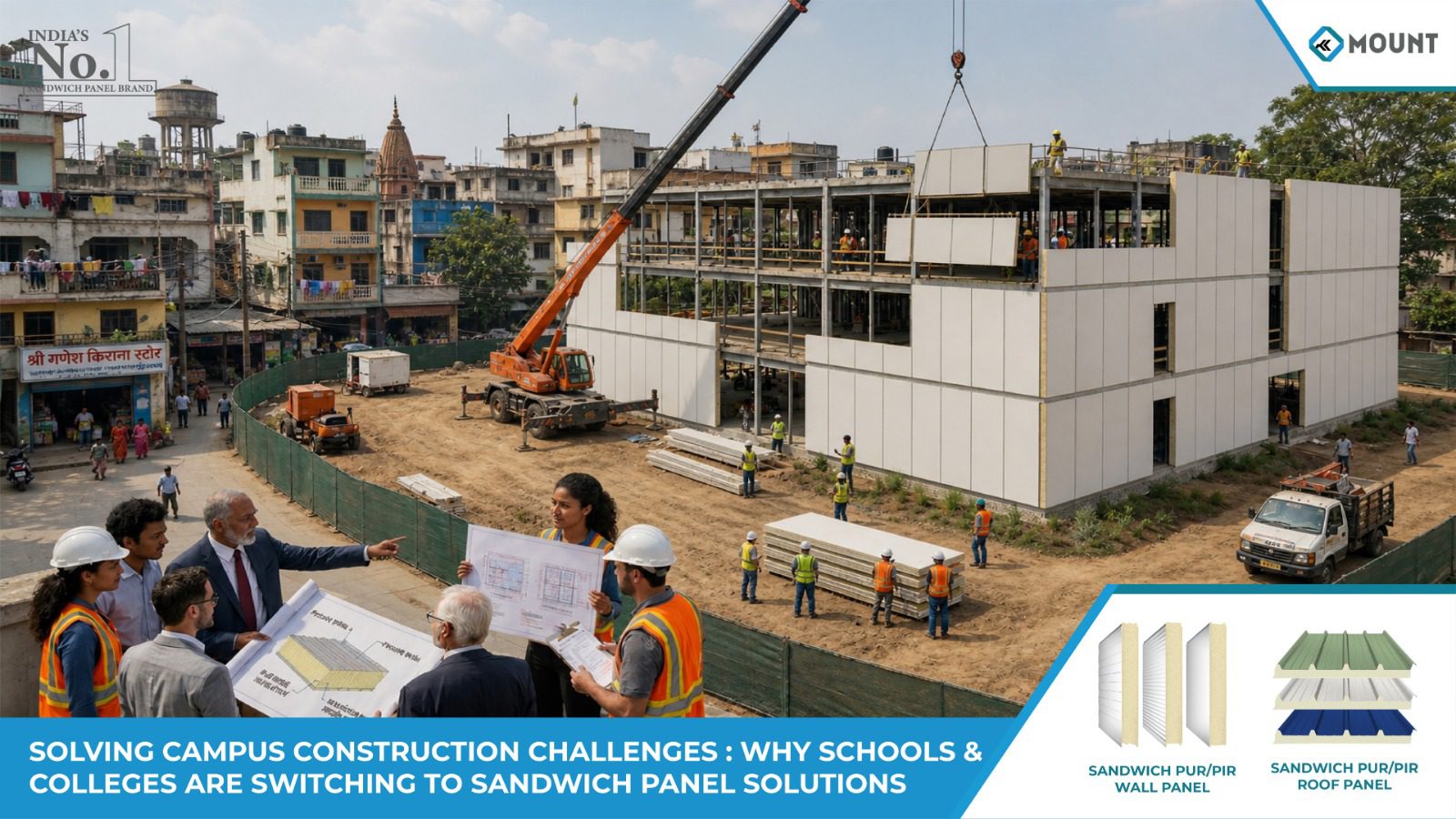
With systems developed by a sandwich panel manufacturer, the approach is different. A large portion of the work is done before materials even reach the site. Once they arrive, it’s more about assembly than construction.That changes execution on the ground. Fewer interruptions, fewer dependencies, and more predictable completion timelines. It’s not about speed alone , it’s about reducing uncertainty.
Cost Predictability and Financial Control
Budget overruns in educational projects don’t just stay within the project. They affect future plans , sometimes even other departments.Traditional construction has too many moving parts. Material wastage, labour variation, rework , all of this adds up slowly.
Working with an insulation panel supplier shifts a lot of that risk away from the site. Since panels are manufactured in controlled conditions, material usage is more consistent. There’s less guesswork during execution.
From a planning perspective, that makes a difference. Institutions can commit to budgets with more confidence instead of adjusting midway.
Thermal and Acoustic Performance in Learning Spaces
Classrooms and hostels don’t just need space , they need stable conditions.In many conventional buildings, temperature swings and outside noise become noticeable after a while. It doesn’t stop operations, but it affects how comfortable the space feels.
Systems like insulated panels for steel buildings handle this differently. Since insulation is part of the panel itself, performance is more consistent across the structure.It’s not something that stands out immediately, but over time, it improves how the space is used , especially in regions with extreme weather or noisy surroundings.
Reducing Long-Term Maintenance Burden
Maintenance is one of those things that rarely gets enough attention during planning.But a few years down the line, it becomes a regular expense , repainting, fixing seepage, patchwork repairs.With sandwich panels for walls, the surface finish is already part of the system. It’s not something applied later.
That reduces the kind of wear and tear you typically see in conventional buildings. Less repainting, fewer repairs, fewer interruptions to campus activity.Over time, that adds up , not just in cost, but in reduced operational hassle.
Flexibility and Scalability for Growing Campuses
Campuses don’t stay fixed. New departments come in, intake increases, facilities expand.With conventional structures, expansion often means working around existing limitations. Matching design, adjusting structure , it’s rarely straightforward.
Systems developed by a puf panel manufacturer are easier to extend because they’re modular by nature. Additions can be planned without reworking the entire structure.That flexibility becomes useful, especially for institutions that grow in phases rather than all at once.
Safety, Hygiene, and Compliance Requirements
Different parts of a campus have different requirements. Labs, kitchens, hostels , each space needs to meet certain safety and hygiene standards.
Panel systems can be adapted based on these needs. For example, Fire Proof Wall Panels are used where fire resistance becomes critical, while materials like PIR Sandwich Panels and Modular PUR Panels help maintain controlled environments.
This makes it easier to standardize construction while still meeting different functional requirements across the campus.
Mount Roofing & Structures: A More Grounded Approach
Mount typically comes into projects where execution challenges are already clear , tight timelines, operational campuses, multiple requirements.Instead of treating panels as standalone materials, the approach is more about how everything works together , structure, panels, and installation.
As a Top PUF Panels Manufacturer And Suppliers In India, the focus stays on making sure what’s designed actually performs the same way on-site.For institutions, that reduces the usual gaps between planning and execution.
Conclusion: A More Practical Way to Build Campuses
The shift toward sandwich panel systems isn’t really about following a trend. It’s more about solving problems that keep coming up in campus projects , delays, cost variability, maintenance, and expansion challenges.Traditional methods still work, but they come with limitations that are harder to manage in today’s timelines.
Panel-based construction changes how projects are executed. It brings more control, more predictability, and fewer surprises.And for institutions that need to build while continuing to operate, that becomes a practical advantage.
FAQs
- Why do campus construction projects often face delays?
Because they depend on multiple on-site processes that are affected by weather, labour, and sequencing. - How do sandwich panels improve execution timelines?
By shifting a large portion of work off-site and reducing dependency on sequential construction stages. - Are panel-based buildings suitable for long-term use?
Yes, they are designed for durability with lower maintenance requirements compared to conventional structures. - Can campuses expand easily using sandwich panel systems?
Yes, modular construction allows phased expansion without major structural changes. - How does Mount Roofing & Structures support such projects?
By aligning design, manufacturing, and execution to ensure predictable timelines and consistent performance.
Similar Events
 21 October, 2026