 May 18, 2026
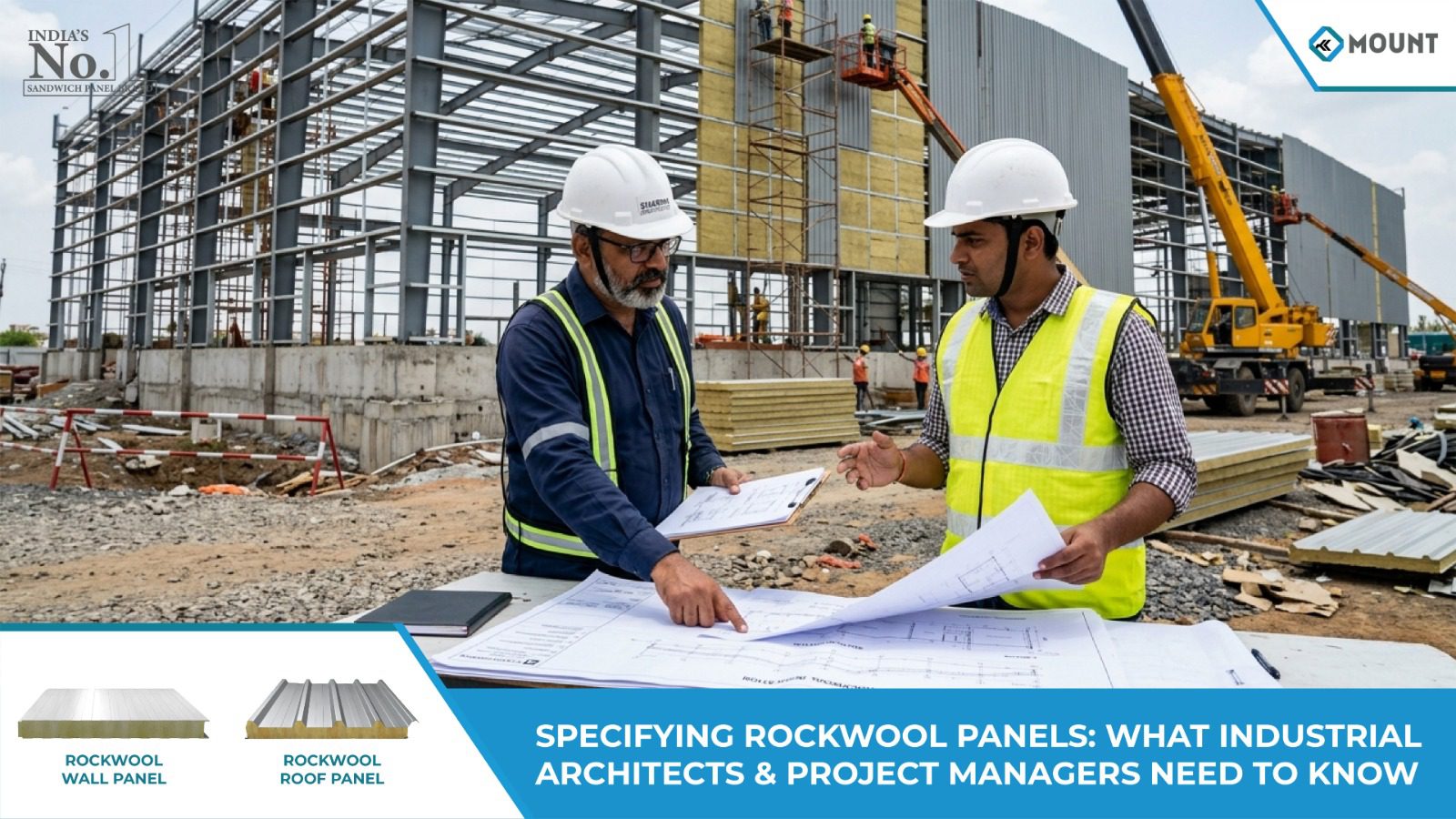
Specifying Rockwool Panels: What Industrial Architects and Project Managers Need to Know
Rockwool panels usually come into discussion when the project has tighter requirements , fire norms, thermal control, sometimes even noise issues. They’re not typically the first option on paper, but once performance starts driving decisions, they get specified more often.
That said, most issues with Rockwool panels don’t come from the material itself. They come from how it’s specified , or more accurately, how incomplete the specification is at the design stage.
What You’re Actually Working With
Rockwool is basically mineral wool made from basalt rock. The fibre structure is random, not directional, which is why it behaves consistently across the panel.
Unlike polymer cores, it doesn’t soften or collapse under heat. It holds form even at higher temperatures. That’s the main reason Rockwool Fire Rated Panels get used in industrial projects where fire containment matters.
But that property alone isn’t enough. The way the panel is built around that core , bonding, density, outer skin , makes a difference.
Fire Rating Isn’t Just a Number
On drawings, you’ll see fire ratings mentioned , 60 min, 120 min, sometimes more. But those ratings depend on the entire system, not just the core.
If you’re specifying Fire Rated Rockwool Sandwich Panels, you also need to look at:
- Core density consistency
- Panel thickness
- Joint sealing and overlap
A poorly sealed joint can compromise the rating, even if the panel itself meets standards.
This is where a lot of specifications fall short , they mention the panel, but not the system behaviour.
Thermal Performance , What Actually Changes
Rockwool doesn’t insulate the same way PUF or PIR does. It’s not about trapping gas , it’s about resisting heat flow through fibre structure.
So when you use Rockwool Insulated Panels, what you get is stability more than peak insulation performance.
In large industrial sheds, that matters. Temperature fluctuations reduce, especially under direct sun exposure. You won’t get extreme insulation values at low thickness, but you’ll get consistency.
From a project standpoint, that means fewer surprises in internal conditions.
Noise , Usually Ignored Until It’s Too Late
Most industrial projects don’t prioritise acoustics early on. It comes up later, once operations begin.
Rockwool handles sound differently. Instead of reflecting it, it absorbs it. That reduces echo and overall noise build-up inside the space.
If you’re dealing with machinery-heavy environments, specifying High Density Rockwool Panels can make a noticeable difference. Not dramatic, but enough to improve working conditions.
This is one of those decisions that’s easier to make at the design stage than to fix later.
Density vs Thickness , Not the Same Thing
This is where confusion usually happens.
Thickness affects thermal performance. Density affects fire and acoustic behaviour.
You can increase thickness and still have poor fire resistance if density is low. Similarly, increasing density won’t improve thermal performance beyond a point.
When specifying Rockwool Wall Panels, both need to be aligned with what the building actually needs , not just what’s available.
Over-specifying adds weight and cost. Under-specifying leads to performance gaps.
Outer Skin and Coating , Often Overlooked
The Rockwool core does its job internally, but the outer sheet takes the environmental load.
If the building is in a humid zone, industrial belt, or coastal area, coating selection becomes critical.
For Rockwool Roof Panels, UV exposure and corrosion are constant factors. Standard coatings may not hold up long-term in aggressive environments.
This is where you start seeing early surface deterioration , not because the panel failed, but because the coating wasn’t matched to the site.
Joint Detailing , Where Most Problems Start
Panels don’t usually fail in the middle. They fail at joints.
If the interlocking system isn’t specified clearly, or if installation isn’t precise, gaps start forming. Those gaps lead to thermal bridging, moisture entry, sometimes even air leakage.
Specifying the Best Rockwool Sandwich Panels won’t help if joint detailing is left open-ended.
You need clarity on:
- Joint profile
- Sealant type
- Fastening method
Otherwise, performance becomes inconsistent across the building.
Installation , Not Just Execution, But Control
Even with correct specifications, execution quality decides the outcome.
Panels need to be handled properly, aligned correctly, and sealed immediately after installation. Leaving them exposed, even briefly, can affect internal layers.
This is why projects that combine supply and installation tend to perform better. There’s less disconnect between design intent and actual execution.
Where Mount Adds Value
Mount typically gets involved at the stage where specifications need to be aligned with execution realities.
Instead of treating panels as standalone components, the approach is to look at how the entire system will behave , structure, panel, joint, and installation.
That reduces the usual gaps between what’s designed and what actually gets built.
For architects and project managers, it simplifies coordination. Fewer variables, fewer corrections later.
Final Thought
Rockwool panels work well when they’re specified with intent.
If the focus stays limited to “fire-rated panel,” a lot gets missed , density, joints, coating, installation.
But when those factors are considered together, the system performs the way it’s expected to.
And in industrial projects, that difference shows up over time , not immediately, but clearly.
FAQs
Q1: Are Rockwool panels always better than PUF or PIR panels?
A: Not always. They’re preferred where fire resistance and acoustics matter more than maximum thermal efficiency.
Q2: What density should be specified for Rockwool panels?
A: It depends on fire and acoustic requirements. Higher density improves both but increases weight.
Q3: Do Rockwool panels require special installation practices?
A: Yes, especially around joint sealing and handling to prevent moisture ingress.
Q4: Can Rockwool panels be used for both walls and roofs?
A: Yes, but roof panels require additional consideration for coating and exposure conditions.
Q5: Why do Rockwool panel systems sometimes underperform?
A: Usually due to incomplete specification , especially around joints, density, or installation quality.
Similar Events
 23 October, 2026