 Sep 16, 2026
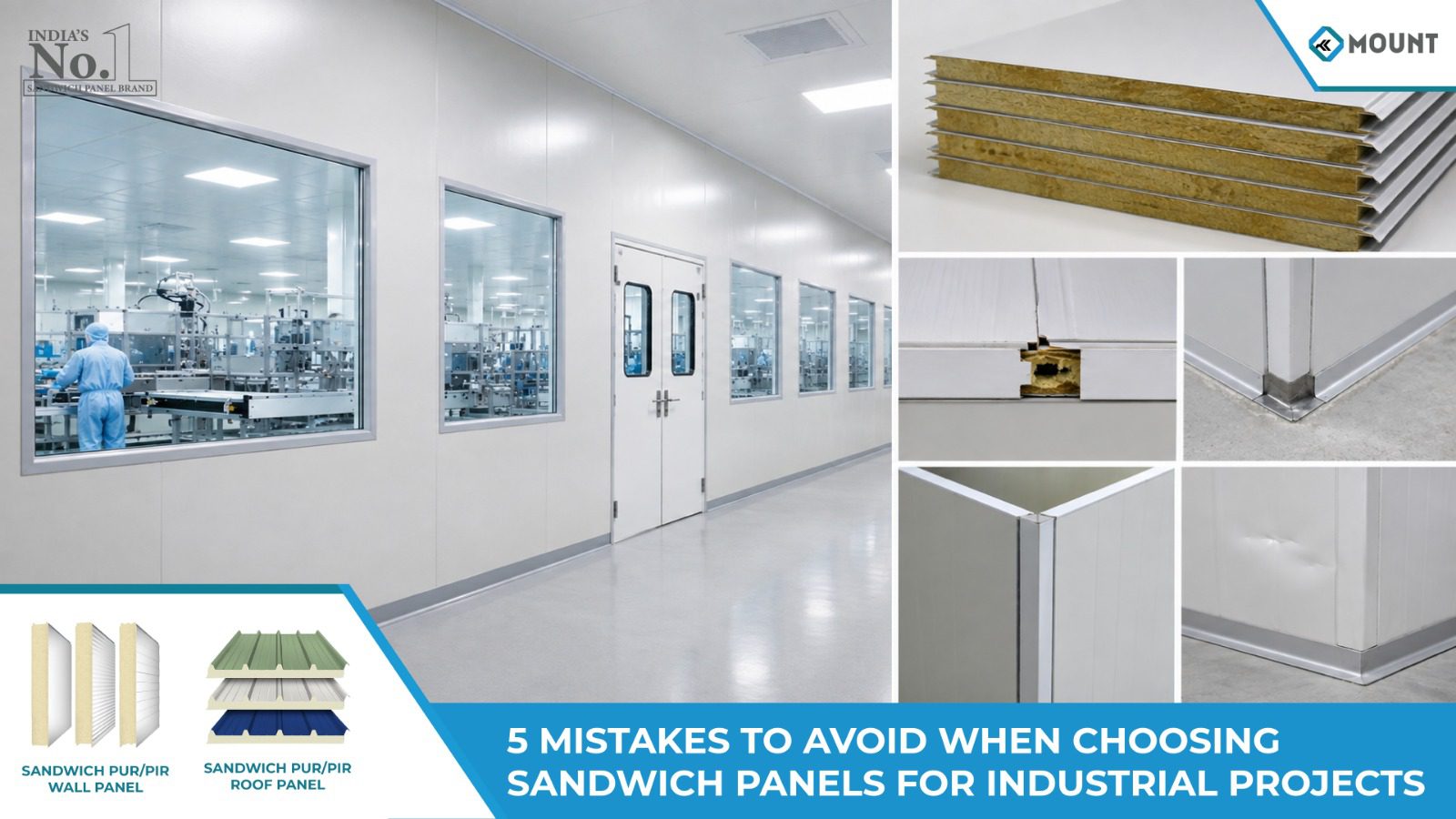
5 Mistakes to Avoid When Choosing Sandwich Panels for Industrial Projects
Choosing a sandwich panel for an industrial project involves considerably more than selecting a thickness and comparing prices. The panel becomes part of the building envelope, influencing thermal behaviour, fire safety, acoustic control, moisture management, installation, maintenance and the long-term operating environment. A specification that looks economical during procurement can create complications later if the panel has been selected without considering the actual requirements of the facility.
This becomes particularly important when projects involve large warehouses, manufacturing plants, food-processing facilities, cold rooms, clean rooms or other specialised industrial environments. Sandwich PUF Panels can provide an insulated building-envelope solution, while PIR and Rockwool systems address applications with different fire and performance requirements. The key is to select the panel around the building’s function rather than treating every project as the same application.
1. Choosing the Panel Before Defining the Building Requirement
One of the most common mistakes is starting with the product rather than the performance requirement. A warehouse, pharmaceutical facility and manufacturing plant may all require insulated panels, but their design criteria can be very different.
Thermal requirements, internal operating temperatures, fire classification, acoustic objectives, moisture exposure, hygiene requirements, structural conditions and expected maintenance practices should be established before the panel specification is finalised.
For example, PUF Panels for Industrial Roofing may be appropriate where thermal insulation and efficient roof enclosure are important, while a facility requiring a non-combustible insulated assembly may need a Rockwool solution. The selection should follow the application.
Mount’s panel portfolio includes PUF, PIR and Rockwool systems, allowing specifications to be developed according to the performance requirements of different industrial environments rather than applying one panel type universally.
2. Treating Thickness as the Only Measure of Performance
A thicker panel is not automatically the right panel. Insulation thickness needs to be evaluated alongside thermal conductivity, core properties, joint configuration, facing material, structural support conditions and the intended operating environment.
Mount’s PUF panels are available from 30 mm to 200 mm, with a documented core density range of 38–42 kg/m³ and thermal conductivity of approximately 0.022–0.028 W/m·K.
For PUF Panel Thickness, the appropriate specification should therefore be established through project-specific thermal calculations. Climate, HVAC requirements, internal heat loads and the desired indoor conditions all influence the final selection.
The same principle applies to PIR and Rockwool panels. Thickness should support the required thermal, fire or acoustic performance rather than becoming a procurement shortcut.
3. Ignoring Joints and Installation Details
A panel specification can be technically sound and still produce an underperforming envelope if the installation is poorly detailed. Panel joints, corners, flashings, fasteners, penetrations and interfaces with doors and other building components all influence the finished system.
For PUF Sandwich Roofing Panel systems, joint continuity is particularly important because the roof must manage both environmental exposure and water movement. Mount offers cam-lock and tongue-and-groove jointing configurations depending on the application.
The same attention is required for wall systems. Misalignment, inadequate sealing or incorrectly executed penetrations can affect air movement, moisture control and the continuity of the insulated envelope.
For EPC contractors, installation methodology should therefore form part of the technical evaluation before procurement rather than being left entirely to site execution.
4. Selecting a Panel Without Considering Fire and Acoustic Requirements
Another mistake is treating insulation as a purely thermal decision. Certain industrial buildings require additional attention to fire behaviour, while others need acoustic separation between operational zones.
Rockwool panels, for instance, use mineral wool cores that can provide non-combustible construction characteristics. Mount’s documented Rockwool range has an A1 classification under EN 13501 and an EI 60–EI 120 fire-resistance range, depending on the assembly.
Similarly, Rockwool Sandwich Panel systems can be considered where acoustic insulation forms part of the project requirement. Mount specifies an Rw sound-insulation range of 32–42 dB for its Rockwool panels, depending on configuration.
These properties should not be assumed from the product name alone. Consultants and project teams should review the relevant test data, assembly configuration and applicable project requirements before approval.
5. Evaluating Only the Price Per Square Metre
The lowest quoted panel price does not necessarily represent the lowest project cost. Industrial projects involve procurement, logistics, installation, quality control, maintenance and programme considerations. A panel supplier’s ability to manufacture and deliver the required quantity consistently can influence site productivity just as much as the initial material rate.
When evaluating PUF Panel Manufacturers & Suppliers Companies In India, project teams should examine manufacturing capacity, core-density control, dimensional consistency, facing options, technical documentation, quality processes, delivery capability and project support.
Mount operates continuous sandwich-panel manufacturing infrastructure covering PUF, PIR and Rockwool products, with a stated overall panel production capacity of up to 7,00,000 square metres per month across its sandwich-panel manufacturing operations.
For large industrial projects, this manufacturing scale can become relevant when significant panel quantities need to be produced and supplied within a defined construction programme.
The Right Panel Is a Project Decision
Choosing a sandwich panel should begin with the building’s operating requirements and work backwards toward the product specification. Thermal performance, fire behaviour, acoustic requirements, moisture exposure, panel thickness, joint configuration, structural conditions and installation methodology all need to be considered together.
This approach also allows different panel technologies to be specified where different areas of the same project require different characteristics. PUF can serve applications where thermal insulation is central, PIR can be considered where enhanced fire-related requirements influence the specification, and Rockwool can address applications requiring mineral-wool-based fire and acoustic characteristics.
Mount’s integrated manufacturing portfolio enables project teams to source these insulated panel systems through one established building-envelope manufacturer while maintaining application-specific specifications.
Why Mount for Industrial Sandwich Panel Requirements?
Mount combines continuous panel manufacturing with a broader building-solutions portfolio covering insulated panels, PEB structures and other roofing and building-envelope systems. Its manufacturing infrastructure and technical range allow project teams to approach panel selection through engineering requirements rather than a one-product-fits-all model.
For developers, consultants, EPC contractors and industrial procurement teams, the better question is not simply which sandwich panel costs less? It is which panel specification provides the required performance, can be manufactured consistently and can be executed correctly at project scale?
That distinction is what turns panel procurement into a building-envelope decision,and it is where Mount’s manufacturing and technical capabilities become valuable to industrial projects.
FAQs
Q. How should a sandwich panel be selected for an industrial project?
A. Start with the building’s thermal, fire, acoustic, structural, moisture and operational requirements. The panel type, thickness, facing and joint system should then be selected around those criteria.
Q. Is a thicker sandwich panel always better?
A. No. Thickness should be determined through the required thermal performance and project conditions. Core properties, joints, thermal bridges and installation quality also influence the finished envelope.
Q. When should Rockwool panels be considered?
A. Rockwool panels can be considered where non-combustible construction, fire resistance or acoustic insulation is an important part of the project requirement. The final selection should be based on the required tested assembly and applicable standards.
Q. Why are panel joints important?
Joints influence continuity of the insulated and weather-resistant envelope. Their geometry, sealing, alignment and installation directly affect the finished system’s performance.
Q. What should be evaluated when comparing sandwich panel manufacturers?
A. Project teams should look beyond price and review manufacturing capacity, core properties, dimensional consistency, facing specifications, joint systems, technical documentation, quality control, logistics and project support. For large projects, the supplier’s ability to maintain consistent production and meet the construction programme is particularly important.
Similar Events