 Sep 9, 2026
The Hidden Cost of Temperature Fluctuations in Cold Storage Facilities
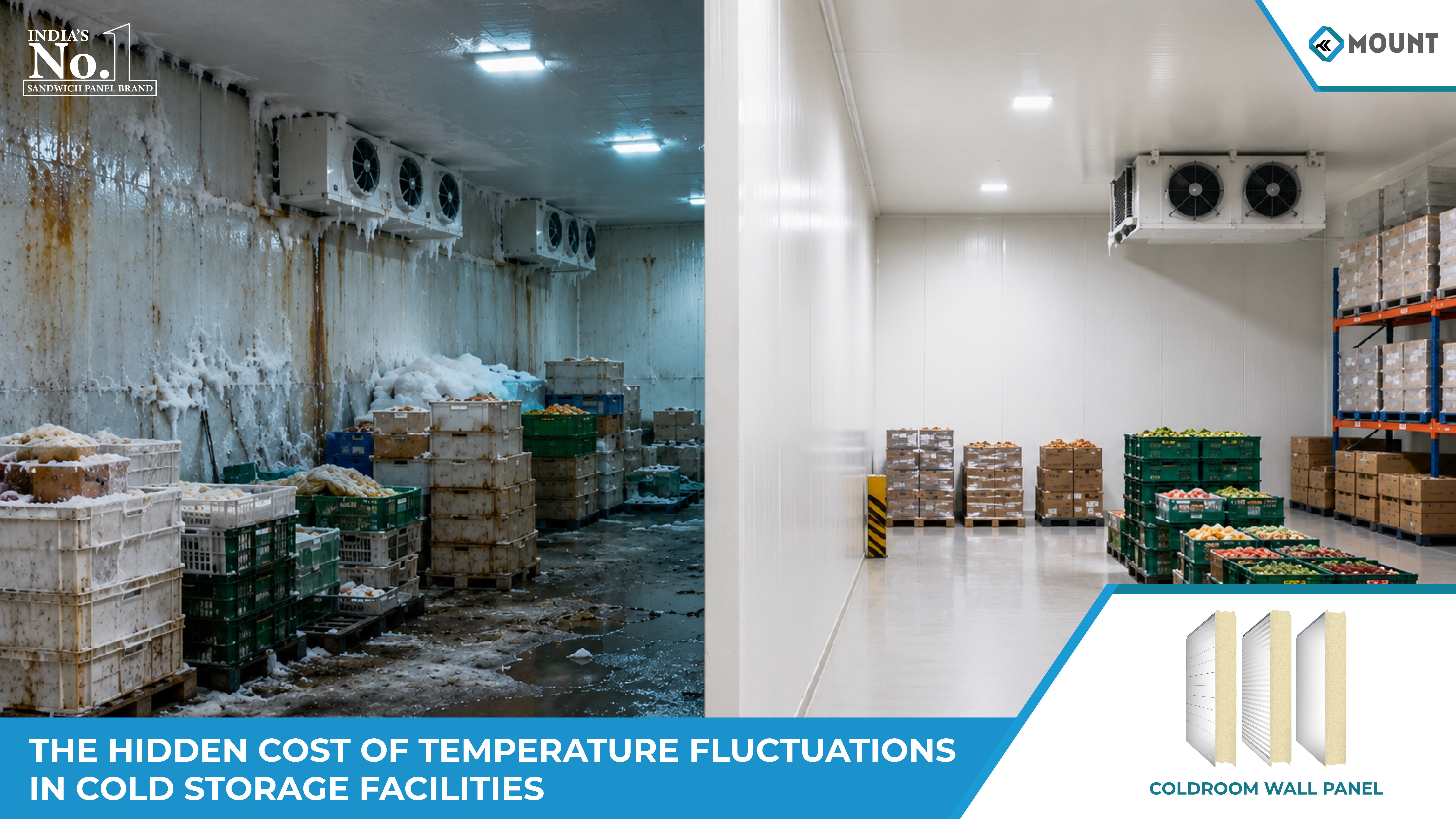
In a cold storage facility, temperature control is a process requirement, not simply an HVAC setting. A refrigeration system may be correctly sized and operated, yet the facility can still experience temperature variation when heat enters through inadequately insulated walls and roofs, air infiltrates through doors or joints, or moisture enters the refrigerated envelope. For facilities handling food, pharmaceuticals, agricultural produce and other temperature-sensitive products, these variations can affect more than the electricity bill.
The cost can appear across several areas: increased refrigeration demand, greater equipment runtime, product quality concerns, shorter shelf life, condensation-related maintenance and more demanding operating conditions. ASHRAE notes that refrigerated storage temperatures need to be accurately maintained for product quality and that heat leakage and infiltration form part of refrigeration load calculations.
Temperature Stability Starts With the Building Envelope
A cold room constantly works against the temperature difference between its controlled interior and the surrounding environment. Every part of the envelope that allows unwanted heat transfer increases the refrigeration system’s workload.
For cold storage panels, insulation thickness and thermal conductivity are therefore important design parameters. ASHRAE’s refrigerated-facility guidance shows that insulation resistance is a major component of wall and roof heat-transfer calculations and notes that thermal bridges can reduce the effective thermal resistance of an assembly.
The issue becomes more significant in facilities operating at lower temperatures. A freezer maintained well below 0°C has a substantially larger temperature difference with the ambient environment than a chilled storage room. The insulation system must therefore be selected according to the required operating temperature rather than applying one standard panel specification across every cold-storage application.
Where Temperature Fluctuations Come From
Temperature variation rarely has a single cause. Heat can enter through the roof and walls, while doors, service openings and poorly sealed interfaces can introduce warm ambient air directly into the refrigerated space. Frequent door opening is particularly important in loading and dispatch areas where products move continuously between storage and transport.
For cold storage PUF panels, the insulation core reduces conductive heat transfer through the envelope, but the complete system still depends on properly executed joints and openings. ASHRAE specifically identifies infiltration as a significant refrigeration load in food-processing and refrigerated facilities, particularly where outside air enters through loading areas or pressure imbalances.
This means a cold room specification should consider the panel, joint system, doors, penetrations, floor interfaces and installation methodology as one thermal envelope.
The Refrigeration Cost Is Only the Beginning
When additional heat enters a cold room, the refrigeration system must remove it. That can increase compressor and refrigeration-system operating requirements, depending on the size and nature of the load. But the operational implications can extend further.
Repeated temperature variation can affect product handling and storage conditions. ASHRAE notes that maintaining accurate product and air temperatures is important for storage quality and recommends monitoring temperatures at locations where undesirable highs or lows may occur.
For PUF panels for cold storage, the objective is therefore not simply to achieve a low internal temperature. The envelope needs to help the refrigeration system maintain that temperature consistently across the storage volume.
This is especially important for facilities where products remain in storage for extended periods. Food products, agricultural produce and pharmaceutical materials may each have defined storage requirements, making temperature stability a fundamental part of facility operation.
Insulation Thickness Must Match the Application
There is no universal panel thickness for every cold room. Required insulation depends on the target temperature, ambient conditions, room dimensions, refrigeration strategy and project design criteria.
Mount’s cold-room panel range is documented from 60 mm to 200 mm for temperature-controlled applications ranging from approximately +18°C to -40°C. This range allows the specification to be developed around the operating conditions rather than treating insulation as a fixed construction parameter.
For insulated panels for cold storage, thermal conductivity is another important consideration. A lower thermal conductivity generally indicates greater resistance to conductive heat flow for a given thickness, although the actual performance of the completed assembly depends on joints, thermal bridges, penetrations and installation quality. ASHRAE likewise notes that thermal bridges can reduce the effective resistance of insulated wall and roof assemblies.
Joints, Airtightness and Moisture Control Matter
A cold-room panel can have suitable insulation properties on paper while the finished envelope underperforms if joints are poorly executed. Gaps between panels, inadequately sealed penetrations and interfaces around doors can provide pathways for air infiltration.
This is why cold room panels should be installed with attention to joint continuity and airtight detailing. Mount’s panel range includes cam-lock or tongue-and-groove jointing configurations, depending on the panel application.
Moisture control is equally important. Warm, humid air entering a cold environment can lead to condensation when surfaces fall below the relevant dew point. Over time, uncontrolled moisture can create maintenance concerns and affect the condition of adjacent materials. Proper sealing, vapour-control detailing and installation supervision therefore form part of cold-room performance rather than being secondary finishing activities. ASHRAE guidance similarly emphasises sealing vapour-barrier penetrations to prevent moisture migration.
Mount Cold Room Panels for Controlled Environments
Mount manufactures insulated sandwich panels using continuous panel manufacturing infrastructure, with PUF panels produced using a rigid polyurethane foam core bonded between metal facings under controlled production conditions.
For cold storage roofing panels, this factory-manufactured construction creates a coordinated roof component in which the external facing and insulation core are produced as one panel system. The same principle applies to wall applications, helping project teams develop a continuous insulated envelope around the temperature-controlled space.
Mount’s documented applications include cold storage facilities, food and beverage processing, logistics centres, poultry and dairy facilities and other temperature-controlled industrial environments.
The panel specification can be developed around the required storage temperature, thickness, facing and joint configuration. Surface selection also needs to reflect the operating environment, cleaning requirements and exposure conditions of the facility.
Designing for Cold-Chain Performance
For cold chain insulation panels, performance needs to extend beyond the storage chamber itself. Receiving areas, processing rooms, ante-rooms, dispatch zones and refrigerated loading interfaces can all influence how effectively the facility maintains temperature.
Product movement is another consideration. Refrigeration load calculations need to account for product entering storage, including the heat that must be removed from incoming material. ASHRAE notes that non-uniform loading of warm products can create substantially greater short-term refrigeration loads.
This is where the panel system, refrigeration design and operating procedure need to work together. An insulated envelope cannot compensate for uncontrolled door operation or unsuitable product loading practices, but a properly engineered envelope can reduce one of the major pathways through which unwanted heat enters the facility.
Mount’s Manufacturing Capability for Cold Storage Projects
For cold storage construction panels, consistency across large quantities matters. A cold-chain project may require extensive wall and ceiling areas, multiple rooms and different temperature zones, making dimensional control and coordinated supply important to site execution.
Mount’s continuous panel manufacturing infrastructure has a stated overall sandwich-panel production capacity of up to 7,00,000 square metres per month across its PUF, PIR and solar profiled panel operations.
Mount combines this production capability with an integrated building-product portfolio and technical support for industrial projects. For cold storage developers, food processors, pharmaceutical facilities and logistics operators, the value is in specifying the insulated envelope around the actual operating requirement and then executing it with controlled manufacturing and coordinated project supply.
Temperature stability is ultimately a system-level outcome. Panel thickness, thermal properties, joints, doors, penetrations, refrigeration capacity and operating procedures all contribute. Mount Roofing & Structures brings the manufacturing infrastructure and panel range required to engineer that envelope around the temperature requirements of the facility.
FAQs
Q. How do temperature fluctuations increase cold-storage operating costs?
A. Temperature fluctuations can increase the refrigeration load because the system must remove additional heat entering through the envelope or through infiltration. The extent of the impact depends on the facility’s temperature, ambient conditions, product load, door activity and refrigeration system.
Q. What thickness of cold-room panel should be selected?
A. Panel thickness should be established from the required storage temperature, ambient conditions, thermal calculations, room configuration and project requirements. Mount’s documented cold-room PUF range extends from 60 mm to 200 mm for applications ranging from approximately +18°C to -40°C.
Q. Why are panel joints important in cold-room construction?
A. Joints need to maintain thermal and air-barrier continuity between adjacent panels. Poor joint execution can allow unwanted air movement and moisture infiltration, increasing the difficulty of maintaining stable internal conditions.
Q. Are PUF panels suitable for pharmaceutical cold-storage applications?
A. They can be considered where the panel specification, surface finish, temperature range, fire requirements, hygiene requirements and applicable facility standards are satisfied. Pharmaceutical applications should be specified according to the exact storage and regulatory requirements of the facility.
Q. What should a cold-storage project team evaluate before selecting panels?
A. The evaluation should cover operating temperature, insulation thickness, thermal conductivity, core properties, facing specification, joint configuration, airtightness, moisture control, cleaning requirements, installation methodology, technical documentation and manufacturer supply capability.
Similar Events