 Oct 16, 2026
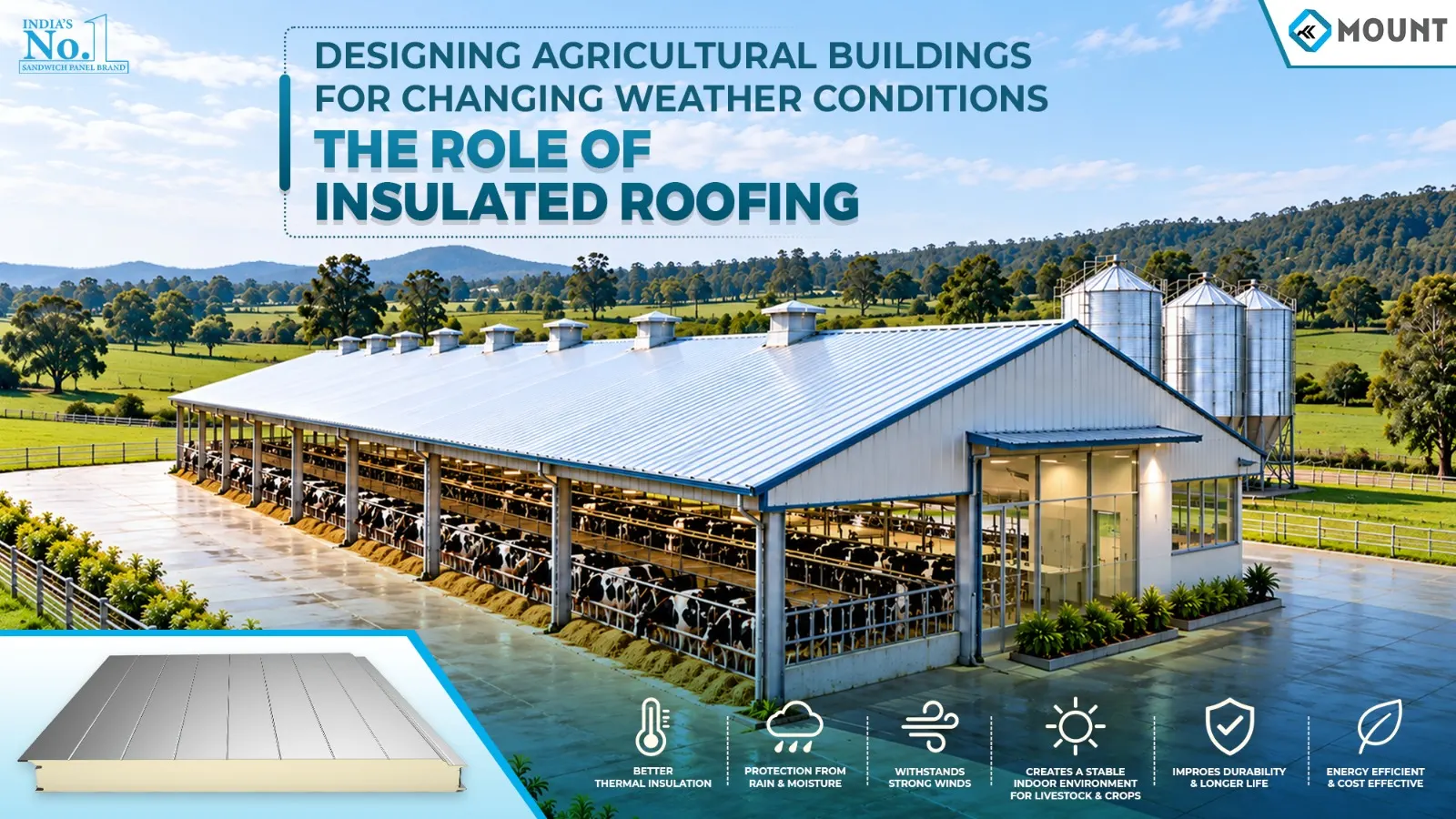
Designing Agricultural Buildings for Changing Weather Conditions: The Role of Insulated Roofing
Agricultural buildings operate in an environment where temperature, humidity, solar radiation and rainfall can change considerably across seasons. For poultry sheds, dairy facilities and agricultural processing spaces, the roof is one of the most exposed parts of the structure and plays an important role in controlling the internal environment.
Poultry, in particular, are sensitive to temperature and humidity fluctuations. FAO guidance identifies temperature, humidity and air movement as important elements of the physical environment for poultry housing, while Penn State Extension notes that heat stress can affect poultry health, feed consumption and production.
This makes roofing more than a weather barrier. The insulation strategy, ventilation system, wall construction and building orientation need to work together. Mount Roofing & Structures provides insulated Sandwich PUF Panels for agricultural structures, including poultry sheds and other temperature-sensitive applications.
Why Weather Conditions Matter in Agricultural Buildings
A poultry or dairy building has to manage heat from several sources: solar radiation through the roof, outdoor air temperature, heat generated by animals and, in some facilities, equipment and lighting.
During hot weather, excessive heat gain can increase the thermal load inside the building. In poultry houses, ventilation is particularly important because birds rely heavily on evaporative cooling and cannot regulate body heat through sweating. High humidity can further reduce the effectiveness of evaporative cooling.
At the other end of the range, poorly insulated buildings can experience rapid temperature changes when outdoor conditions become cooler. The objective, therefore, is not to seal the building completely but to create an envelope that limits unwanted heat transfer while allowing the designed ventilation system to control air quality, moisture and temperature.
The Roof: A Critical Part of the Building Envelope
The roof receives direct solar radiation and can become a significant source of heat gain. A conventional metal roof transfers heat more readily into the occupied space than an insulated roof assembly.
A Sandwich PUF Panel uses a rigid polyurethane foam core between metal facings. The insulated core provides thermal resistance, reducing the rate at which heat moves through the roof assembly.
Mount’s roofing panels are available in different thicknesses, allowing the specification to be matched to the requirements of the agricultural facility. Mount currently publishes PUF panel thickness options ranging from 20 mm to 200 mm across its sandwich-panel range.
The correct thickness, however, should be determined through the building’s thermal requirements rather than treated as a universal specification.
Insulation and Ventilation Must Work Together
Insulation and ventilation perform different functions.
Insulation slows heat transfer through the building envelope. Ventilation removes heat, moisture and unwanted gases while bringing in fresh air. In poultry buildings, ventilation also helps manage ammonia and carbon dioxide concentrations.
This distinction is important when designing agricultural buildings. Adding insulation does not remove the requirement for correctly designed ventilation. Similarly, relying entirely on ventilation to address solar heat gain can increase the amount of hot outdoor air entering the building.
A well-designed poultry or dairy facility therefore needs an appropriate balance between insulated roofing, wall construction, ventilation openings, exhaust systems, air movement and moisture management.
Why PUF Roofing Works for Poultry and Dairy Facilities
For agricultural structures, an insulated roof can help moderate the effect of external temperature fluctuations on the internal environment. This can be particularly relevant for enclosed poultry houses, dairy processing areas, milk storage spaces and agricultural warehouses.
Mount’s agricultural applications include poultry sheds and farm structures, while its broader panel portfolio is also used in food-processing and cold-storage environments.
For dairy facilities, insulation becomes especially relevant when the building contains milk reception, chilling, processing or refrigerated storage areas. Mount identifies insulated PUF panels as a solution for dairy infrastructure requiring thermal control and hygienic surfaces.
The specification should still be matched to the individual area. An animal housing shed, milk processing room and refrigerated chamber have very different environmental requirements.
Choosing the Right Wall and Roof Configuration
Roof insulation should not be considered independently from the walls. Heat can enter through both surfaces, and discontinuities at roof-to-wall interfaces can create weak points in the building envelope.
The Sandwich puf wall panel thickness should therefore be evaluated alongside roof-panel thickness, indoor temperature targets, external climate, ventilation strategy and the intended use of the facility.
Other details also matter:
- Panel joints and sealing
- Roof-to-wall connections
- Openings and ventilation systems
- Door and service penetrations
- Moisture and condensation control
- Surface finish and cleanability
- Structural and wind-load requirements
- Maintenance access
These details can influence the performance of the completed building just as much as the nominal insulation material.
Insulation for Food and Agricultural Processing Areas
Agricultural buildings increasingly connect primary production with processing, storage and distribution. Once milk, poultry products, food ingredients or other perishable materials enter a controlled processing environment, thermal and hygiene requirements become more demanding.
This is where food processing insulation panels can form part of an integrated building-envelope solution. The panel specification needs to account for temperature, humidity, cleaning requirements, surface finish and the operating environment.
Mount provides insulated panels across agricultural, food-processing, cold-storage and industrial applications, allowing the core, thickness and panel configuration to be considered according to the intended use.
When Should Rockwool Be Considered?
PUF is not the only insulation option for agricultural infrastructure. Facilities with elevated fire or acoustic requirements may also evaluate mineral-wool systems.
High Density Rockwool Panels can be considered where the project requires the characteristics associated with stone-wool insulation, particularly in areas where fire and acoustic performance are significant design considerations.
Similarly, Fire Rated Sandwich Panels should be selected based on the required classification and the tested panel assembly rather than simply the product name. The core, facings, thickness, joints and installation configuration all contribute to the final performance.
Why Choose Mount for Agricultural Building Solutions?
Agricultural construction requires a supplier that understands the relationship between the structure, envelope and operating environment.
Mount Roofing & Structures combines Sandwich PUF Panels with PEB and roofing solutions, enabling poultry, dairy and agricultural projects to coordinate structural and envelope requirements through one technical partner. Its published portfolio specifically includes agricultural structures and PUF panels for poultry sheds and related applications.
Mount also operates an automated continuous panel manufacturing line in Tumakuru, Karnataka, giving project teams access to a dedicated manufacturing capability for insulated sandwich panels.
Build for the Climate, Not Just the Structure
Changing weather conditions make thermal control an important consideration in agricultural building design. The right roof system can reduce unwanted heat transfer, while correctly designed ventilation manages air movement, moisture and indoor air quality.
For poultry and dairy facilities, Mount Sandwich PUF Panels provide an insulated building-envelope option that can be evaluated alongside the project’s ventilation, wall, structural and operational requirements.
The most effective agricultural building is not created by insulation alone. It comes from coordinating roofing, walls, ventilation, moisture management, structural design and the specific requirements of the animals, products and processes inside the facility.
FAQs
Q. How does insulated roofing help poultry buildings during hot weather?
An insulated roof reduces the rate of heat transfer from the external roof surface into the building. This can help moderate indoor thermal conditions, while ventilation and cooling systems continue to perform their separate functions.
Q. Does an insulated poultry shed still require ventilation?
Yes. Insulation and ventilation solve different problems. Ventilation is necessary for supplying fresh air and removing heat, moisture and gases such as ammonia and carbon dioxide.
Q. How should PUF panel thickness be selected for an agricultural building?
Thickness should be determined from the required thermal performance, local climate, indoor operating conditions, building orientation, ventilation strategy and the type of agricultural activity. Mount offers multiple panel thicknesses for different applications.
Q. Can PUF panels be used in dairy processing facilities?
Yes. Insulated PUF panels can be used in dairy processing and temperature-controlled areas where thermal insulation and suitable hygienic surfaces are required. Mount specifically positions its PUF panels for dairy processing, cold storage and related applications.
Q. Should agricultural buildings use PUF or Rockwool panels?
The choice depends on the building’s requirements. PUF can be evaluated where thermal insulation is the primary envelope consideration, while Rockwool may be considered where fire and acoustic requirements have greater importance. The final selection should be based on the complete building specification rather than insulation material alone.
Similar Events
 14 October, 2026