 Oct 12, 2026
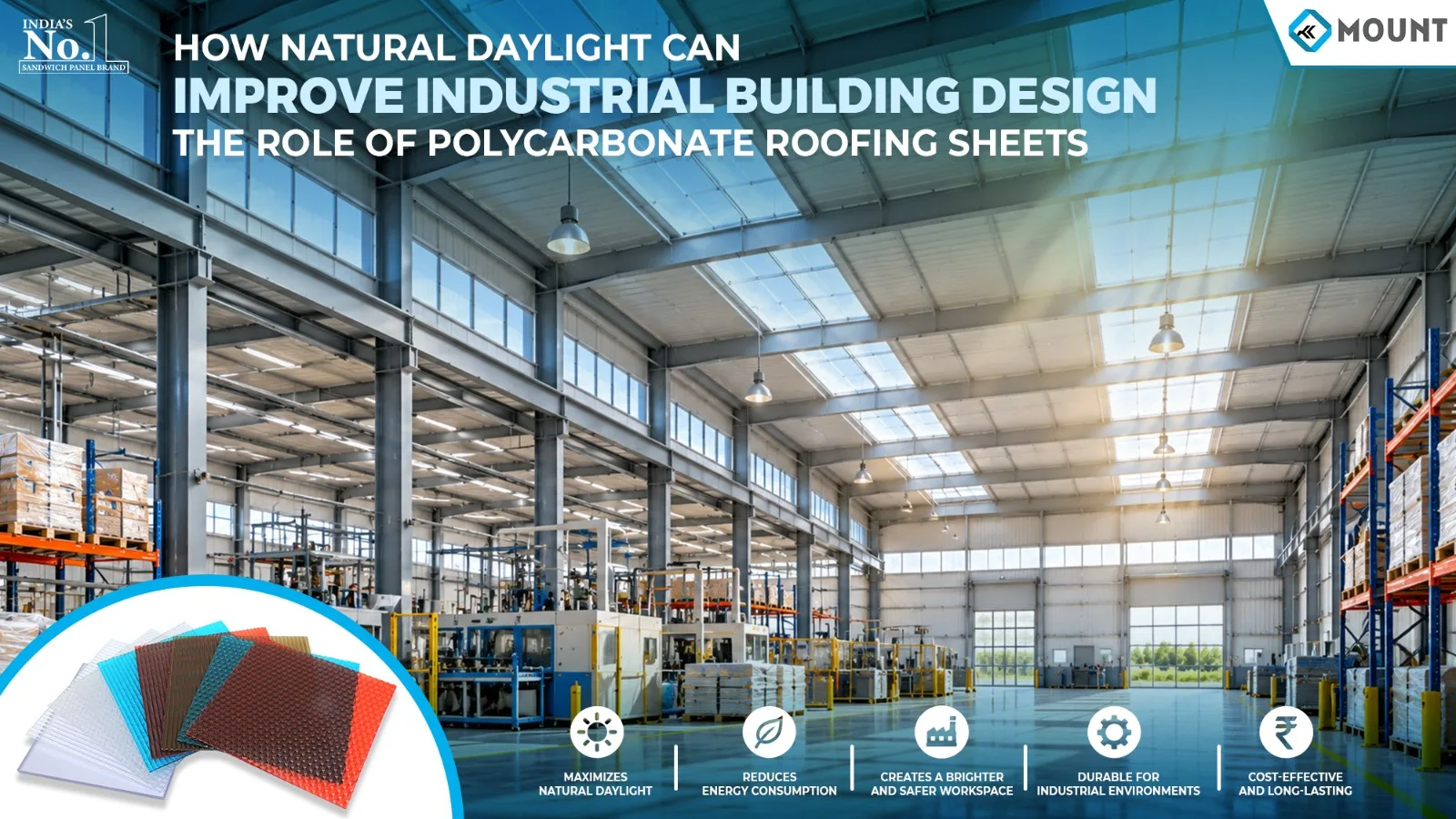
How Natural Daylight Can Improve Industrial Building Design: The Role of Polycarbonate Roofing Sheets
Natural daylight is often treated as an architectural feature, but in commercial and semi-open structures, it can also influence how a space functions throughout the day. A mall atrium, covered walkway, entrance canopy or industrial passage can feel significantly more open when daylight is incorporated into the roof rather than relying entirely on opaque overhead surfaces.
For project developers and consultants, the challenge is to introduce daylight without compromising weather protection, structural requirements or practical maintenance. This is where polycarbonate roofing becomes relevant. Unlike opaque roofing, translucent or transparent polycarbonate systems can allow controlled daylight into selected areas while providing an overhead barrier against rain and outdoor exposure.
Mount Roofing & Structures offers polycarbonate solutions under its Mount Lite range, including solid, multiwall, textured and corrugated variants for different architectural and roofing applications.
Daylight Should Be Designed, Not Simply Added
A well-designed daylighting strategy starts with understanding where natural light is actually required.
In a large commercial building, for example, the objective may be to bring daylight into an atrium, entrance zone or covered circulation area. In a walkway, the requirement may be more straightforward: provide weather protection while retaining a bright, visually open environment.
Installing translucent roofing across an entire structure is rarely necessary. A more controlled approach is to introduce daylight sections at selected locations within an otherwise conventional roof. This allows the project team to balance daylight transmission with solar exposure, thermal requirements, structural design and budget.
The position, size and orientation of each translucent section therefore become part of the roof design rather than an afterthought.
Why Polycarbonate Works for Daylighting Applications
Polycarbonate is a thermoplastic material that combines relatively low weight with impact resistance and light-transmitting properties. Depending on the product configuration, sheets can provide clear visibility or diffuse incoming light.
Mount’s range includes Solid Polycarbonate Sheets, which provide high light transmission and optical clarity, alongside textured variants designed to diffuse light and reduce glare. Multiwall sheets use internal cellular structures to provide a different combination of light transmission, weight and thermal behaviour.
That distinction matters in commercial design. A clear sheet may be appropriate where maximum transparency is required, while a diffused surface may be more suitable where direct glare or concentrated sunlight could affect occupants.
Malls and Commercial Spaces
Large commercial developments often contain areas where daylight can improve the visual character of the built environment without exposing occupants to outdoor conditions.
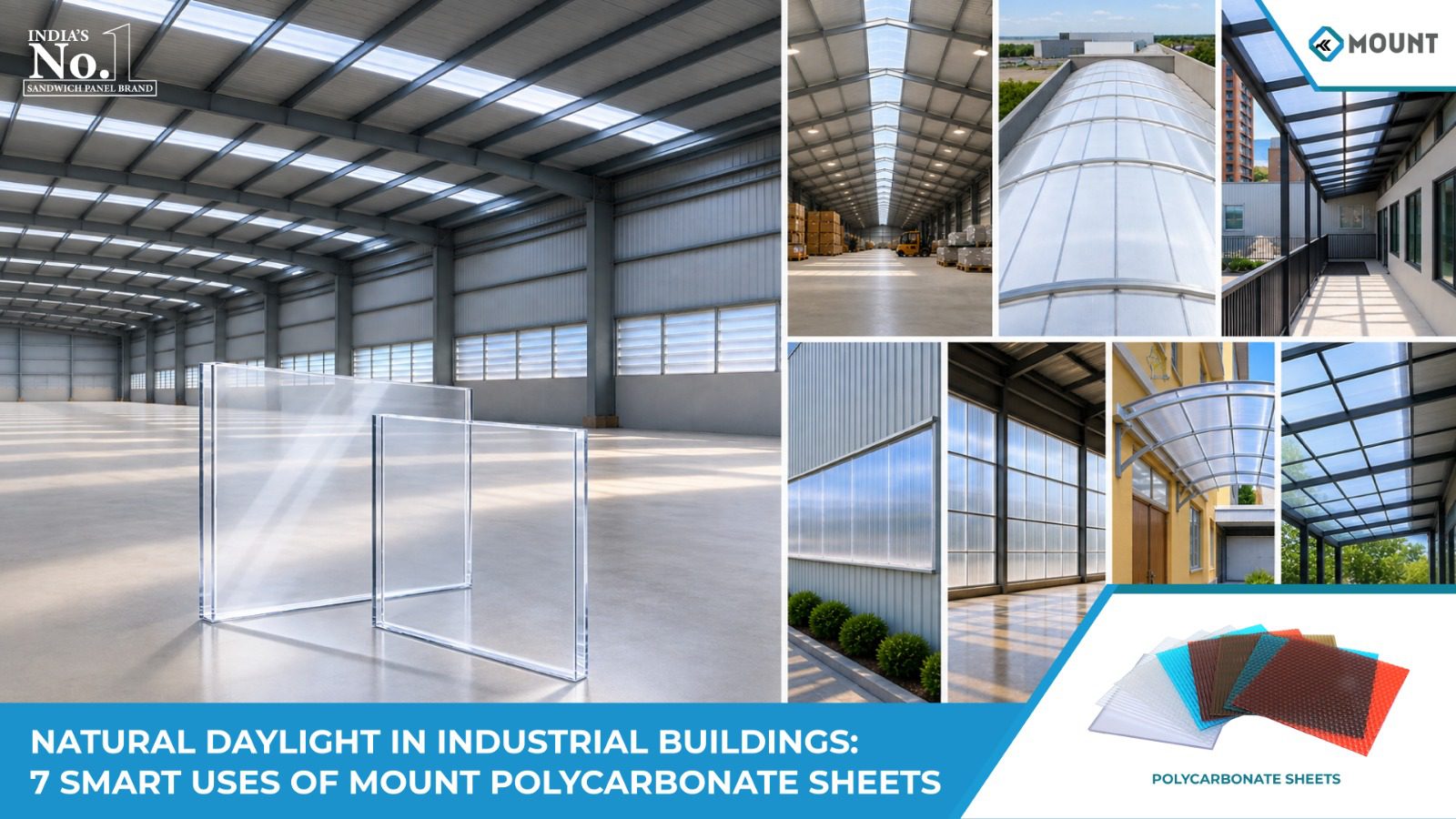
Atriums, entrance canopies, internal courtyards and covered retail circulation zones are examples where translucent roofing can introduce daylight from above. Mount lists mall atrium roof features, commercial applications and architectural glazing among its polycarbonate applications.
The engineering requirement changes according to the space. A large atrium roof may require careful consideration of structural spans, panel geometry and drainage, while a smaller entrance canopy may have a much simpler support arrangement.
For designers evaluating Transparent Roofing sheets, the important question is therefore not simply how much light the material transmits. The specification should also consider glare, heat gain, weather exposure, structural support and the intended visual effect.
Canopies and Light Coverings
Canopies are often expected to perform two functions at the same time: protect people from weather while keeping the space underneath bright and visually connected to its surroundings.
Polycarbonate can support this requirement because the roof itself can transmit daylight while acting as an overhead covering. Mount’s product information identifies outdoor structures, pergolas, carports and covered walkways among potential applications.
For a project such as a shopping-centre entrance canopy, the sheet profile and support structure need to be coordinated carefully. The design should account for drainage direction, sheet movement, fixing details and the loads acting on the canopy.
Covered Walkways Need a Different Daylighting Strategy
A pedestrian walkway does not require the same daylighting approach as a mall atrium.
Here, the objective is usually to create a continuous sheltered passage while maintaining adequate natural illumination during the day. Strategic use of translucent roofing can help achieve that without converting the entire walkway into a fully enclosed structure.
Corrugated polycarbonate sheets can also be integrated with compatible metal roofing profiles for daylight sections. Mount identifies corrugated polycarbonate sheets as a solution for skylight integration with metal roofing.
This approach can be particularly useful for long passages, factory walkways, warehouse connections and commercial access routes where complete transparency may not be required.
Billboards and Advertising Structures
Billboard structures present a different design requirement. The roof or covering may be intended primarily to protect equipment, service personnel or associated infrastructure rather than provide occupied indoor space.
Here, lightweight polycarbonate can offer a practical covering option where daylight transmission or visual openness is desirable. The support frame, fixing arrangement and sheet configuration should be engineered according to the dimensions and exposure of the structure.
Because billboard installations can have relatively exposed locations, wind loading and secure fixing become particularly important. The sheet selection should therefore be coordinated with the supporting framework rather than treated as an independent material choice.
Choosing Between Clear, Textured and Multiwall Sheets
The term polycarbonate roofing covers several distinct product configurations.
Clear sheets prioritise transparency and visual openness. Textured or embossed surfaces can diffuse incoming light, helping distribute illumination more evenly and reducing glare. Multiwall construction introduces internal air chambers, changing the sheet’s thermal and weight characteristics.
Mount offers multiwall and solid polycarbonate solutions, along with textured and corrugated options for different applications.
A project looking for the Best Multiwall Polycarbonate Sheets For Greenhouses, for example, has a different technical requirement from a mall entrance canopy or a transparent walkway. Application conditions should determine the sheet configuration rather than using one specification across unrelated projects.
Strategic Daylighting With Conventional Roofing
One of the practical advantages of polycarbonate roofing is that it does not require an entire roof to become translucent.
Imagine a warehouse with an otherwise conventional metal roof. Instead of replacing the complete roof, selected roof bays can incorporate compatible translucent panels. Daylight can then enter through predetermined zones while the majority of the roof retains its conventional construction.
This approach allows designers to establish a daylighting ratio suited to the building and its operating conditions. The exact proportion should be determined through architectural, structural and environmental analysis rather than a universal rule.
For industrial facilities, such an arrangement can also simplify the concept of daylighting: conventional roofing provides the primary roof surface, while polycarbonate sections perform the targeted daylighting function.
Installation Is Part of the Design
Polycarbonate performance depends on more than the sheet itself. The supporting structure, purlin or framing arrangement, fixing system, clearances, overlaps and drainage details all need to be considered during installation.
Thermal movement is particularly relevant because thermoplastic sheets can expand and contract with temperature changes. Installation details therefore need to follow the manufacturer’s requirements for fixing and movement allowances.
A technically suitable sheet can still perform poorly if it is incorrectly fixed, inadequately supported or installed without sufficient provision for movement.
A More Integrated Approach to Daylight Design
Mount’s position as an integrated roofing and structural solutions provider allows polycarbonate daylighting to be considered alongside the wider building envelope. The company supplies PUF panels, PEB structures, roofing systems, uPVC roofing and polycarbonate products, enabling project teams to coordinate different components of a building rather than specifying each element in isolation.
For architects, developers and contractors, this becomes particularly useful when a project combines opaque roofing with translucent daylighting sections. The interface between the two systems needs to be considered from the beginning.
Why Choose Mount Polycarbonate Solutions?
A successful daylighting system is not defined by transparency alone. It needs to balance light transmission, weather protection, structural compatibility, thermal behaviour, appearance and installation requirements.
As a Polycarbonate Roofing Sheets Manufacturer, Mount provides multiple configurations under its Mount Lite range, including solid, multiwall, textured and corrugated sheets. Its product portfolio is intended for applications ranging from industrial skylights and roofing to canopies, walkways, commercial spaces and architectural features.
For projects where daylight needs to be introduced without abandoning practical roof design, Mount can support the selection of a polycarbonate solution based on the application’s structural and architectural requirements.
Designing With Daylight in Mind
Natural daylight can change how commercial and semi-open spaces look and function, but effective daylighting requires more than choosing a transparent material.
The right sheet profile, translucency, location, support arrangement and installation detail all contribute to the final result. Whether the application is a mall atrium, entrance canopy, billboard structure or covered walkway, the goal should be controlled daylight combined with dependable weather protection.
Mount Polycarbonate Sheets provide a versatile option for projects where lightweight covering, daylight transmission and architectural flexibility need to work together.
FAQs
Q. Are clear polycarbonate sheets always better for maximum daylight?
Not necessarily. Clear sheets provide high optical clarity, but textured or diffused sheets can distribute daylight more evenly and reduce glare. The appropriate choice depends on the application’s visual and environmental requirements.
Q. Can polycarbonate sheets be installed together with conventional metal roofing?
Yes. Corrugated polycarbonate sheets can be used as selected daylighting sections within compatible roofing systems. This allows project teams to introduce daylight in specific roof areas instead of replacing the complete roof.
Q. What should be checked before specifying polycarbonate for a walkway canopy?
The design should consider span, support spacing, wind exposure, sheet profile, fixing arrangement, drainage and thermal movement. The structural frame and sheet system should be designed to work together.
Q. What is the difference between solid and multiwall polycarbonate sheets?
Solid sheets provide a continuous panel with high transparency and impact resistance, while multiwall sheets contain internal chambers that reduce weight and provide additional thermal insulation characteristics. The selection should be based on the application’s daylighting, structural and thermal requirements.
Q. Can polycarbonate roofing be used for mall atriums and covered commercial spaces?
Yes. Polycarbonate is used in architectural and commercial applications where daylight transmission, weather protection and lightweight construction are required. Mount specifically lists mall atrium roof features and commercial applications within its polycarbonate portfolio.
Similar Events
 10 October, 2026