 Oct 10, 2026
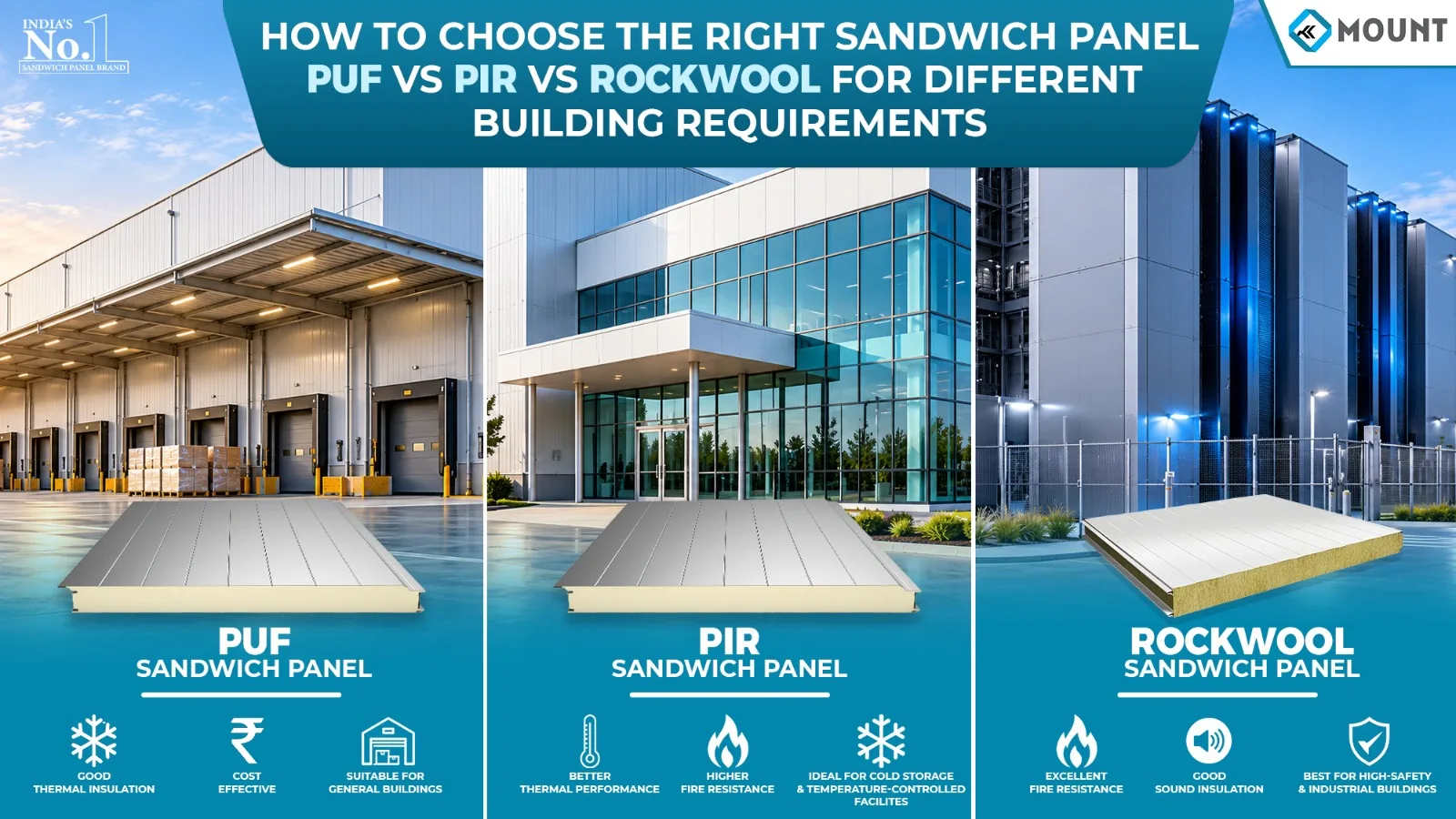
How to Choose the Right Sandwich Panel: PUF vs PIR vs Rockwool for Different Building Requirements
Selecting an insulated sandwich panel is a technical decision that directly affects a building’s thermal environment, fire performance, acoustic conditions and operating efficiency. For industrial and commercial projects, the right specification depends on what the building needs to achieve rather than simply selecting a panel based on initial cost.
Mount Roofing & Structures provides PUF Sandwich Panel, PIR and Rockwool solutions for different building-envelope requirements, allowing project teams to evaluate the insulation core against the application, operating conditions and performance priorities.
What Determines the Right Sandwich Panel?
A sandwich panel consists of metal facings bonded to an insulation core. While the outer sheets provide protection and contribute to the panel’s structural characteristics, the core material largely determines its thermal, fire and acoustic behaviour.
For a project engineer or procurement team, key considerations include:
- Required thermal insulation and temperature control
- Fire-resistance requirements
- Internal noise levels and acoustic separation
- Operating temperature and environmental exposure
- Panel thickness and required U-value
- Building use and hygiene requirements
- Installation and jointing details
- Applicable project specifications and certifications
This is why PUF, PIR and Rockwool panels should be assessed against the actual building requirement rather than treated as interchangeable products.
PUF Sandwich Panels: Thermal Insulation for Controlled Environments
A PUF Sandwich Panel uses rigid polyurethane foam as its insulation core. Its low thermal conductivity makes it suitable where maintaining a controlled internal temperature is a major design objective.
PUF panels are widely considered for warehouses, cold-storage facilities, industrial buildings, food-processing areas and commercial spaces where thermal insulation and efficient construction are important. Mount’s PUF panels are manufactured as insulated composite building elements for roof and wall applications, with specifications selected according to the project requirement.
For cold-chain applications, the panel thickness, joint configuration, refrigeration load, internal temperature and ambient conditions need to be considered together. Simply increasing panel thickness without evaluating the complete building envelope does not automatically produce the required thermal performance.
For businesses seeking a PUF Panel Supplier, the focus should therefore extend beyond material availability to manufacturing consistency, dimensional accuracy, panel specification and technical support.
PIR Sandwich Panels: When Fire Performance Becomes a Key Design Parameter
PIR, or polyisocyanurate, is chemically related to polyurethane but has a different polymer structure and is commonly specified where improved fire performance is required alongside thermal insulation.
PIR Insulated Panels can be considered for facilities where thermal control remains important but fire-performance requirements carry greater weight. Depending on the complete panel construction, thickness, joint design and tested assembly, PIR systems can achieve specified fire classifications.
For pharmaceutical facilities, data-related infrastructure, industrial buildings and other controlled environments, project teams may evaluate PIR Sandwich Panels where the specification calls for a balance of thermal insulation and enhanced fire performance.
However, fire classification should never be assumed from the core material alone. Certified Fire Rated PIR Panels must be assessed using the applicable tested system, including the facings, joints, thickness and installation configuration.
Rockwool Sandwich Panels: Fire and Acoustic Requirements
Rockwool, or stone wool, provides a different performance profile. The material is non-combustible and is widely used in sandwich-panel systems where fire protection and acoustic performance are important design considerations. ROCKWOOL documentation identifies stone wool as non-combustible and highlights its thermal, fire and acoustic properties in sandwich-panel applications.
Rockwool Fire Rated Panels are therefore particularly relevant to industrial facilities, manufacturing units, commercial buildings and projects where fire compartmentation or enhanced fire performance is part of the building specification.
Acoustics can also influence the decision. The fibrous structure of stone wool can contribute to sound absorption and noise reduction, making Rockwool Insulated Panels useful for buildings exposed to machinery, production processes or other significant noise sources.
Where the project requires greater mechanical, acoustic or fire performance, engineers may evaluate High Density Rockwool Panels with the required density and tested assembly rather than selecting a panel solely by nominal thickness.
PUF vs PIR vs Rockwool: How Should You Decide?
| Requirement | PUF | PIR | Rockwool |
| Thermal insulation | Strong consideration for temperature-controlled buildings | Strong thermal performance with fire-performance advantages | Good thermal insulation |
| Fire performance | Must be evaluated against the complete tested assembly | Often selected where enhanced fire performance is required | Non-combustible core; strong fire-performance option |
| Acoustic requirements | Application dependent | Application dependent | Particularly suitable where acoustic control is important |
| Cold storage | Commonly considered | Can be evaluated where project specifications require it | Generally selected when fire/acoustic priorities outweigh thermal optimisation |
| Warehouses | Suitable depending on thermal requirements | Suitable where additional fire performance is specified | Suitable where fire and acoustic requirements are significant |
| Food processing | Suitable for controlled environments | Suitable where thermal and fire requirements demand it | Suitable where fire and acoustic performance are priorities |
| Pharmaceutical facilities | Suitable for controlled environments | Suitable where fire-performance requirements are elevated | Suitable where fire, acoustic and compartmentation requirements are important |
| Industrial facilities | Widely applicable | Useful for projects with enhanced fire requirements | Strong option for fire and acoustic requirements |
The table is a selection framework rather than a universal specification. Actual performance depends on panel thickness, density, facings, joints, installation quality and the tested/certified assembly.
Why Core Material Should Be Selected at the Design Stage
Choosing the insulation core after the building design is finalised can create avoidable compromises. Thermal requirements influence panel thickness and HVAC loads, while fire requirements can affect wall and roof assemblies, compartmentation and compliance documentation.
The operating environment matters just as much. A cold-storage facility has different requirements from a general warehouse, while a pharmaceutical production area may require controlled environmental conditions and specific hygiene considerations.
For this reason, Mount approaches sandwich panels as a building-envelope solution rather than a commodity sheet. Its portfolio includes PUF, PIR and Rockwool panel options, enabling project teams to evaluate different core materials against the intended application.
Why Choose Mount Roofing & Structures?
For industrial and commercial construction, panel selection is only one part of the process. Specification support, manufacturing capability, dimensional consistency, supply coordination and installation requirements also influence project outcomes.
Mount Roofing & Structures brings PUF, PIR and Rockwool sandwich-panel options under one product portfolio, enabling businesses to work with a single source while selecting the core appropriate to their building requirements. Its broader offering also includes PEB and other building-envelope products, supporting coordinated construction requirements.
Instead of asking which panel is universally better, project teams should ask: What thermal, fire, acoustic and operating requirements does this building need to meet? That question provides a more reliable basis for selecting the right sandwich-panel system.
FAQs
Q. Is PUF suitable for cold-storage construction?
PUF can be considered for cold-storage applications because of its thermal insulation properties. However, panel thickness, joint design, refrigeration requirements, internal temperature and ambient conditions should be evaluated together before final specification.
Q. When should a project consider PIR instead of PUF?
PIR may be evaluated when a project requires thermal insulation together with enhanced fire-performance characteristics. The final decision should be based on the tested panel assembly and the fire classification required by the project specification.
Q. Are Rockwool panels suitable for industrial buildings with high noise levels?
Yes. Rockwool’s fibrous structure can provide sound absorption and contribute to acoustic control, while its non-combustible characteristics make it suitable for applications where both fire and acoustic performance are important.
Q. Does panel thickness alone determine insulation performance?
No. Thermal performance depends on several factors, including core material, thickness, thermal conductivity, joints, installation and the overall building-envelope design. The required U-value should be considered when selecting the panel specification.
Q. Can one manufacturer supply PUF, PIR and Rockwool panels for different areas of the same project?
Yes. A building may use different panel specifications depending on the requirements of individual zones. Mount Roofing & Structures offers PUF, PIR and Rockwool sandwich-panel options, allowing project teams to evaluate the appropriate core for different building applications.
Build around the requirement, not the material name. With Mount Roofing & Structures, businesses can evaluate PUF, PIR and Rockwool sandwich-panel solutions against the thermal, fire, acoustic and operational requirements of the project before finalising the building envelope.
Similar Events
 25 September, 2026