 Sep 7, 2026
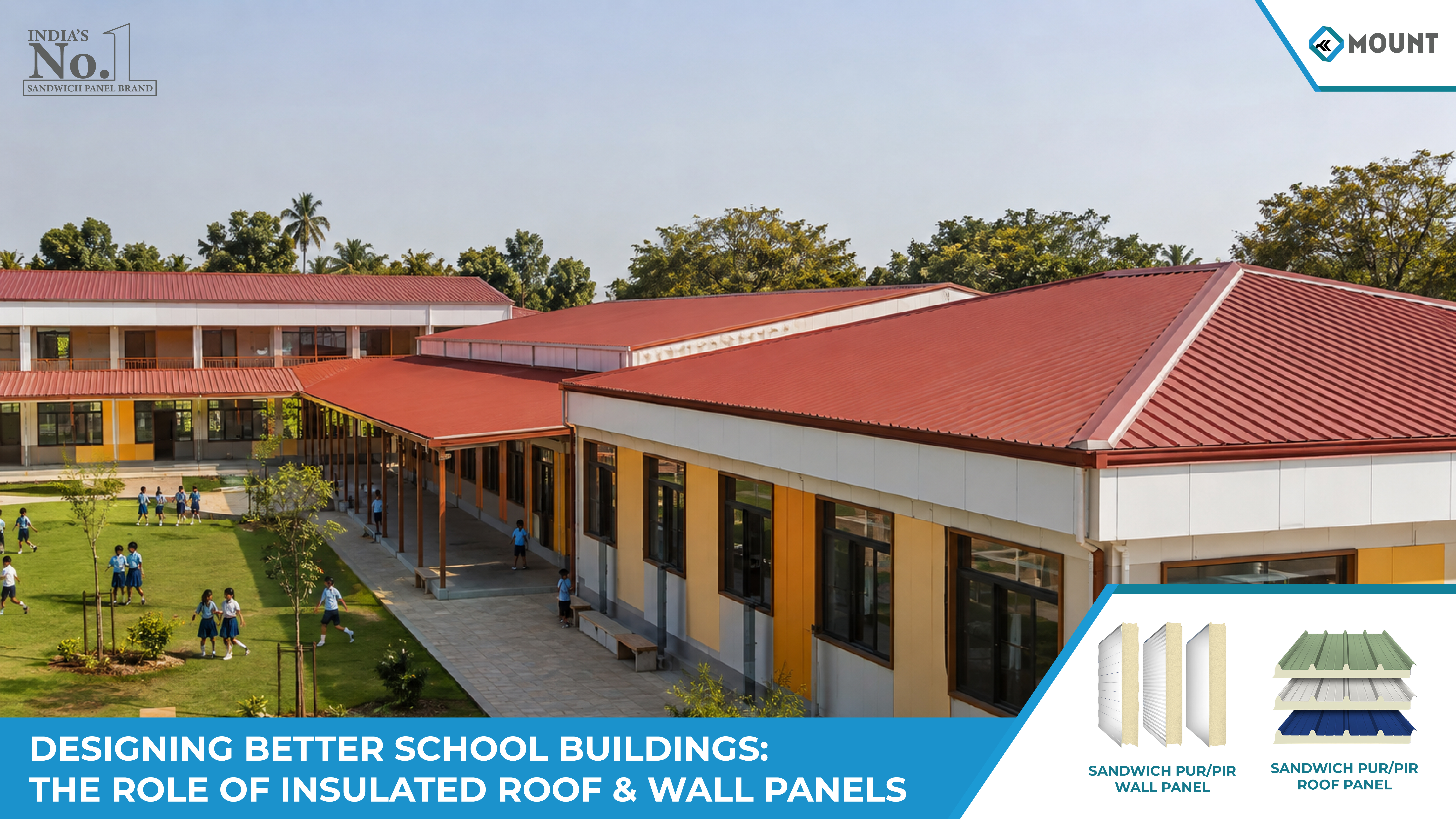
Designing Better School Buildings: The Role of Mount Insulated Roof & Wall Panels
A school building has to perform consistently through long operating hours, changing weather conditions and continuous occupancy. Classrooms, laboratories, auditoriums, administrative blocks and common areas each place different demands on the building envelope. Heat entering through the roof can affect indoor comfort, external noise can interfere with teaching, and inadequate fire protection can create unacceptable risks in a densely occupied environment.
For architects, consultants and institutional project teams, this makes the selection of PUF Sandwich Panel systems a design decision rather than simply a material choice. An insulated roof or wall can combine thermal control, weather protection and construction efficiency within a factory-manufactured building component. Where fire resistance and acoustic control have greater importance, mineral wool-based systems provide another engineered option. The objective is to match the panel system to the function of each part of the campus.
Why the Building Envelope Matters in Educational Infrastructure
Educational buildings operate differently from many commercial structures. Occupancy is concentrated during defined hours, classrooms may accommodate groups of students simultaneously, and spaces such as laboratories and computer rooms can have specific environmental requirements. In warm climates, solar exposure through extensive roof areas can increase indoor heat gain and place additional demand on ventilation or air-conditioning systems.
Monsoon conditions introduce another consideration. Roof and wall assemblies need to manage rainwater effectively through appropriate slopes, flashings, joints, sealants and drainage detailing. The panel itself forms only one part of the complete weather-resistant envelope.
PUF Wall Panel systems can be used where insulated wall construction is required as part of an institutional building envelope. Mount’s PUF panels use a rigid polyurethane foam core bonded between steel facings and are manufactured in thicknesses ranging from 30 mm to 200 mm.
Thermal Comfort and Energy Management
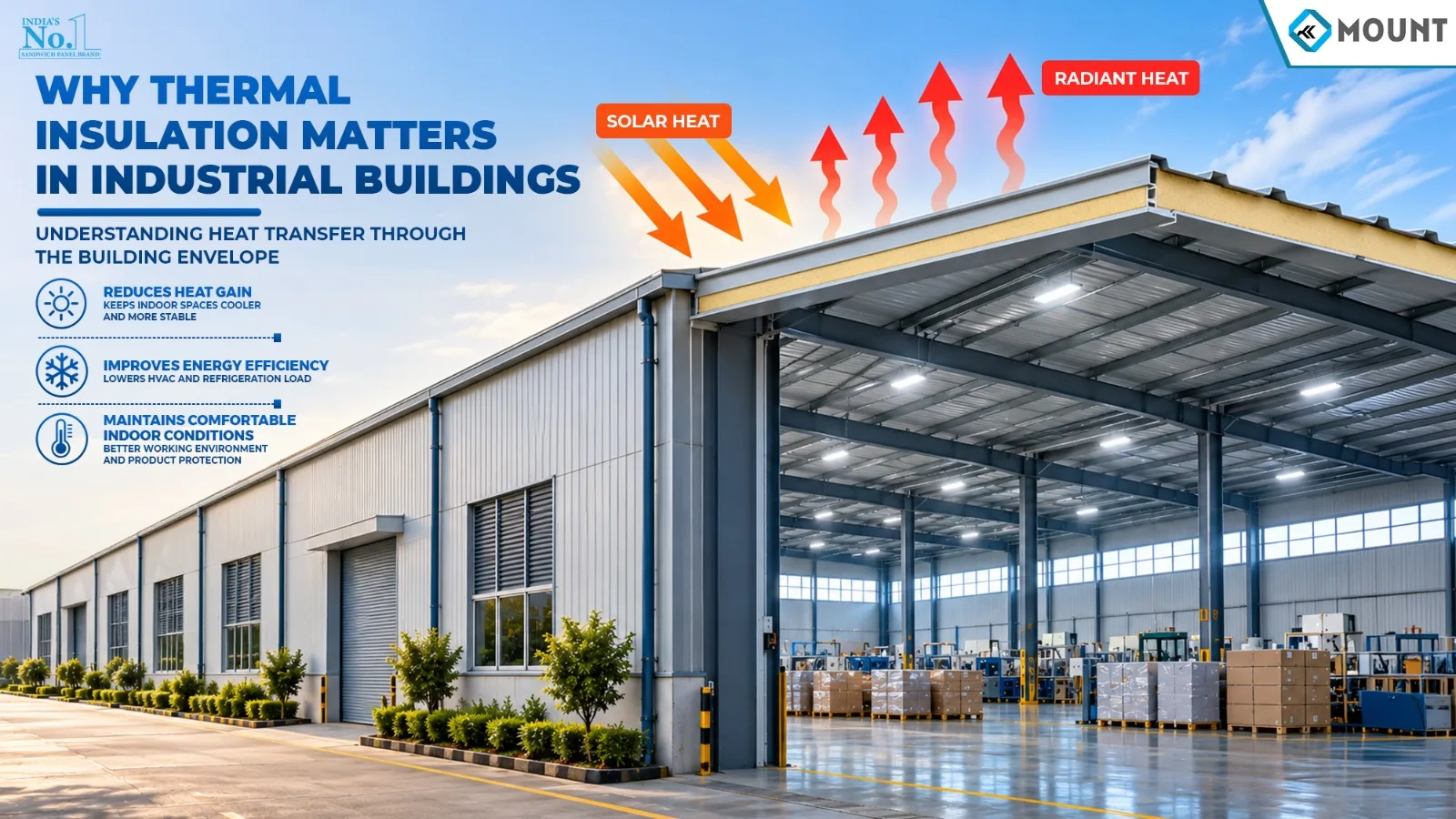
A comfortable classroom is not created by HVAC equipment alone. The roof, walls, glazing and other envelope elements determine how much heat enters or leaves the building. Effective insulation reduces conductive heat transfer and can help HVAC systems maintain the required indoor conditions more efficiently.
This makes Insulated roofing sheet manufacturers relevant during the early design stage of school projects. Panel thickness should be selected based on climate, indoor temperature requirements, building orientation, HVAC strategy and the thermal performance required from the overall envelope.
Mount’s PUF panels have a stated thermal conductivity range of 0.022–0.028 W/m·K, with controlled core density of 38–42 kg/m³. The appropriate specification still needs to be established through project-specific thermal calculations rather than relying on a generic panel thickness.
Acoustic Control for Classrooms and Shared Spaces
Noise management becomes particularly important in educational buildings. Sound from corridors, adjacent classrooms, playgrounds, mechanical equipment and external traffic can affect concentration and communication. Laboratories and auditoriums can have additional acoustic requirements depending on their use.
This is where Rockwool Panels can be considered for applications where acoustic performance needs to be addressed alongside fire and thermal requirements. Mineral wool cores provide sound insulation characteristics, while the complete wall or roof assembly determines the final acoustic result. Industry guidance confirms that stone wool sandwich panels can be used for walls, roofs, partitions and acoustic applications, with acoustic performance depending on the designed assembly.
Mount’s Rockwool sandwich panels are specified with an Rw sound insulation range of 32–42 dB and are available in thicknesses from 50 mm to 200 mm.
Fire Safety Needs to Be Designed Into the Envelope
Schools and institutional buildings have a large number of occupants, making passive fire protection an important consideration in wall and roof specification. Material selection should therefore be based on the required fire classification and tested assembly rather than on product terminology alone.
Mount’s Rockwool panels use a stone wool core with a documented fire resistance range of EI 60 to EI 120 and A1 non-combustible classification under EN 13501, subject to the relevant assembly configuration. This makes them suitable for applications where the building design calls for non-combustible insulated panel construction.
Fireproof PUF Panel requirements should similarly be evaluated against the exact application, applicable standards and tested system. Fire performance is an assembly-level consideration involving the core, facings, joints, fixings and supporting construction.
Faster Construction for New Campuses and Expansions
Educational projects often involve phased construction: new classroom blocks, laboratories, administrative buildings, sports facilities or additional campus wings may need to be completed while existing operations continue. Factory-manufactured panels can simplify installation because the insulation and metal facings arrive as a coordinated component rather than as multiple separate layers.
Mount manufactures insulated panels using continuous panel manufacturing infrastructure. Its PUF, PIR and Rockwool product lines form part of a broader building-envelope manufacturing ecosystem, allowing project teams to coordinate panel requirements with other building components.
For PUF Panels for Warehouses, the same principle applies to large industrial buildings, although educational projects require the specification to be adapted to classrooms, laboratories and occupied institutional spaces rather than simply transferring an industrial standard.
Selecting PUF and Rockwool Around the Application
Different areas within a school campus can have different performance requirements. PUF sandwich panels can be specified where thermal insulation, weather protection and efficient enclosure are central requirements. Rockwool systems can be considered for areas where fire resistance and acoustic control require greater emphasis.
The objective is not to establish one panel as universally preferable. Instead, PUF Panel Thickness and Rockwool panel thickness should be determined from the performance criteria of each building zone, including thermal calculations, fire requirements, acoustic objectives, structural conditions and installation details.
For example, a classroom block may require strong thermal control and controlled external noise, while an auditorium may place greater emphasis on acoustic separation and fire-rated construction. Laboratories can introduce additional requirements around environmental control and maintenance.
Mount as a Building-Envelope Partner for Educational Projects
Mount’s role extends beyond supplying individual panels. Its manufacturing infrastructure covers PUF, PIR and Rockwool sandwich panels along with PEB structures and other building-envelope products. The company states a total sandwich-panel production capacity of up to 7,00,000 square metres per month across its panel manufacturing operations.
For institutional developers and EPC contractors, this manufacturing scale can be valuable when multiple buildings or large campus phases require coordinated panel supply. Mount’s technical range also allows specifications to be developed around the requirements of individual spaces rather than applying one envelope solution across an entire project.
The right school building envelope should bring together thermal performance, acoustic control, fire safety, moisture management and maintainability from the design stage. Mount Roofing & Structures combines panel manufacturing capability with an integrated building-product portfolio to support that approach across classrooms, laboratories, auditoriums, administrative blocks and other educational infrastructure.
FAQs
Q. Are PUF panels suitable for school roofing?
A. PUF sandwich panels can be used for insulated roof applications where the specified thermal, structural, weather-resistance and fire requirements are satisfied. Panel thickness and configuration should be selected according to the building design.
Q. Where can Rockwool panels be used within a school campus?
A. They can be considered for walls, partitions, roofs and spaces where fire resistance and acoustic control are important. Mount documents Rockwool applications including fire-rated partitions, acoustic enclosures and industrial building envelopes.
Q. How does panel thickness affect school building performance?
A. Thickness influences the thermal resistance of an insulated panel, but it should not be selected independently. Climate, HVAC requirements, internal loads, fire requirements, structural conditions and the intended use of the space should all be considered.
Q. Can insulated panels help reduce construction time for institutional projects?
A. Factory-manufactured sandwich panels integrate the insulation core and metal facings into one component, which can simplify site installation and sequencing. Actual project duration depends on structural readiness, panel detailing, logistics, installation resources and site conditions.
Q. What should an EPC contractor check before specifying insulated panels for a school?
A. The specification should cover thermal data, panel thickness, core properties, fire classification, acoustic requirements, facing material, joint details, structural design, installation methodology, quality documentation and manufacturer supply capability. The final system should be aligned with the applicable project codes and tested assembly requirements.
Similar Events
 23 October, 2026