 Oct 19, 2026
Mount Max ASA UPVC Roofing Sheets vs Conventional Roofing: What Should Industrial Buyers Consider?
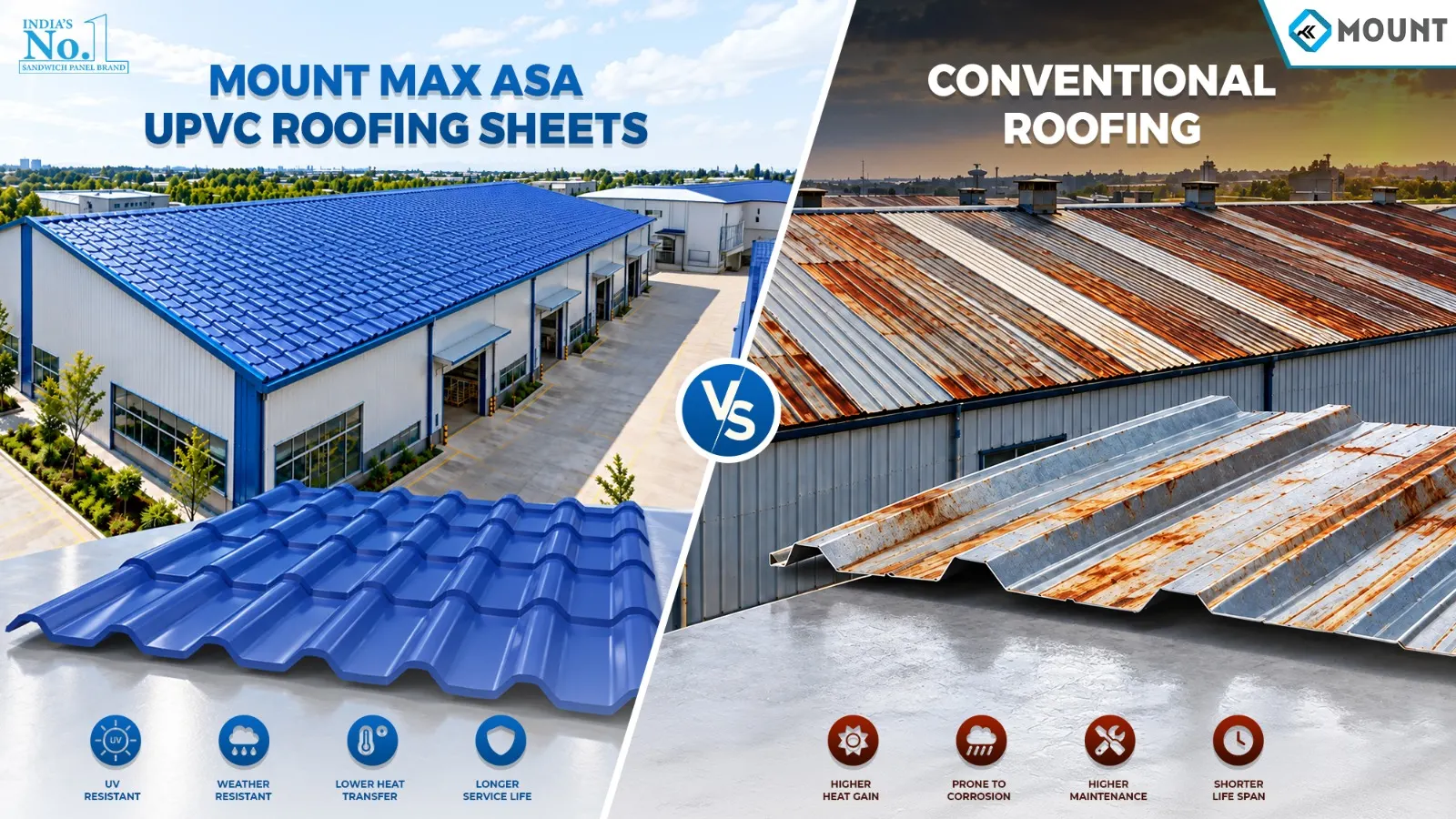
For an industrial facility, roofing is a long-term building-envelope decision. The lowest initial quotation may not represent the lowest lifecycle cost once corrosion, heat gain, rain noise, maintenance and periodic replacement are taken into account.
This is particularly relevant for factories, warehouses, agricultural sheds and industrial buildings exposed to intense sunlight, monsoon rainfall, humidity or corrosive operating environments. Mount Max ASA UPVC Roofing Sheets offer an alternative to conventional metal roofing, with a material composition and multi-layer construction designed around weather resistance, thermal insulation and corrosion protection. Mount manufactures its uPVC roofing sheets using a 3–4 layer co-extrusion process for industrial and commercial applications.
The right choice, however, depends on the site’s climate, operating environment, structural system and expected service requirements.
What Should Industrial Buyers Compare?
A roofing comparison should go beyond sheet thickness and purchase price. Facility owners should examine:
- Resistance to rain and water exposure
- Corrosion behaviour
- Heat transfer into the building
- Acoustic performance
- Electrical insulation
- UV exposure and colour stability
- Maintenance requirements
- Profile, span and fixing requirements
- Expected service conditions
These factors can have a direct bearing on the roof’s operating cost over its useful life.
Mount Max ASA UPVC Roofing Sheets: A Different Material Approach
Conventional industrial roofs commonly use metallic sheets, with their long-term performance depending on the base metal, coating system, environment, detailing and maintenance regime.
Mount Max ASA UPVC Roofing Sheets use a non-metallic uPVC construction. Mount states that its sheets are designed to resist corrosion and are suitable for environments where saline, acidic or alkaline exposure can create challenges for conventional metal roofing.
The 3–4 layer co-extrusion construction is significant because the sheet is engineered as a layered system rather than a single homogeneous polymer sheet. Mount positions the construction around weather resistance, thermal insulation, corrosion protection and outdoor durability.
For an industrial buyer, the important question is how those characteristics correspond to the actual site conditions.
Weather and Water Resistance
Industrial roofs face continuous exposure to rainfall, wind, solar radiation and seasonal temperature changes. A roofing system needs to shed water effectively while maintaining its dimensional and mechanical integrity under the expected conditions.
Mount’s uPVC sheets are positioned as weatherproof roof panels, with resistance to rain, UV exposure and demanding outdoor environments. The trapezoidal profile is intended for industrial and commercial applications and is specified with recommended roof slopes and purlin spans.
Water resistance is not determined by the sheet alone. Roof slope, overlaps, fastener placement, flashings, penetrations and installation quality all influence the completed roof.
Corrosion Resistance in Demanding Environments
Corrosion can become a significant maintenance issue for metal roofs in coastal areas, chemical-processing environments, agricultural buildings and facilities with persistent humidity.
Because Mount Max ASA UPVC Roofing Sheets are non-metallic, they do not rust in the same manner as steel roofing. Mount specifically identifies corrosion resistance as a product attribute and highlights applications involving saline and acidic environments.
For industrial buyers, this can make material selection particularly relevant where atmospheric exposure is expected to accelerate deterioration of conventional metal roofing.
Heat Insulation and Indoor Conditions
Metal roofing has relatively high thermal conductivity, so solar heat absorbed at the roof surface can contribute to heat transfer into the building.
uPVC has lower thermal conductivity than metal, and Mount’s roofing sheets are designed to provide thermal insulation that can help reduce heat transfer through the roof.
The actual impact on indoor temperature and cooling demand depends on the complete building envelope, including roof colour, insulation, ventilation, building orientation, internal heat loads and HVAC design. Roofing material should therefore be assessed as one component of the facility’s thermal strategy.
Sound Insulation: An Operational Consideration
Rain striking a large metal roof can create considerable impact noise, particularly inside warehouses and manufacturing buildings with large roof areas.
Mount positions its uPVC sheets as providing sound dampening compared with conventional metal roofing. For facilities where rain and wind noise affect workers, office areas or equipment operations, this characteristic can be a relevant specification consideration.
For buyers specifically searching for soundproof roofing sheets, it is important to distinguish between material-level sound dampening and a fully engineered acoustic roof assembly. Overall acoustic performance depends on the roof construction, internal lining, ceiling, openings and surrounding structure.
Electrical Insulation
Unlike metallic roofing, uPVC is electrically insulating. This can be relevant for facilities where electrical insulation is considered as part of the roofing material specification.
However, electrical safety for an industrial facility still depends on the complete electrical and structural design, including earthing, lightning protection and equipment installation. The roofing material should not be treated as a substitute for the facility’s electrical protection system.
UV Exposure and Long-Term Colour Stability
Long-term exposure to ultraviolet radiation can affect the appearance and properties of polymeric roofing materials. This makes UV stabilisation an important consideration when specifying uPVC sheets for exposed industrial roofs.
Mount states that its uPVC sheets use UV-stabilised surface layers and provides a 15-year quality guarantee, while its product positioning specifies colour stability for up to 10 years.
For procurement teams, warranty conditions should always be reviewed alongside the technical specification, installation requirements and applicable exclusions.
Maintenance: Look Beyond the Purchase Price
The maintenance profile of roofing can influence lifecycle economics. Conventional metal roofs may require attention to coating deterioration, corrosion at vulnerable locations, fasteners and damaged areas, depending on the environment and coating system.
Mount’s non-metallic uPVC construction eliminates rusting of the roofing material itself, while its published product information positions the sheets as low-maintenance roofing for demanding applications.
That does not mean the roof requires no inspection. Flashings, fasteners, drainage paths, overlaps and penetrations still need periodic checks regardless of the roofing material.
Where Mount Max ASA UPVC Roofing Sheets Can Be Considered
Mount’s uPVC roofing range is designed for industrial, commercial, institutional and agricultural applications. The trapezoidal profile is particularly suited to industrial and commercial roofing where strength, weather resistance and longer spans are required.
Typical applications include:
- Manufacturing facilities
- Warehouses and logistics buildings
- Agricultural and poultry sheds
- Workshops
- Industrial utility structures
- Commercial back-end facilities
- Institutional buildings
- Corrosive or humid operating environments
The appropriate profile, thickness and fixing arrangement should be established from the structural and site requirements.
What Should Buyers Ask Before Comparing uPVC Roofing Prices?
When evaluating uPVC roofing sheets price, procurement teams should compare equivalent specifications rather than comparing only the cost per square metre.
The evaluation should include:
- Sheet thickness and profile
- Effective and overall coverage width
- Purlin spacing
- Roof slope
- Fastener and washer specification
- Site wind and weather conditions
- Corrosive exposure
- Thermal requirements
- Warranty and quality documentation
- Installation and maintenance requirements
This provides a more meaningful comparison between roofing systems and helps identify the actual lifecycle implications of the purchase.
Why Consider Mount as Your uPVC Roofing Partner?
Choosing a uPVC roofing manufacturer involves more than sourcing a polymer sheet. Industrial projects need consistency in profile, thickness, dimensions and technical specifications, along with support for application-specific requirements.
Mount Roofing & Structures is a fully integrated manufacturer of uPVC roofing sheets, Sandwich Panels, PEB systems, polycarbonate sheets and related building-envelope products. Its uPVC range includes trapezoidal and Spanish Tile profiles, with multiple thicknesses and standard as well as custom-length options.
For businesses evaluating a uPVC roofing supplier, Mount’s broader manufacturing capability also allows roofing requirements to be considered alongside structural and envelope solutions rather than as an isolated material purchase.
The Right Roof Depends on the Operating Environment
Mount Max ASA UPVC Roofing Sheets are not intended to make conventional metal roofing irrelevant. Each roofing system has its appropriate applications.
The more useful approach is to compare the two against the actual project: corrosion exposure, temperature conditions, rainfall, acoustic requirements, electrical considerations, structural configuration, maintenance expectations and lifecycle requirements.
Where corrosion resistance, thermal insulation, sound dampening and low-maintenance operation are priorities, Mount Max ASA UPVC Roofing Sheets provide an alternative worth evaluating as part of the industrial roof specification.
FAQs
Q. Are Mount Max ASA UPVC Roofing Sheets suitable for coastal industrial buildings?
They can be considered for coastal applications because uPVC does not rust and Mount identifies corrosion resistance in saline environments as a product characteristic. The complete roof design should still account for wind loading, fasteners, flashings, drainage and installation conditions.
Q. How does uPVC roofing compare with metal roofing for heat transfer?
uPVC has lower thermal conductivity than metal, so it can reduce heat transfer through the roof material. However, the final indoor thermal environment depends on the complete roof assembly, ventilation, insulation, solar exposure and building operation.
Q. Does Mount Max ASA UPVC Roofing have a warranty?
Mount states that its uPVC roofing range is backed by a 15-year quality guarantee. The specific warranty terms, conditions and coverage should be reviewed against the quotation and product documentation for the project.
Q. How important is roof profile when selecting uPVC sheets?
Profile affects effective coverage, water drainage, structural behaviour, purlin spacing and installation. Mount’s trapezoidal profile, for example, has published recommended purlin spans and a recommended roof slope, so profile selection should be coordinated with the structural design.
Q. Are Mount Max ASA UPVC Roofing Sheets completely maintenance-free?
No roofing system should be treated as maintenance-free. Although the uPVC material itself does not rust and is designed for low-maintenance operation, industrial roofs still require periodic inspection of fasteners, flashings, drainage, overlaps, penetrations and other interfaces.
Similar Events
 16 October, 2026