 Oct 23, 2026
Why Thermal Insulation Matters in Industrial Buildings: Understanding Heat Transfer Through the Building Envelope
In an industrial building, the roof and walls do more than enclose the facility. They form the building envelope that controls how heat enters and leaves the occupied space. For warehouses, factories, food-processing units, cold-storage facilities and manufacturing plants, poor thermal control can increase the load on HVAC and refrigeration systems while making internal conditions more difficult to maintain.
This makes insulation a design consideration rather than an afterthought. Mount Roofing & Structures develops insulated building-envelope solutions using Sandwich PUF Panels, designed to reduce unwanted heat transfer through industrial roofs and walls while supporting more controlled indoor conditions.
How Does Heat Move Through an Industrial Building?
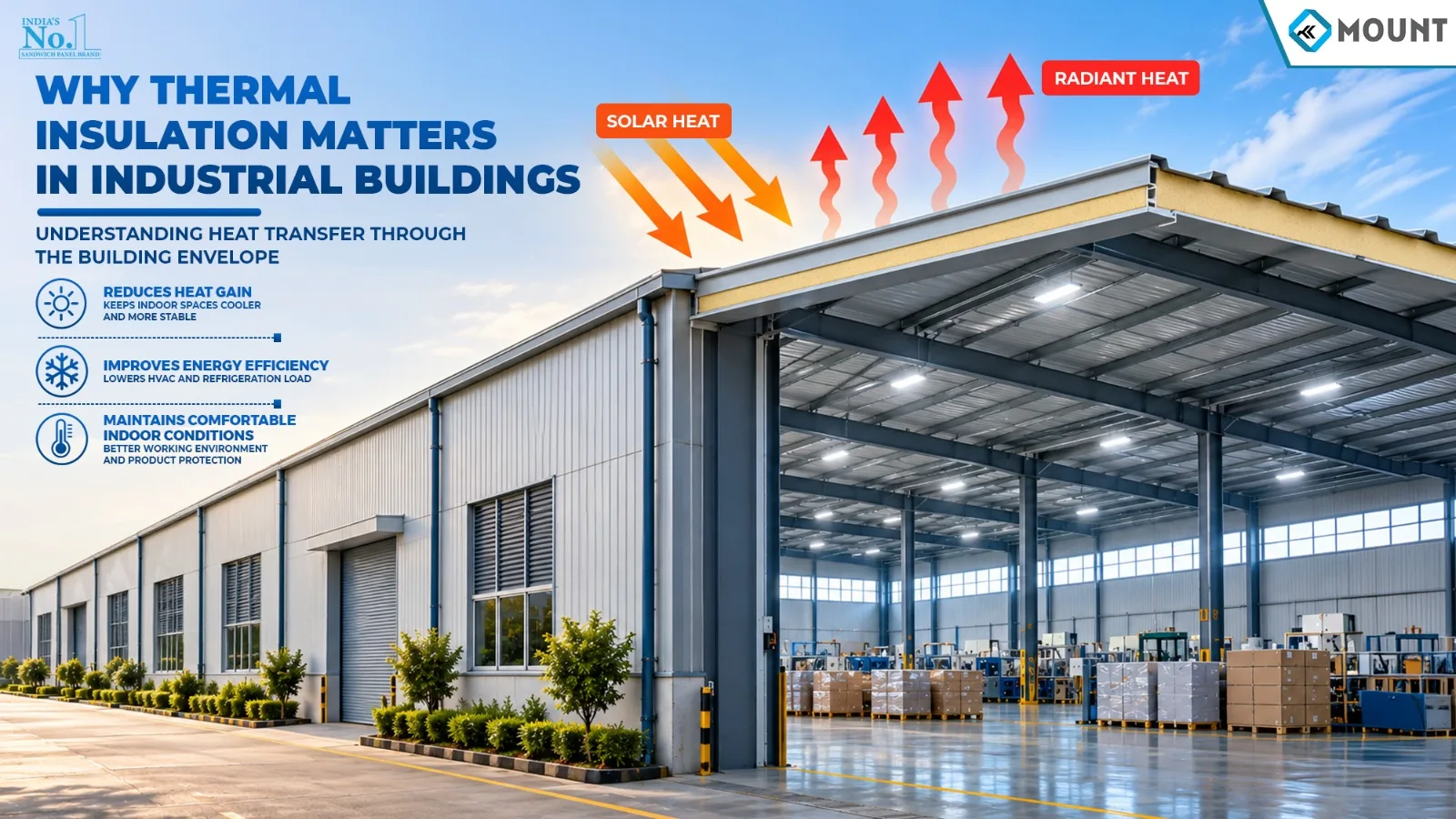
Heat transfer through a building envelope generally occurs through conduction, convection and radiation.
Conduction is the transfer of heat through a material due to a temperature difference. A conventional metal roof exposed to strong solar radiation can become significantly hotter than the indoor environment, allowing heat to conduct through the roof assembly.
Convection involves heat movement through fluids such as air. Gaps, poorly sealed joints and uncontrolled air movement can contribute to heat entering or escaping a building.
Radiation occurs when thermal energy is transferred through electromagnetic waves. Solar radiation is particularly relevant to industrial buildings because large roof areas are directly exposed to the sun for extended periods.
An effective building envelope needs to address these heat-transfer mechanisms as part of an integrated design.
Why Thermal Insulation Matters in Industrial Facilities
Large industrial buildings typically have substantial roof and wall areas. This increases the amount of envelope exposed to external temperature conditions.
Insulation introduces a material layer with low thermal conductivity between the exterior and interior environments. By increasing resistance to heat flow, the building can maintain internal temperatures with less influence from outdoor conditions.
This becomes particularly relevant where the facility contains temperature-sensitive materials, production processes or controlled work environments. Warehouses storing temperature-sensitive goods, for example, may require a more stable internal environment than a conventional storage building.
For facilities using mechanical cooling, reducing heat transfer can also help control the cooling load. The actual energy impact depends on factors such as climate, building orientation, glazing, ventilation, internal heat gains, HVAC efficiency and operating schedules.
How Sandwich PUF Panels Reduce Heat Transfer
A Sandwich PUF Panel consists of a rigid polyurethane foam core positioned between metal facings. The core provides thermal resistance while the prefabricated panel assembly forms part of the external wall or roof envelope.
Mount’s PUF panel range is available in multiple thicknesses, allowing specifications to be matched to the insulation requirements of different applications. Mount publishes panel thickness options ranging from 20 mm to 200 mm on its product pages, while specific roof-panel configurations include 30 mm through 200 mm options.
The key consideration is that PUF Panel Thickness should not be selected independently. Engineers need to consider the target thermal performance, indoor operating conditions, external climate, panel joints, structural requirements and the complete envelope design.
Why the PUF Core and Panel Construction Matter
The insulation core is only one component of the system. Panel construction also affects how effectively the envelope performs.
A properly manufactured sandwich panel combines the insulation core with metal facings to create a prefabricated building element. Consistent core density, bonding between the core and facings, dimensional accuracy and correctly executed joints are important considerations when specifying insulated panels.
Mount states that its PUF panels are produced using controlled manufacturing processes intended to maintain consistent core density, bonding and dimensional quality.
For industrial projects, this system-based approach is important because the thermal performance of an installed envelope depends on more than the nominal insulation material.
Roof and Wall Insulation Must Work Together
A common design mistake is to focus on wall insulation while overlooking the roof. In many industrial facilities, the roof represents a substantial exposed surface and receives direct solar radiation.
Using insulated roofing alongside insulated wall panels creates a more continuous thermal envelope. This is particularly important for large warehouses, production facilities and PEB structures where extensive roof and wall surfaces form the primary enclosure.
Mount’s Sandwich PUF Panels can be used for both roofing and wall applications, supporting coordinated envelope design across industrial facilities.
Where Are PUF Panels Used?
Thermally insulated panels can support a range of industrial applications, including:
- Warehouses and logistics facilities where internal temperature stability can help protect stored materials.
- Manufacturing units where worker comfort and controlled indoor conditions matter.
- Cold-storage facilities where maintaining specified temperatures is critical.
- Food-processing facilities where controlled environments and cleanable surfaces are important.
- Pharmaceutical and controlled-environment facilities where temperature and hygiene requirements need to be addressed together.
- Industrial workshops and commercial buildings where insulated roofing and wall systems can reduce external thermal influence.
The appropriate panel specification varies according to the application. A cold-storage chamber, for example, cannot be specified in the same way as a general warehouse simply because both require insulation.
PUF, PUR and PIR: Understanding the Terminology
In technical discussions, terms such as PUR, PUF and PIR Thermal Insulation Panels can sometimes appear together. PUR refers to polyurethane, while PUF is commonly used in the construction industry to describe polyurethane foam insulation. PIR refers to polyisocyanurate, a related insulation material with different fire-performance characteristics.
For procurement teams evaluating Thermal Insulation PUR Panels, the important factors remain the actual material specification, thickness, thermal properties, facing system, joints and certified performance rather than terminology alone.
Why Mount for Industrial Thermal-Insulation Requirements?
For industrial construction, choosing among Top Puf Panel Manufacturers And Suppliers should involve more than comparing panel prices. Manufacturing consistency, engineering support, panel configuration, thickness selection and integration with the building structure all influence the finished envelope.
Mount Roofing & Structures combines Sandwich PUF Panels with broader building solutions, including PEB systems and other roofing products. This allows project teams to coordinate structural and envelope requirements through a single technical partner.
For businesses evaluating Best Puf Sandwich Panels Manufacturers, Mount provides project-oriented support for selecting panel configurations according to application, insulation requirements and building conditions.
For an industrial building, thermal insulation should be designed as part of the building envelope,not added after the structure is complete. Mount Roofing & Structures helps project teams evaluate the right PUF panel configuration, thickness and application strategy to create a more controlled and technically considered industrial environment.
FAQs
Q. How does PUF insulation reduce heat transfer in an industrial building?
The rigid polyurethane foam core provides thermal resistance between the external and internal metal facings. This reduces the rate at which heat moves through the panel compared with an uninsulated metal enclosure.
Q. How should PUF Panel Thickness be selected for a warehouse?
Thickness should be determined from the required thermal performance, indoor temperature requirements, external climate, building usage and overall envelope design. There is no single thickness suitable for every warehouse.
Q. Are PUF panels suitable for cold-storage applications?
Yes, PUF panels are commonly used for insulated cold-storage enclosures. However, the panel specification must be evaluated alongside refrigeration load, target temperature, joint design, door openings and other sources of heat gain.
Q. Are PIR Thermal Insulation Panels the same as PUF panels?
No. PIR and polyurethane insulation are related materials but have different chemical structures and performance characteristics. The appropriate material should be selected according to the project’s thermal, fire and application requirements.
Q. Why should roof and wall insulation be specified together?
Treating the roof and walls as one building envelope helps reduce weak points in thermal control. Coordinated insulation can provide a more consistent barrier against external temperature variations across the industrial facility.
Similar Events

 21 October, 2026