 Oct 21, 2026
How to Select Sandwich Panels for Pharmaceutical Manufacturing Facilities
In pharmaceutical manufacturing, the building envelope forms part of the controlled environment in which materials, processes and products are handled. Walls and ceilings must support temperature control, hygiene, cleaning and contamination-control strategies while remaining suitable for the facility’s operating conditions.
That makes sandwich panel selection a technical decision rather than a simple choice of insulation material. Core type, surface finish, joint configuration, moisture resistance, fire performance and installation quality all need to be considered together. Mount Roofing & Structures provides insulated panel solutions for controlled environments, including pharmaceutical and cleanroom applications, where enclosure integrity and thermal control are important design considerations.
Why Panel Selection Matters in Pharmaceutical Facilities
Pharmaceutical buildings can contain several zones with different environmental requirements. A cleanroom used for production may have different requirements from a raw-material store, laboratory, packaging area or temperature-controlled storage room.
The building envelope should therefore be selected according to the function of each space. A suitable panel system can provide thermal resistance, create a continuous enclosure and offer surfaces that are easier to clean and maintain.
WHO guidance for sterile pharmaceutical facilities states that exposed surfaces in cleanrooms and critical zones should be smooth, impervious and unbroken, while materials should allow repeated cleaning and disinfection.
1. Start With the Thermal Requirement
Temperature stability is a fundamental consideration when specifying pharmaceutical manufacturing spaces. External heat gain through walls and roofs can increase the cooling requirement and make internal conditions more difficult to control.
The insulation core in a sandwich panel creates thermal resistance between the external and internal metal facings. PUR Insulated Panels can therefore be considered for areas where thermal insulation forms a key part of the building-envelope design.
Panel thickness should be established from the required thermal performance, internal operating temperature, external climate, HVAC design and other sources of heat gain. Selecting a thicker panel simply because it provides more insulation is not a substitute for designing the complete envelope correctly.
2. Evaluate PUR and PIR According to the Application
PUR and PIR are closely related insulation materials but should not be treated as identical specifications. The choice depends on the required thermal properties, fire-performance requirements, panel construction and project conditions.
PIR Roof & Wall Panels can be considered where the specification requires insulation together with defined fire-performance characteristics. The actual classification must be verified against the tested panel assembly, including its core, facings, thickness and joint configuration.
For procurement teams evaluating Certified Fire Rated PIR Panels, certification and test documentation should be reviewed for the exact system being specified rather than relying on a generic statement about PIR.
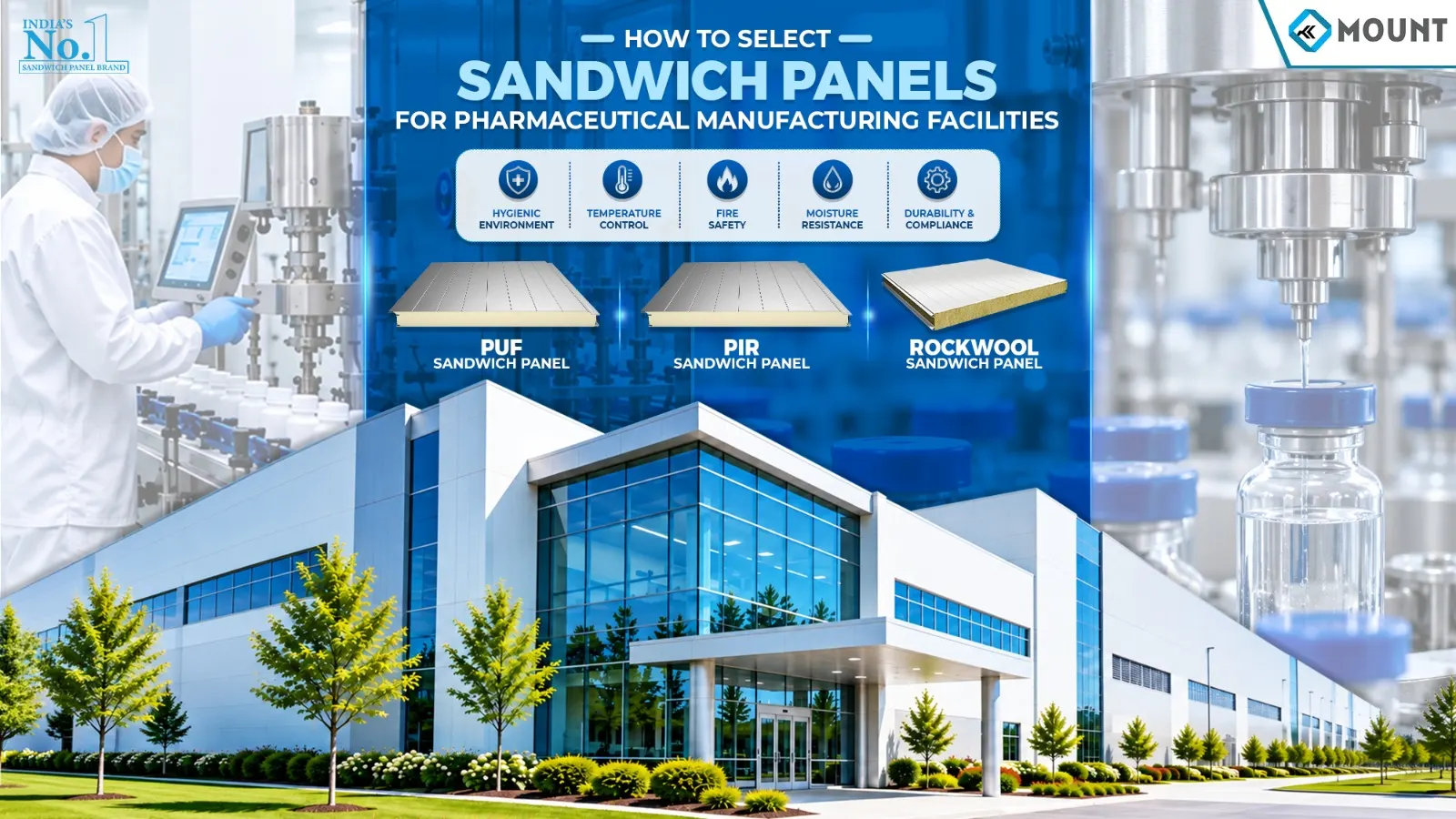
Mount’s cleanroom-panel portfolio identifies PUR, PIR and Rockwool cores as options depending on project requirements, allowing the panel specification to be aligned with the intended environment.
3. Surface Finish and Cleanability Are Critical
In pharmaceutical production areas, the internal panel surface is part of the working environment. Smooth, impervious surfaces with properly treated joints reduce areas where dust or residues can accumulate and make routine cleaning easier.
WHO pharmaceutical guidance similarly calls for interior walls, floors and ceilings in relevant manufacturing areas to be smooth, free from cracks and open joints, non-shedding and suitable for effective cleaning and disinfection.
Mount’s cleanroom panel solutions incorporate smooth surfaces and sealed joint approaches intended for controlled and hygiene-sensitive environments.
The finish should also be assessed against the cleaning agents, disinfectants, temperature and operating conditions expected within the facility. The correct surface specification is therefore a project requirement, not merely an aesthetic choice.
4. Joint Detailing Can Be as Important as the Panel Core
A technically suitable panel can still underperform as part of a building envelope if joints, penetrations and interfaces are poorly detailed.
In pharmaceutical facilities, uncontrolled gaps can become difficult-to-clean locations and may compromise enclosure integrity. WHO guidance specifically highlights the importance of avoiding cracks, open joints and difficult-to-clean recesses in relevant manufacturing environments.
This makes panel-to-panel joints, wall-to-ceiling connections, door interfaces, service penetrations and HVAC openings important during design and installation.
A properly detailed system should create a continuous enclosure while allowing necessary services to be integrated without creating avoidable contamination or moisture pathways.
5. Consider Moisture and Condensation Risk
Temperature differences between the conditioned interior and surrounding environment can create condensation risks when the envelope is poorly designed or inadequately sealed.
Moisture can affect insulation performance and create maintenance concerns over time. For temperature-controlled pharmaceutical spaces, the panel system should therefore be evaluated alongside vapour control, HVAC conditions, humidity levels and joint sealing.
This is particularly important for areas with significant temperature differentials or frequent cleaning operations.
Where Are These Panels Used?
Depending on the project specification, insulated sandwich panels can be used across:
- Pharmaceutical cleanrooms
- Production and formulation areas
- Quality-control laboratories
- Packaging areas
- Raw-material and finished-product storage
- Temperature-controlled rooms
- Change rooms and controlled support areas
- Interconnecting corridors and controlled zones
Each area should be evaluated independently. A storage room, for example, may have different thermal and hygiene requirements from a sterile production area.
What Should Pharmaceutical Project Teams Check Before Ordering?
Before finalising a panel specification, project and procurement teams should evaluate:
Thermal: Required U-value, panel thickness, internal temperature and HVAC conditions.
Fire: Required fire classification and certification for the complete panel assembly.
Hygiene: Surface smoothness, cleanability, resistance to the intended cleaning regime and minimisation of difficult-to-clean interfaces.
Moisture: Vapour control, condensation risk, joint sealing and operating humidity.
Installation: Panel alignment, joint execution, penetrations, corners, doors, ceilings and service interfaces.
Documentation: Product specifications, test reports, certifications and installation requirements applicable to the selected system.
This approach helps prevent a common procurement mistake: selecting a panel based primarily on insulation thickness or price without assessing how the complete enclosure will operate.
Why Choose Mount for Pharmaceutical Panel Requirements?
For pharmaceutical construction, the panel supplier needs to understand more than the insulation core. The solution has to be considered in relation to the building layout, controlled areas, roofing, wall systems, service penetrations and installation details.
Mount Roofing & Structures provides insulated panel solutions for pharmaceutical and cleanroom applications, alongside roofing, PEB and related building-envelope systems. Its cleanroom offering is designed around smooth surfaces, sealed joints and insulation requirements for controlled environments.
For organisations comparing PIR Panel Manufacturers, the selection process should therefore include manufacturing capability, technical documentation, panel configuration and project-specific support,not simply the quoted rate per square metre.
Choose the panel system around the pharmaceutical process, not the other way around. Mount can help project teams evaluate the appropriate core, panel configuration, surface finish and detailing requirements for insulated and hygienic pharmaceutical spaces.
FAQs
Q. What type of sandwich panel is suitable for pharmaceutical cleanrooms?
The appropriate core depends on the project’s thermal, fire, hygiene and environmental requirements. PUR, PIR and Rockwool systems can each have applications in controlled environments, but the final specification should be based on the required performance and tested panel assembly.
Q. Why are smooth panel surfaces important in pharmaceutical facilities?
Smooth, impervious surfaces reduce locations where particles or residues can accumulate and make cleaning and disinfection easier. WHO GMP guidance specifically addresses these characteristics for relevant pharmaceutical manufacturing areas.
Q. Are Leak Proof PUR Roof Panels suitable for pharmaceutical buildings?
Insulated PUR roof systems can be considered where thermal insulation and weather protection are required. However, roof waterproofing depends on panel geometry, laps, flashings, penetrations, drainage and installation quality, so “leak proof” should not be treated as an unconditional property of the insulation core.
Q. How should fire-rated PIR panels be specified for a pharmaceutical facility?
The required fire classification should be established from the project’s fire strategy and applicable requirements. The project team should then verify the certification or test evidence for the complete panel assembly, including the core, facings, thickness and joints.
Q. Can the same panel specification be used throughout a pharmaceutical facility?
Not necessarily. Production rooms, laboratories, storage areas, corridors and temperature-controlled spaces may have different thermal, hygiene, fire and environmental requirements. Zone-by-zone specification can therefore be more appropriate than using one panel configuration throughout the facility.
Conclusion
Sandwich panel selection for pharmaceutical manufacturing should be treated as an integrated building-envelope decision. Thermal insulation, surface finish, cleanability, fire performance, moisture control and joint detailing all influence how effectively the enclosure supports the facility’s intended operating environment.
With PUR and PIR options alongside other controlled-environment panel solutions, Mount Roofing & Structures can support pharmaceutical projects where insulation, hygiene and enclosure detailing need to be considered together.
Similar Events
 19 October, 2026