 Oct 30, 2026
How Corrosion, Moisture and Weather Exposure Affect Roofing in Chemical & Processing Facilities
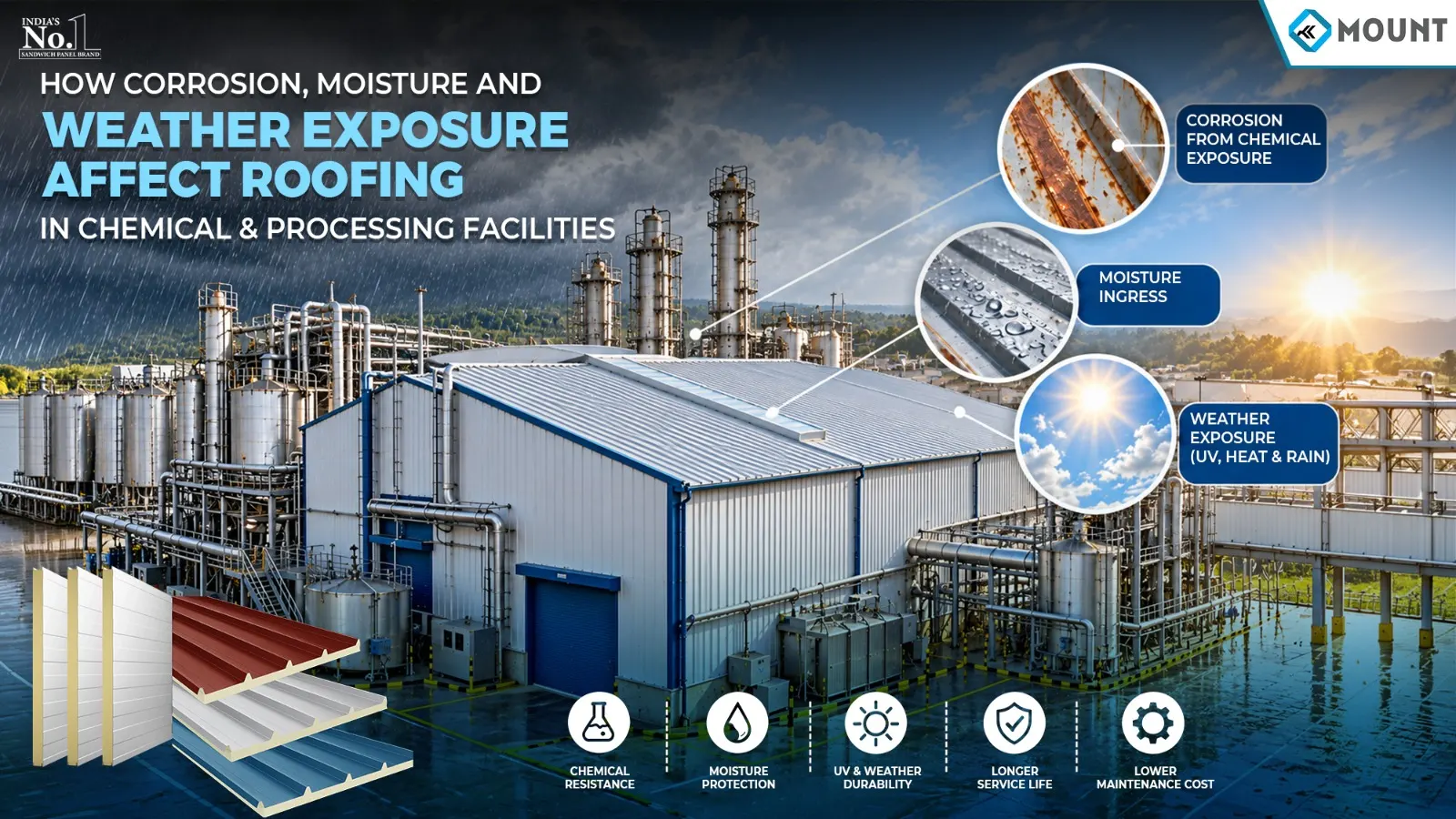
In a chemical or processing facility, the roof has to deal with more than rain and sunlight. Humid operating conditions, process vapours, airborne contaminants, condensation and prolonged outdoor exposure can place additional demands on the roofing system. Over time, these conditions can influence the condition of exposed metal components, protective coatings, fasteners and roof interfaces.
For industrial project teams, roofing selection therefore needs to begin with the operating environment. The question is not simply whether a material can cover the building, but whether its material properties, construction and installation details are appropriate for the conditions the roof will encounter throughout its service life.
Mount Max ASA UPVC Roofing Sheets offer a non-metallic roofing option for industrial environments where corrosion, moisture and weather exposure are important considerations. Mount manufactures the sheets using a 3–4 layer co-extrusion process and identifies chemical and processing units, manufacturing plants and industrial sheds among its applications.
The Roof Is Exposed to the Facility’s Environment
A chemical or processing plant can create an atmosphere that differs significantly from a conventional warehouse.
Moisture may originate from humidity, condensation, wash-down activities or rainfall. Depending on the process, vapours and airborne substances may also settle on exposed roof surfaces. When these conditions repeatedly interact with susceptible metallic surfaces, corrosion can become a maintenance concern.
The degree of exposure varies from one facility to another. A dry manufacturing unit, a humid processing area and a coastal chemical plant cannot automatically be given the same roofing specification.
Before selecting a roof, project teams should understand what the building will be exposed to, how frequently that exposure occurs and which components of the roofing assembly are most vulnerable.
Corrosion Begins With the Exposure Environment
Metal roofing typically relies on the base metal and protective coating system to withstand environmental exposure. Damage to coatings, cut edges, fasteners, overlaps and other interfaces can create locations where deterioration may begin.
Mount Max ASA UPVC Roofing Sheets take a different material approach. The roofing sheet is manufactured from non-metallic uPVC, and Mount identifies corrosion resistance as one of its product characteristics. The manufacturer also identifies chemical and processing units, manufacturing plants and coastal buildings among relevant applications.
This can make uPVC relevant where rusting of the roofing material itself is an important consideration. It should not, however, be interpreted as universal chemical compatibility. The actual chemical, concentration, temperature and exposure mechanism still need to be evaluated before specifying the product for a particular process environment.
Moisture Changes the Equation
Water exposure is another issue that needs to be considered at system level.
A roof may encounter heavy rainfall from outside while the underside is exposed to humid internal conditions or condensation. If water remains around vulnerable joints, penetrations or fasteners, it can contribute to deterioration of susceptible components.
Mount Max ASA UPVC Roofing Sheets are designed for water and weather resistance, while their non-metallic construction prevents conventional rusting of the sheet itself.
But the sheet cannot compensate for poor roof detailing.
Slope, drainage, overlaps, flashings and penetrations all influence how effectively water is removed from the roof. Mount’s published information specifies a recommended slope greater than 20° for its trapezoidal uPVC profile, with purlin-span recommendations varying by sheet thickness. These parameters need to be coordinated with the structural and drainage design of the individual project.
Weather Exposure Is a Long-Term Design Consideration
Chemical facilities remain exposed to the same external forces affecting other industrial buildings: solar radiation, rainfall, wind and temperature variation.
The difference is that these environmental stresses can occur alongside the facility’s internal operating conditions.
Mount Max ASA UPVC Roofing Sheets use a 3–4 layer co-extrusion construction. Mount associates this layered construction with weather resistance, thermal insulation, corrosion protection and outdoor durability.
The construction is particularly relevant when evaluating how a roofing material will behave as part of an exposed industrial building envelope. Rather than evaluating only one characteristic, project teams need to consider how the material’s properties correspond with the combined exposure at the site.
UV Exposure Should Also Enter the Specification
A roof that remains exposed to sunlight throughout its service life needs appropriate consideration of ultraviolet exposure.
Polymeric roofing materials can experience changes when subjected to prolonged UV radiation, which makes UV stabilisation an important part of product selection. Mount states that its uPVC roofing sheets incorporate UV-stabilised surface layers and are designed for outdoor exposure.
For projects evaluating UV resistant roof sheets, procurement teams should review the manufacturer’s technical specifications and warranty conditions alongside the actual site exposure and installation requirements rather than evaluating UV resistance as an isolated marketing claim.
What Happens at the Roof’s Weak Points?
The sheet itself is only one part of the roofing assembly.
Consider a roof penetration for a service line. Or a flashing where two roof surfaces meet. Or a fastener passing through the sheet into a supporting purlin. These interfaces can experience different exposure conditions from the central roof surface.
This is why long-term roof performance depends heavily on detailing.
For a chemical-processing facility, the design should account for roof slope, sheet profile, thickness, purlin spacing, fixing locations, flashings, edge details, movement allowances and service penetrations. Inspection access and maintenance requirements should also be considered during the design stage.
A material with corrosion-resistant characteristics still needs a properly engineered supporting system.
Thermal Conditions Inside the Facility Matter Too
The roof influences the internal environment as well as the external building envelope.
uPVC has lower thermal conductivity than metal, and Mount identifies thermal insulation as a characteristic of its roofing sheets. This can reduce heat transfer through the roofing material, although the actual effect on indoor temperatures and cooling requirements depends on the complete building envelope, ventilation, insulation, HVAC system and internal heat loads.
This makes thermal behaviour another factor worth considering when specifying roofing for manufacturing and processing facilities, particularly where indoor operating conditions need to be managed carefully.
Acoustic and Electrical Properties Add Further Considerations
Rain falling on large metal roof surfaces can create significant impact noise within industrial buildings. Mount positions its uPVC roofing sheets as providing sound dampening compared with conventional metal roofing. For processing areas, occupied spaces or facilities where noise levels matter, this can form part of the roofing evaluation.
The material also provides electrical insulation, unlike metallic roofing. That characteristic may be relevant when evaluating roofing materials around industrial electrical infrastructure.
It should not, however, be treated as a substitute for a facility’s electrical safety system. Earthing, lightning protection, electrical equipment and structural design remain separate engineering requirements.
Chemical Compatibility Needs a Project-Specific Assessment
One of the most important distinctions for chemical-industry roofing is between corrosion resistance and universal chemical resistance.
A roofing material should not be specified simply because the word “chemical” appears in its application list. The substances present at the facility need to be identified, along with their concentration, operating temperature and method of exposure.
Mount’s published guidance specifically recommends assessing compatibility according to the chemicals and operating conditions involved.
This makes technical consultation particularly important for chemical plants, processing units and agro-chemical storage facilities.
Where Mount Max Can Be Considered
Mount identifies a range of industrial environments for its uPVC roofing systems, including chemical processing facilities, manufacturing plants, processing units, industrial sheds, fertilizer and agro-chemical storage structures, utility buildings and warehouses exposed to corrosive environments.
The actual specification still needs to reflect the conditions at the individual project.
For example, a humid manufacturing shed may place greater emphasis on moisture management, while a chemical-processing facility may require a more detailed compatibility assessment. A coastal industrial building may need particular attention to atmospheric exposure, while a general-purpose warehouse may have a different set of priorities.
Why Mount for Industrial uPVC Roofing?
For companies looking to buy uPVC sheets, the procurement decision should extend beyond material price.
Mount Roofing & Structures operates across uPVC roofing sheets, Sandwich Panels PEB structures, polycarbonate sheets and related building-envelope products. Its uPVC range includes trapezoidal and Spanish Tile profiles, with multiple thicknesses and custom-length options.
That broader product capability is relevant to industrial projects where the roofing system needs to be coordinated with the supporting structure and wider building envelope.
For an uPVC sheets company serving industrial and chemical-processing requirements, manufacturing capability is only one part of the value proposition. The ability to understand the roof’s operating environment and coordinate the material with structural, drainage and installation requirements is equally important.
Specify the Roof Around the Facility
The most effective roofing specification begins with the building rather than the product catalogue.
Chemical exposure, humidity, rainfall, solar radiation, operating temperature and maintenance conditions all influence the material decision. At the same time, slope, drainage, fasteners, joints, flashings and penetrations determine how the selected material functions once installed.
Mount Max ASA UPVC Roofing Sheets provide a non-metallic option for projects where corrosion resistance, weather protection, thermal insulation and sound dampening are relevant considerations.
For organisations evaluating the best uPVC sheets, the technically sound approach is to match the product to the actual exposure conditions and project requirements rather than relying on a generic material comparison.
FAQs
Q. Can Mount Max ASA UPVC Roofing Sheets be used in every chemical-processing facility?
No roofing material should be assumed to be compatible with every chemical environment. The chemical type, concentration, temperature and exposure mechanism should be assessed before the roofing specification is finalised.
Q. Does uPVC roofing completely eliminate corrosion-related maintenance?
The uPVC sheet itself does not rust like conventional metal roofing, but other components—including fasteners, flashings and supporting steel—can still require appropriate material selection and periodic inspection.
Q. Why is drainage important even when using water-resistant uPVC roofing?
Water resistance of the sheet does not replace roof drainage. Slope, overlaps, gutters, flashings, penetrations and installation quality all influence how the completed roof manages water.
Q. What makes the 3–4 layer construction relevant for industrial roofing?
Mount’s 3–4 layer co-extrusion construction is designed around multiple material characteristics, including weather resistance, thermal insulation and corrosion protection. Its relevance should be evaluated against the actual operating and environmental conditions of the project.
Q. What should a chemical plant evaluate before selecting its roofing material?
The project team should document chemical exposure, humidity, temperature, UV exposure, rainfall and operating conditions, then evaluate profile, thickness, purlin spacing, fasteners, drainage and chemical compatibility together before finalising the roof specification.
Similar Events
 28 October, 2026