 Oct 28, 2026
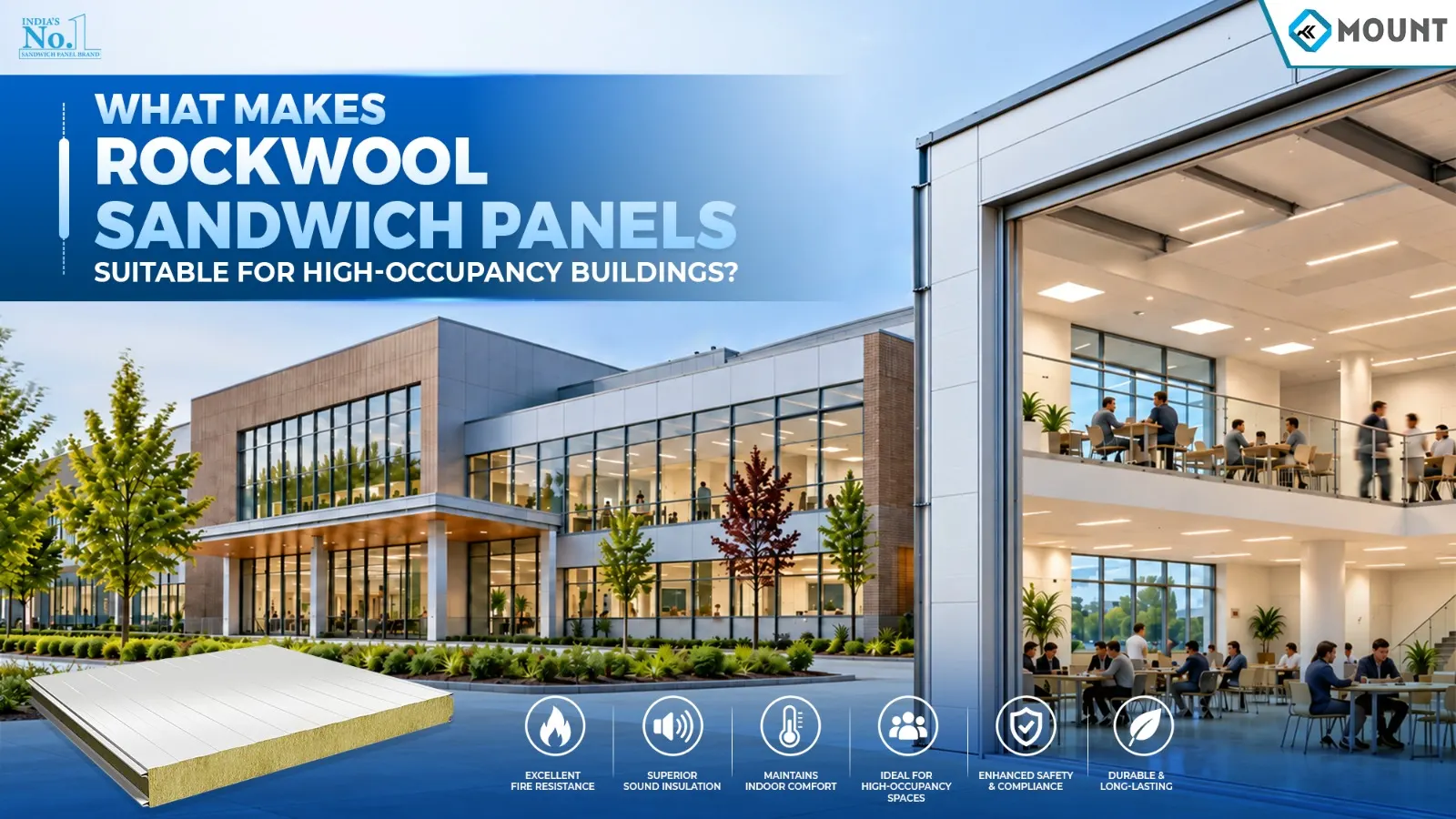
What Makes Rockwool Sandwich Panels Suitable for High-Occupancy Buildings?
In buildings designed for large numbers of occupants, the building envelope has to address more than weather protection. Fire performance, acoustic control, thermal comfort and the integrity of walls and roofs all influence how the space performs during everyday use and under demanding conditions.
Convention centres, auditoriums, educational institutions and public buildings can have large occupied areas, high sound levels and significant variations in occupancy. For these projects, the insulation core becomes an important part of the panel specification. Rockwool, or stone wool, is particularly relevant because it combines thermal insulation with non-combustible characteristics and acoustic properties.
Mount Roofing & Structures provides sandwich panel systems with Rockwool cores for projects where fire, acoustic and thermal requirements need to be considered together. Mount’s portfolio includes Rockwool alongside PUF and PIR panel options, allowing the building envelope to be selected according to the application.
Why Fire Performance Matters in High-Occupancy Buildings
When a building accommodates hundreds or thousands of people, fire safety becomes closely connected with occupant movement, evacuation strategy and compartmentation. India’s National Building Code addresses fire and life safety across different occupancies, including assembly and educational buildings, and includes provisions covering fire safety, materials, construction and building services.
This makes the fire behaviour of building materials an important consideration during specification.
Rockwool is manufactured from stone wool, a mineral-fibre material that is non-combustible. In sandwich-panel applications, stone wool cores can provide a building envelope with a strong fire-performance basis. ROCKWOOL notes that stone wool sandwich-panel systems can achieve high reaction-to-fire classifications, subject to the specific tested assembly.
However, a panel should never be described as fire-rated solely because it contains Rockwool. The required fire resistance or reaction-to-fire classification depends on the complete assembly, including core, facings, thickness, joints, fixings and installation.
This distinction is particularly important when specifying Rockwool Fire Rated Panels for an assembly building or educational facility.
Acoustic Comfort: An Important Requirement for Large Gathering Spaces
Fire safety is only one part of the specification. Acoustic conditions can significantly affect how a large public or educational space functions.
Convention centres, auditoriums and educational buildings may experience speech, crowd movement, mechanical equipment and other sources of sound. If sound travels easily through walls or between adjacent spaces, it can affect speech intelligibility, concentration and the usability of rooms.
The fibrous structure of stone wool can absorb and dissipate sound energy, making it useful in building-envelope and partition applications where acoustic control is required. ROCKWOOL identifies acoustic performance as one of the principal benefits of stone wool sandwich-panel systems.
For projects specifying Rockwool Insulated Panels, the acoustic objective should still be defined clearly. Reverberation control, airborne sound insulation and mechanical-noise transmission are different design issues, and the panel is only one component of the overall acoustic strategy.
Thermal Insulation Still Matters
A public building can have excellent fire and acoustic characteristics while still experiencing uncomfortable internal temperatures if its thermal envelope is poorly designed.
Stone wool provides thermal insulation by restricting heat flow through the building envelope. This can help moderate the influence of outdoor temperature variations on occupied spaces.
For Mount projects, the panel specification can therefore be evaluated around three interconnected requirements: the required thermal resistance, the fire-performance criteria and the acoustic objective.
This is especially relevant in large buildings where substantial roof and wall areas are exposed to external conditions.
Where Rockwool Sandwich Panels Can Be Considered
Convention Centres
Convention centres combine large gathering spaces, meeting rooms, circulation areas and service zones. Rockwool roof panels for convention centres can be evaluated where the roof assembly needs to contribute to thermal insulation while the overall building design addresses fire and acoustic requirements.
Educational Buildings
Schools, colleges and training facilities contain classrooms, laboratories, halls and administrative areas with different environmental requirements. Rockwool roof panels for educational buildings can be considered where fire and acoustic performance are important alongside thermal control.
Auditoriums and Public Buildings
Auditoriums and other public spaces can have demanding acoustic requirements because speech, performances and audience noise all interact within large volumes. Rockwool wall systems can form part of a broader acoustic and fire strategy.
Large Assembly Spaces
Sports facilities, exhibition halls and other gathering spaces can similarly benefit from evaluating insulation materials based on the combined requirements of fire, acoustics and thermal performance.
How Panel Thickness Influences the Specification
Rockwool wall panel thickness should be selected based on the project’s thermal, acoustic, fire and structural requirements rather than using a standard thickness for every building.
Increasing thickness may influence thermal resistance and, depending on the panel construction, acoustic and fire performance. The actual outcome must be established from the technical data and tested assembly applicable to the selected system.
For a high-occupancy project, the design team should therefore evaluate the panel alongside the structural frame, building height, compartmentation strategy, HVAC system, openings and internal partitions.
Joints and Installation Are Part of the Performance
A panel specification can only deliver its intended function when the completed installation is properly executed.
Panel joints, corners, roof-to-wall interfaces, penetrations and openings can affect enclosure continuity. Poorly executed joints may introduce unwanted air movement, moisture pathways or acoustic weaknesses.
Mount describes its sandwich panels as integrated building-envelope systems, with consideration for engineered jointing, mechanical fastening, air and vapour control, and interfaces with the wider building system.
For high-occupancy buildings, this system-level approach is important because fire, thermal and acoustic performance cannot be evaluated by the insulation core alone.
Why Choose Mount Rockwool Sandwich Panels?
For projects where fire, acoustic and thermal requirements overlap, Mount Roofing & Structures offers Rockwool sandwich-panel solutions as part of a broader building-envelope portfolio.
Mount is an integrated manufacturer of sandwich panels and PEB systems, enabling project teams to coordinate the structural frame and enclosure rather than treating them as unrelated packages. Its published portfolio identifies PUF, PIR and Rockwool as available insulation-core options.
Mount is also expanding Rockwool manufacturing capability in Karnataka with a continuous Rockwool sandwich-panel production line, strengthening its manufacturing offering for projects requiring mineral-wool panel systems.
For project teams evaluating High Density Rockwool Panels, the decision should ultimately be based on the required fire classification, thermal performance, acoustic objectives, structural requirements and tested panel configuration.
A Specification Built Around Occupancy
For a high-occupancy building, the right panel is determined by the demands placed on the building envelope. Fire performance supports the life-safety strategy, acoustic insulation contributes to occupant comfort, and thermal insulation helps regulate the indoor environment.
Mount Rockwool Sandwich Panels provide a practical option for projects where these requirements need to be evaluated together. The final specification should be developed around the building’s occupancy, applicable codes, design conditions, panel assembly and installation details—not around insulation material alone.
FAQs
Q. Why are Rockwool panels considered for high-occupancy buildings?
Rockwool combines thermal insulation with non-combustible stone-wool characteristics and acoustic properties. This makes it relevant to projects where fire and sound control are important alongside thermal requirements.
Q. Are all Rockwool panels automatically fire-rated?
No. Fire performance depends on the complete tested panel assembly. Core material, thickness, facings, joints, fixings and installation can all affect the declared classification or fire-resistance performance.
Q. How do Rockwool panels contribute to acoustic control?
The fibrous structure of stone wool can absorb and dissipate sound energy. The resulting acoustic performance depends on panel construction, thickness, density, joints and the surrounding building assembly.
Q. How should Rockwool wall panel thickness be selected?
Thickness should be determined from the project’s thermal, fire, acoustic and structural requirements. The design team should use the technical data and tested performance applicable to the exact panel configuration rather than selecting thickness solely by nominal value.
Q. Can Rockwool panels be used for both roofs and walls?
Yes. Stone-wool sandwich-panel systems can be used for exterior walls, interior partitions, ceilings and roofs, subject to the particular product configuration and project requirements.
Similar Events
 26 October, 2026