 Oct 26, 2026
PUF Sandwich Panels for Warehouses: How Insulation Can Influence the Indoor Environment
A warehouse may have a large floor area, tall clear heights and relatively simple operations, but maintaining a controlled indoor environment across such a space can be technically demanding. Solar heat entering through the roof, temperature fluctuations across the day and uncontrolled heat transfer through walls can influence both working conditions and the environment around stored goods.
For modern warehouses, distribution centres and logistics facilities, the building envelope therefore needs to be considered as part of the operational design. Insulated sandwich panels can reduce heat transfer through the roof and walls, helping create a more stable internal environment. Mount Roofing & Structures provides Sandwich PUF Panels for industrial, warehousing and temperature-controlled applications, with panel configurations selected according to project requirements.
Why Thermal Control Matters in Large Warehouses
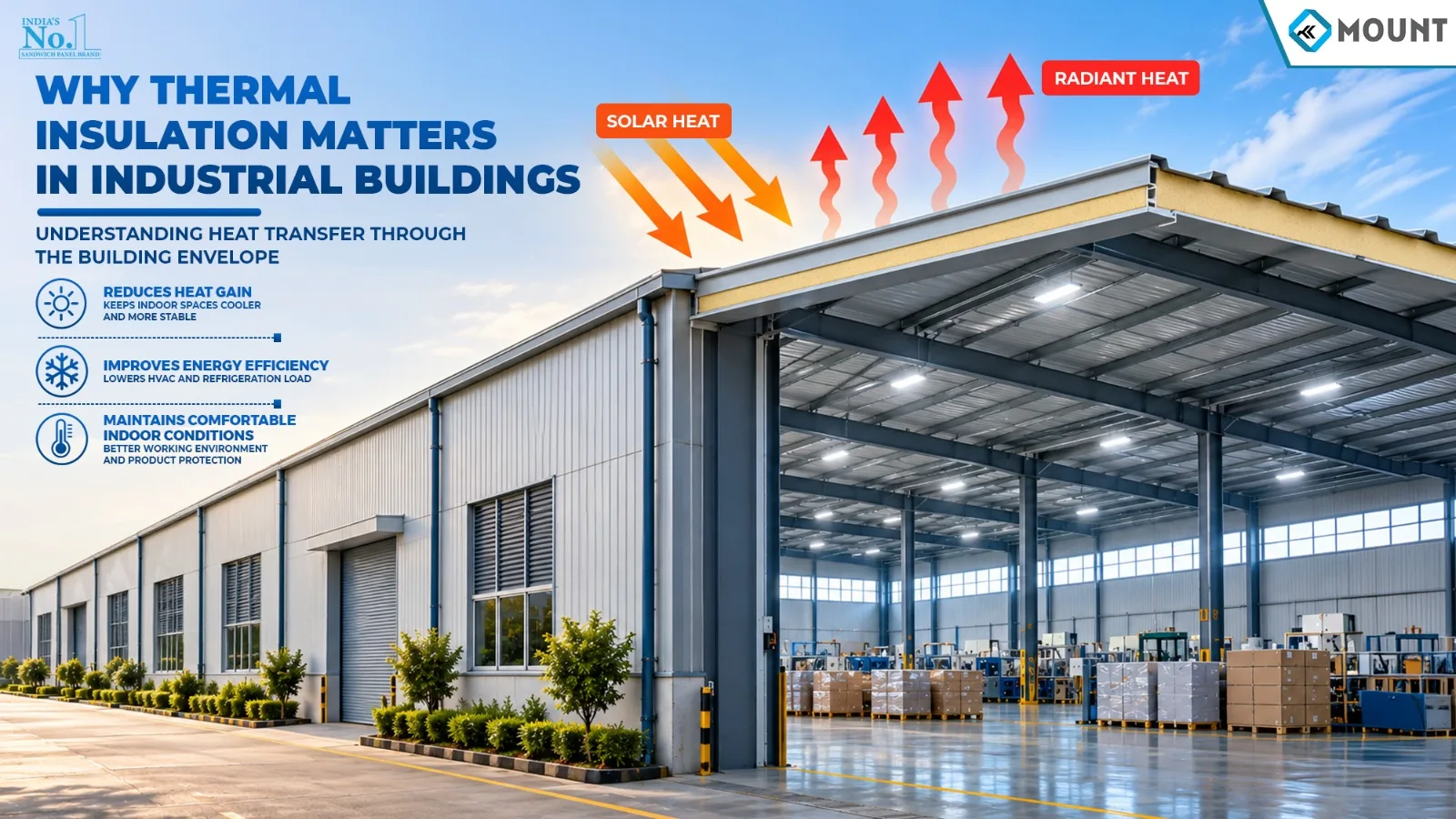
Warehouses typically have extensive roof and wall surfaces exposed to external conditions. During hot periods, solar radiation can heat the roof skin, while differences between outdoor and indoor temperatures drive heat flow through the building envelope.
The challenge becomes more significant in facilities with high roof areas and large internal volumes. Cooling an entire warehouse can require considerable mechanical capacity, particularly when the envelope allows substantial heat gain.
Insulation does not eliminate heat transfer, but it increases resistance to heat flow. This can help reduce the rate at which external temperature variations influence the indoor environment.
For logistics operators, the objective is not necessarily to maintain the same temperature throughout every warehouse. Rather, the envelope should be designed around the facility’s actual operating requirements, occupancy, ventilation, stored materials and HVAC strategy.
How the Building Envelope Influences Warehouse Conditions
The roof and walls work together as the primary enclosure between the external environment and the warehouse interior.
A conventional uninsulated metal roof can transmit heat more readily than an insulated assembly. Walls exposed to direct sunlight can also contribute to heat gain. Openings, doors, joints and service penetrations create additional points where thermal and air movement can affect internal conditions.
A properly specified insulated envelope addresses these areas as a system rather than treating the roof and walls as independent components.
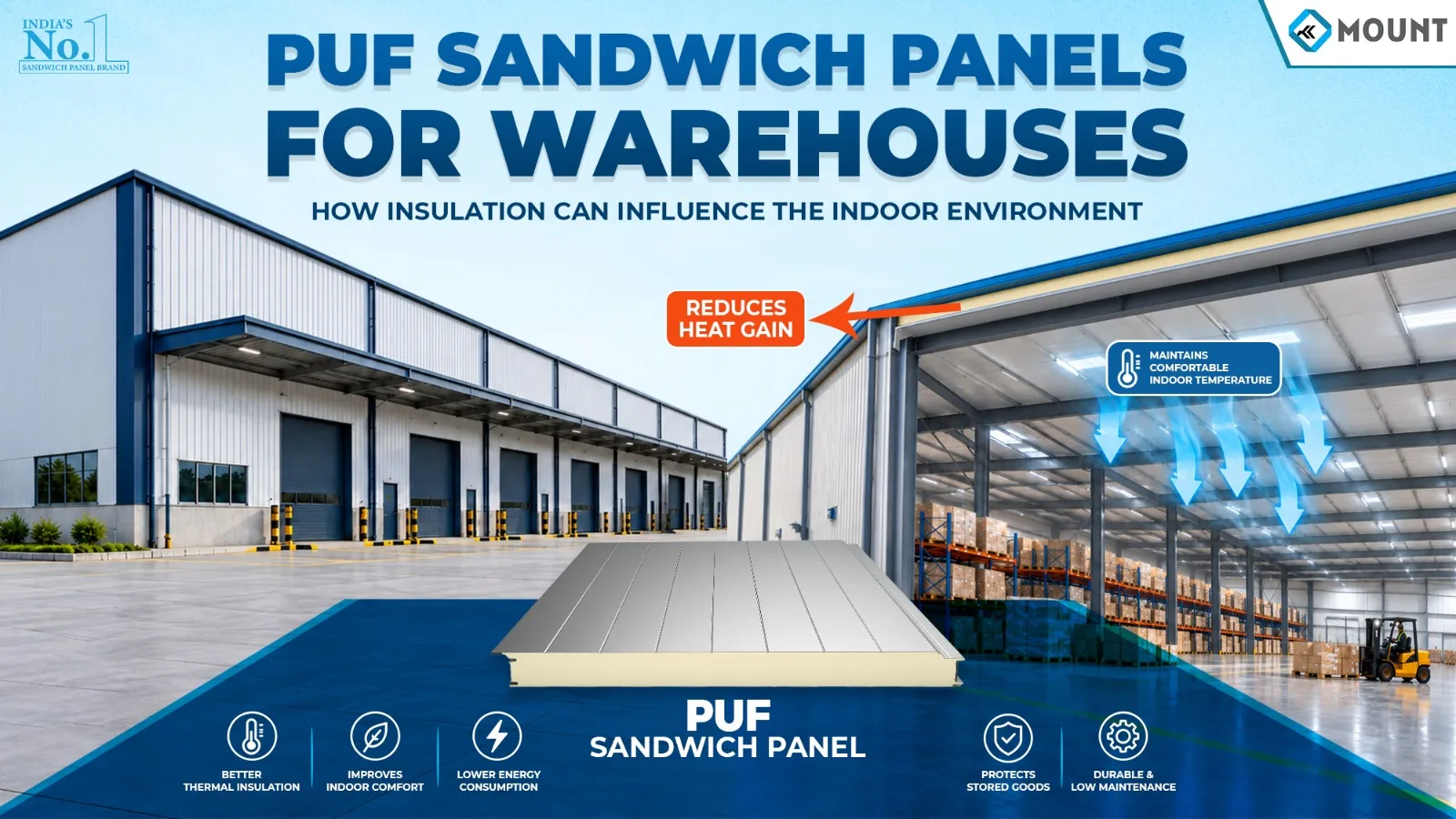
This is where a PUF Sandwich Panel can provide an advantage. Its rigid polyurethane foam core is positioned between metal facings, creating an insulated composite element for wall or roof applications.
How Mount Sandwich PUF Panels Support Thermal Insulation
The PUF core provides thermal resistance within the panel assembly, slowing the movement of heat between the exterior and interior surfaces.
Mount’s published product specifications include PUF/PUR insulation and panel thickness options from 30 mm to 200 mm for its roofing systems. The appropriate thickness should be determined according to the project’s thermal requirements rather than selected as a standard value for every warehouse.
For example, a general storage warehouse in a moderate climate may have very different requirements from a temperature-controlled distribution centre. Internal temperature targets, external design conditions, refrigeration or HVAC loads, occupancy and the type of goods being stored all influence the specification.
The same principle applies to wall panels. Mount provides insulated wall-panel configurations for industrial and warehouse applications, with thickness and facing options selected according to project needs.
Roof and Wall Insulation Should Be Designed Together
One of the most important considerations in warehouse design is avoiding an insulated roof combined with poorly insulated walls, or vice versa.
The roof is particularly exposed to solar radiation, while walls can experience different levels of heat gain depending on orientation and surrounding conditions. A coordinated roof-and-wall system creates a more continuous thermal envelope.
For large PEB warehouses, this approach also allows the insulated panels to be coordinated with the structural framing and roof geometry. Mount supplies both PUF panel and PEB solutions, supporting integration between the building structure and envelope.
Why Panel Thickness and Joints Matter
Insulation performance depends on more than the core material.
Panel thickness affects the thermal resistance of the assembly, but the required value depends on the building’s design conditions. Increasing thickness without considering HVAC design, thermal bridges and installation details does not automatically produce an efficient building.
Panel joints are equally important. Gaps or poorly executed connections can create thermal bridges and unwanted air or moisture pathways. Correct alignment, fastening, sealing and detailing around openings should therefore form part of the installation specification.
Installation quality can influence the performance of the completed envelope. Panels need to be handled, aligned and fixed according to the system requirements, particularly at corners, roof interfaces, wall junctions and penetrations.
This is why choosing among PUF Sandwich Panels Manufacturers and Suppliers should involve evaluating technical support and installation capability alongside material specifications.
Applications Across Warehousing and Logistics
Insulated PUF panel systems can be considered across several logistics environments:
Warehouses and Storage Facilities
For general storage, insulation can help moderate the influence of outdoor temperature changes on the internal environment. This can also improve working conditions in occupied areas, depending on ventilation and other building systems.
Distribution Centres
Large distribution centres often combine storage, sorting, loading and dispatch operations. Insulated walls and roofs can contribute to a more controlled indoor environment across these large operational spaces.
Logistics Hubs
Logistics facilities may operate for extended hours, making the interaction between the building envelope and mechanical cooling particularly relevant. An insulated envelope can reduce the rate of external heat transfer, although actual energy consumption depends on the complete building design.
Temperature-Sensitive Storage
Certain food products, pharmaceuticals, chemicals and other materials require specified temperature ranges. In such facilities, insulated panels can form part of the thermal enclosure, while refrigeration, HVAC, doors, airlocks and monitoring systems provide the remaining elements required for temperature control.
What Should Businesses Consider Before Selecting PUF Panels?
Before specifying a panel system, project teams should evaluate:
- Required indoor temperature and operating conditions
- Local outdoor design temperature and solar exposure
- Roof and wall panel thickness
- Core and facing specifications
- Panel joint and sealing details
- Door and loading-bay openings
- HVAC or refrigeration requirements
- Condensation and moisture considerations
- Structural and wind-load requirements
- Installation methodology and quality control
This technical assessment is more useful than selecting panels solely on the basis of price or nominal thickness.
Why Choose Mount for Warehouse Panel Solutions?
When comparing the Best Puf Sandwich Panels Manufacturers, businesses should look beyond the panel itself and assess manufacturing capability, product consistency, specification flexibility and project support.
Mount Roofing & Structures manufactures insulated sandwich panels and offers configurations for roofing and wall applications. Its published product range includes multiple thicknesses and customised panel lengths, supporting different industrial and warehouse requirements.
For organisations researching Top Puf Sandwich Panel Manufacturers From India, Mount combines panel manufacturing with PEB and roofing capabilities, allowing the building structure and envelope to be considered together. Its manufacturing profile includes a fully automated continuous panel line at its Tumakuru facility.
For project teams evaluating Wall Puf Sandwich Panels Manufacturing Companies In India, the practical question should be whether the supplier can support the required panel specification, dimensions, interfaces and installation requirements,not simply whether it can supply insulated panels.
Build the Warehouse Around Its Operating Requirements
Warehouse insulation should be treated as a building-envelope decision with direct implications for indoor conditions, occupant comfort and, where applicable, temperature-sensitive inventory.
Mount Sandwich PUF Panels provide an insulated roof and wall solution that can be configured around the requirements of warehouses, distribution centres, logistics hubs and controlled-storage facilities. By considering panel thickness, joints, roof-and-wall continuity and installation together, project teams can develop a more technically sound envelope for modern logistics infrastructure.
FAQs
- Q. What PUF panel thickness is suitable for a warehouse?
There is no universal thickness. It depends on the target indoor conditions, external climate, building use, HVAC requirements and desired thermal performance. Mount’s published roofing range includes thicknesses from 30 mm to 200 mm. - Can PUF panels be used for both warehouse roofs and walls?
Yes. Insulated PUF systems can be configured for both applications, allowing the roof and wall envelope to be designed as a coordinated system. Mount offers both roof and wall panel solutions. - Do PUF panels eliminate the need for warehouse cooling?
No. Insulation reduces the rate of heat transfer but does not replace HVAC or refrigeration where those systems are required. Actual cooling demand depends on factors including outdoor conditions, internal heat gains, ventilation, occupancy and building operation. - Why are panel joints important in an insulated warehouse?
Joints are potential thermal bridges and pathways for air or moisture movement. Correct joint detailing, sealing, alignment and installation are therefore important for achieving the intended envelope performance. - Are insulated PUF panels suitable for temperature-sensitive goods?
They can form part of the insulated enclosure for temperature-controlled storage, but the complete system must also account for refrigeration capacity, doors, air movement, humidity, monitoring and the required storage temperature. Mount specifically lists cold storage and food processing among its panel applications.
Similar Events
 23 October, 2026