 Sep 25, 2026
Why the Right Self Drilling Screw Can Extend the Life of Your Roofing System
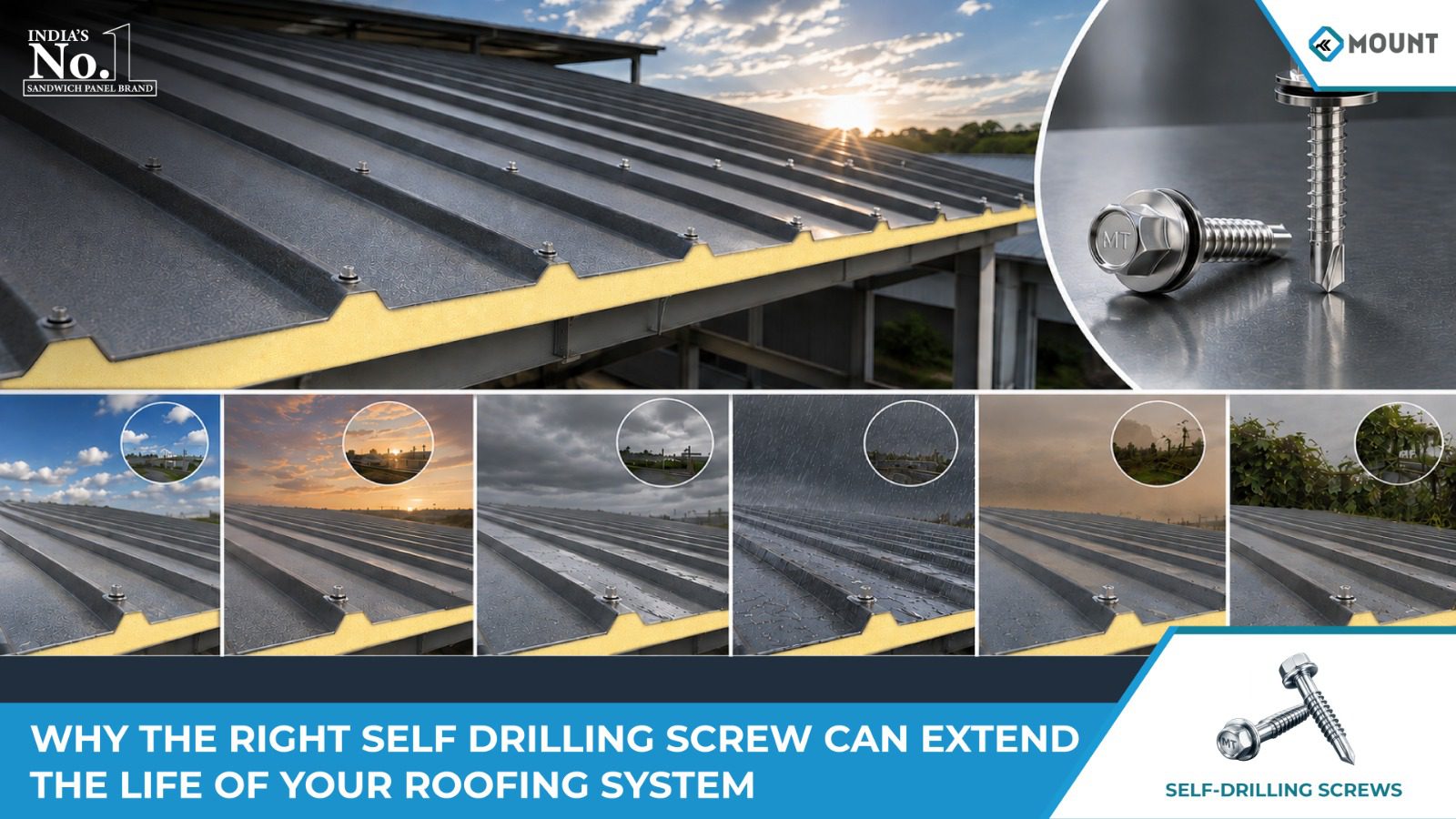
A roofing system can have the right sheet profile, adequate structural support and a well-designed drainage arrangement, yet still develop problems at the fixing points. Fasteners transfer loads between the roof covering and supporting structure, while also creating one of the most exposed interfaces in the building envelope. Their selection and installation influence resistance to wind actions, vibration, moisture ingress, corrosion and movement over time.
This makes industrial roofing panels dependent on more than the roofing material itself. Substrate compatibility, screw geometry, drilling capacity, coating, washer design, embedment and installation practice all need to work together. An unsuitable fastener can damage the sheet, fail to achieve adequate anchorage or compromise the weather seal around the fixing. The result can be leakage and maintenance issues even when the roofing sheets themselves remain in good condition.
1. The Screw Must Match the Substrate
The first consideration is the material and thickness being fastened. A screw selected for one substrate may not provide the same drilling performance or anchorage in another.
For metal roofing sheets for sheds, the fastening system may involve metal-to-metal or metal-to-purlin connections, each requiring the appropriate screw geometry and length. In sandwich-panel applications, the fastener must also be compatible with the panel construction and supporting member.
Mount’s self-drilling range uses carbon steel C1022 and includes configurations designed for metal-to-metal and panel-to-structure applications. The product catalogue also lists drilling capacity up to 4 mm for its MT Hex Flange Head Self Drilling Screws.
The correct length matters as well. Excessive or insufficient embedment can affect the connection, so screw length should be selected according to the total material thickness and supporting substrate.
2. Screw Geometry Affects Installation
A self-drilling screw is designed to create its own hole through the material, eliminating a separate pre-drilling operation when the substrate falls within its specified drilling capacity. This can make installation faster and more consistent across large roof areas.
For roofing sheets for industrial buildings, the drill point, thread geometry and head configuration should be selected according to the application. Mount’s MT screws use a hex flange head, with diameters of 4.8 mm, 5.5 mm and 6.3 mm in the documented range.
A suitable screw should penetrate the intended substrate cleanly without excessive force or distortion of the roofing material. Installation equipment should also be appropriate for the fastener so that the screw is driven correctly without damaging the head or surrounding sheet.
3. The Washer Is Part of the Weather Seal
The screw does more than hold the sheet down. At every fixing point, it also creates a potential pathway for water ingress. The washer and sealing arrangement therefore need to be treated as part of the roofing system.
For sandwich panels for roofing, a suitable sealing washer can help maintain a weather-tight fixing when correctly compressed. Mount’s Drill Fix range includes EPDM washer variants as well as metal-bonded washer configurations, with the EPDM option specified for watertight sealing at fixing points.
Washer compression requires control. Excessive tightening can damage the washer or distort the sheet, while insufficient compression may leave an inadequate seal. The installer should follow the fastener manufacturer’s installation recommendations rather than applying the same torque setting across every roofing application.
4. Corrosion Protection Should Match the Environment
A fastener can become a weak point if its protective coating is unsuitable for the surrounding environment. This is particularly relevant in coastal areas, industrial facilities and buildings exposed to persistent moisture or chemical pollutants.
For roofing panels for steel structures, the fastener coating should be selected alongside the roofing material and environmental exposure. Mount offers its MT self-drilling screws in zinc-plated and Ruspert/epoxy-coated variants.
Mount’s Ruspert-coated screw documentation specifies an anti-rust coating tested to withstand 1,000–1,200 hours of salt spray testing plus 15 Kesternich cycles, with the product recommended for highly corrosive environments and projects exposed to industrial chemicals.
The appropriate coating should still be selected based on the actual exposure classification rather than assuming that one finish is suitable for every building.
5. Installation Quality Determines Connection Performance
Even a correctly specified fastener can underperform if it is installed incorrectly. Screws should be positioned according to the roof manufacturer’s fixing pattern and structural design, with appropriate embedment into the supporting member.
For roofing panel manufacturer specifications, the fastening arrangement should be treated as part of the system rather than decided independently at site. Screw spacing, support location, edge distances and installation sequence should follow the approved roof design.
Overdriving is another common concern. Excessive force can deform the sheet around the fixing and compromise the washer seal. Underdriving can leave insufficient contact between the washer and roofing surface. Correct installation equipment and controlled driving practice are therefore essential.
Why Fastener Selection Matters Over the Roof’s Service Life
Roofing systems experience wind loading, thermal movement, vibration and repeated environmental exposure. These actions are transferred through the connections into the supporting structure. A properly selected fastener helps maintain the intended connection between the roof covering and its substrate.
Mount’s self-drilling screws are manufactured on an automated fastener manufacturing and threading line, with a documented annual production capacity of 7,000–12,000 MT. The range is used for roofing, cladding, structural fixing and sandwich-panel installation.
For an industrial project, this manufacturing capability becomes relevant when large quantities of fasteners must maintain consistent specifications throughout installation.
Mount Self Drilling Screws for Industrial Roofing
Mount’s fastening portfolio includes MT Hex Flange Head Self Drilling Screws and dedicated MT Self Drilling Screws for PUF Panels. The range is available in zinc-plated and Ruspert/epoxy-coated configurations, with carbon steel C1022 specified for the documented products.
For industrial roofing panels manufacturer projects, coordinating the fastener with the panel, purlin gauge and fixing requirement can simplify procurement and reduce the risk of using mismatched components. Mount’s wider manufacturing portfolio includes sandwich panels, PEB structures and roofing systems, allowing fastener selection to be considered alongside the building envelope.
The objective is straightforward: the screw should secure the roof without becoming a source of leakage, corrosion or premature maintenance.
Choosing the Right Fastener Is Part of Roof Engineering
The smallest component in a roofing system can influence the performance of a much larger assembly. Selecting the correct screw means considering the substrate, drilling capacity, diameter, length, coating, washer, embedment and installation method together.
Mount’s integrated manufacturing approach combines roofing products and self-drilling fasteners, giving project teams a coordinated route to specifying the components that hold the building envelope together. For contractors, consultants and industrial procurement teams, that coordination can help turn fastener selection from a routine purchase into a properly engineered part of the roofing system.
FAQs
Q. How do I select the correct self-drilling screw for a roofing application?
A. Start with the substrate, total material thickness, required embedment, drilling capacity, environmental exposure and washer requirement. The screw should then be selected according to the approved roofing and structural design.
Q. Why is the washer important on a roofing screw?
A. The washer forms part of the sealing interface around the fixing. Its material and compression need to be appropriate for the roofing application so that the fixing does not become a water-ingress point.
Q. Are Ruspert-coated screws suitable for corrosive environments?
A. Mount documents its Ruspert-coated screws for highly corrosive environments and projects exposed to industrial chemicals, with stated salt-spray and Kesternich-cycle test performance. Final suitability should be established against the actual exposure conditions.
Q. Can the same self-drilling screw be used for all roofing materials?
A. No. Substrate thickness, material type, panel construction and fixing requirements can differ significantly. Mount’s range includes dedicated screws for PUF panels as well as general MT Hex Flange Head Self Drilling Screws.
Q. How can incorrect screw installation affect a roof?
A. Incorrect drilling, embedment, alignment or tightening can compromise the connection and the sealing interface. Overdriving can damage the sheet or washer, while inadequate tightening may prevent proper sealing. Installation should follow the fastener and roofing system manufacturer’s specified method.
Similar Events