 Sep 3, 2026
How Roof Insulation Impacts Energy Costs in Manufacturing Facilities
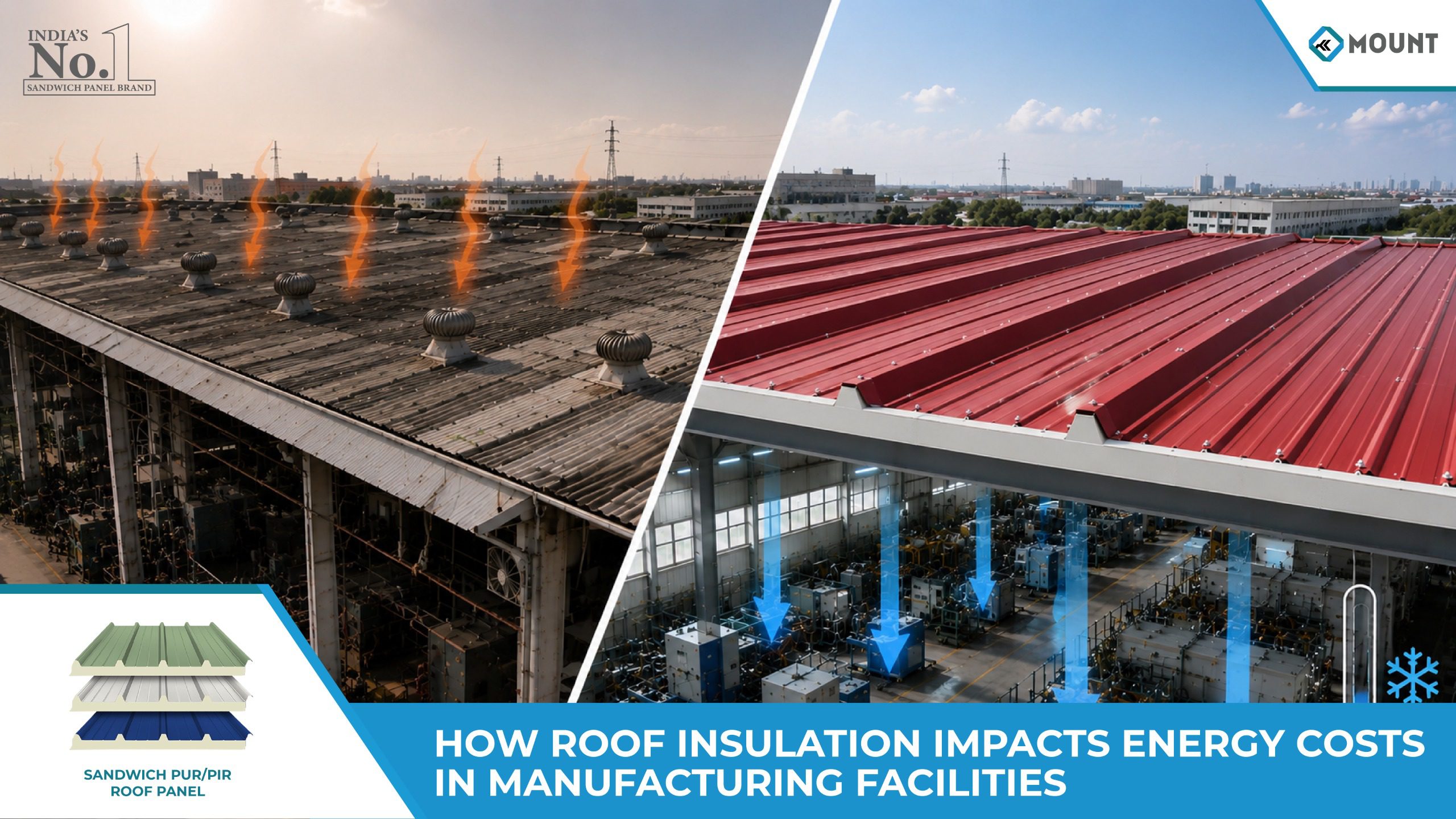
Energy consumption in a manufacturing facility is influenced by far more than the efficiency of its machinery. The building envelope also plays a role, particularly the roof, which may account for a substantial exposed surface area. In a large factory, warehouse or processing facility, solar radiation falling on the roof can increase heat transfer into the occupied space and consequently increase the cooling requirement.`
This is why PUF Sheets are increasingly considered as part of the energy strategy during industrial building design. The objective is not simply to make the roof thicker. It is to control heat flow through a properly engineered assembly, taking into account insulation properties, external conditions, joints, roof geometry and installation quality.
How Heat Enters a Manufacturing Facility Through the Roof
A roof exposed to strong solar radiation absorbs heat, raising the temperature of its external surface. The temperature difference between the outside and inside then drives heat transfer through the roofing assembly. The magnitude of this transfer depends on several factors, including outdoor temperature, solar exposure, roof construction, insulation thickness and the thermal conductivity of the insulation material.
In a manufacturing facility with HVAC-controlled areas, every additional amount of heat entering through the building envelope becomes part of the cooling load that the system must manage. The relationship is straightforward: better control of heat transfer can reduce the amount of heat that HVAC equipment needs to remove.
The insulation material therefore needs to be evaluated using measurable thermal properties rather than thickness alone. Mount’s PUF core, for example, is specified with thermal conductivity in the range of 0.022–0.028 W/m·K and a controlled core density of 38–42 kg/m³.
Insulation Thickness Matters, But So Does the Complete Assembly
Increasing insulation thickness generally increases the resistance to heat flow, but selecting the correct thickness for an industrial facility requires a project-specific assessment. Climate, internal operating temperature, HVAC design, occupancy, process heat and building orientation all influence the required thermal performance.
This is where Roofing PUF Panels can provide an engineered approach. Instead of adding insulation as a separate layer below a roof covering, the insulated core is manufactured between metal facings as one composite panel. Mount’s PUF range is available from 30 mm to 200 mm, allowing the specification to be aligned with the thermal requirements of the facility.
For an EPC contractor, the important consideration is therefore the designed U-value of the roof assembly rather than insulation thickness in isolation. Mount’s technical data provides U-values across different panel thicknesses, including approximately 1.05 W/m²K at 30 mm and 0.11 W/m²K at 200 mm.
Joints and Installation Can Influence Thermal Performance
Even when the insulation material itself has suitable thermal characteristics, gaps or poorly executed joints can compromise the continuity of the building envelope. Panel alignment, joint engagement, sealant application, fastener placement, flashing details and penetrations all require attention during installation.
A PUF Sandwich Panel system therefore needs to be treated as a complete roof assembly. Mount provides cam-lock and tongue-and-groove jointing configurations, depending on the panel application.
The same principle applies to roof penetrations for ducts, services, exhaust systems and other equipment. These interfaces need appropriate detailing so that the thermal and weather envelope remains continuous around the penetration. Good installation practice is consequently as important as the specified insulation value.
What Better Roof Insulation Can Mean for Facility Operations
When heat transfer through the roof is controlled, the HVAC system may have less sensible heat to remove during periods of high external temperature. This can contribute to a more stable internal environment, particularly in facilities where temperature control matters for workers, equipment or manufacturing processes.
For PUF Panels for Warehouses, this becomes particularly relevant because warehouses and logistics facilities can have very large roof areas combined with high internal volumes. The same consideration applies to manufacturing plants, food processing facilities, distribution centres and other industrial buildings where indoor conditions need to remain within defined operating parameters.
The resulting benefit should not be presented as a fixed percentage reduction in electricity consumption. Actual energy savings depend on the complete building envelope, HVAC efficiency, operating schedule, climate and internal heat loads. What insulation provides is better control over one significant pathway for heat transfer.
Mount Sandwich PUF Roof Panels for Industrial Applications
Mount Sandwich PUF Roof Panels combine a rigid polyurethane foam core with steel facings manufactured as a factory-produced composite element. The manufacturing process uses a continuous panel manufacturing line, with the core bonded between the facings under controlled production conditions.
As a PUF Sandwich Roof Sheet system, the panel can serve as the external roof covering and insulation layer within the same assembly. This can simplify site sequencing because separate installation of a roof sheet and insulation layer may not be necessary for applications designed around sandwich-panel construction.
Mount’s PUF panels are used across industrial warehouses, logistics centres, food and beverage processing, poultry and dairy facilities, cold storage and general industrial building envelopes.
Manufacturing Scale Matters When Energy-Efficient Roofing Is Specified
For a large manufacturing project, specifying the right panel is only one part of the procurement decision. The manufacturer also needs to support the required quantity, dimensional consistency and delivery schedule.
Mount operates continuous panel manufacturing infrastructure with a stated capacity of up to 7,00,000 square metres per month across its PUF, PIR and solar profiled panel production. Its PUF panels are available with pre-painted GI, Galvalume and stainless-steel facing options.
For project teams evaluating Insulated roofing sheet manufacturers, production scale and manufacturing controls become important when thousands of square metres must be supplied to a defined construction programme. Mount’s integrated manufacturing model brings insulated panels, PEB structures, roofing products and associated building-envelope components into one manufacturing ecosystem, supporting coordinated project procurement.
Choosing the Right Roofing Partner
Selecting a PUF Roofing Panel Manufacturer should involve more than comparing the quoted rate per square metre. EPC contractors and facility owners should assess core density, thermal conductivity, thickness tolerance, facing specification, joint configuration, technical documentation, manufacturing capacity and project support.
Mount approaches industrial roofing through this combination of product engineering and manufacturing capability. Its controlled panel production, broad thickness range and large-scale supply infrastructure allow manufacturers to develop roofing specifications around the actual thermal and operational requirements of their facilities.
For projects where energy consumption, indoor conditions and construction timelines need to be considered together, selecting the roof insulation system early can make the building envelope a more deliberate part of the facility’s overall performance strategy.
FAQs
Q. Does thicker roof insulation always result in lower energy consumption?
A. Not necessarily. Thickness should be selected based on the facility’s climate, internal temperature requirements, HVAC strategy, process loads and overall envelope design. Beyond a certain point, additional thickness may provide diminishing returns relative to the project requirement.
Q. How does roof insulation affect HVAC sizing?
A. Reducing conductive heat transfer through the roof can reduce the sensible cooling load attributable to the roof. HVAC sizing should still be calculated based on the complete building envelope, occupancy, equipment loads, ventilation and other heat gains.
Q. Why are joints important in an insulated roof system?
A. Joints maintain continuity between adjacent panels. Poorly aligned or inadequately sealed joints can create pathways for air and moisture movement and may reduce the effectiveness of the designed envelope.
Q. Are PUF roof panels suitable for manufacturing facilities with HVAC-controlled areas?
A. They can be suitable where their thermal characteristics, thickness, facing, joint system and structural configuration meet the project’s design requirements. The final specification should be based on the facility’s operating conditions rather than a generic panel selection.
Q. What should manufacturers check before selecting an insulated roof panel supplier?
A. Project teams should review thermal data, panel thickness options, core density, dimensional control, facing specifications, joint details, manufacturing capacity, documentation, logistics capability and technical support before finalising the supplier.
Similar Events
 23 October, 2026