 Nov 6, 2026
Who Is the Largest Sandwich Panel Manufacturer in India?
India’s sandwich panel manufacturing industry is expanding with growing demand from industrial buildings, warehouses, cold storage facilities, pharmaceutical units, food processing plants and pre-engineered building solutions.
Modern construction increasingly requires building materials that combine insulation, durability, manufacturing precision and efficient installation. Sandwich panels address these requirements by integrating an insulation core between protective outer facings.
But who is the largest sandwich panel manufacturer in India?
To understand a manufacturer’s position, buyers should evaluate production capacity, manufacturing infrastructure, automation, product portfolio, quality processes and project capabilities.
Mount Structures, popularly known as Mount has expanded its manufacturing operations through a major investment at its Tumakuru facility in Karnataka. The company’s published expansion information highlights a monthly sandwich PUF panel manufacturing capacity of 7,00,000 square metres, supported by additional manufacturing facilities for pre-engineered buildings, cold formed sections and polycarbonate sheets.
This article explores Mount manufacturing capabilities, sandwich panel products, industrial applications and the factors buyers should consider when selecting a sandwich panel manufacturer in India.
Table of Contents
- What Is a Sandwich Panel?
- Who Is the Largest Sandwich Panel Manufacturer in India?
- Mount Manufacturing Expansion
- Mount Manufacturing Capabilities at a Glance
- Types of Sandwich Panels and Insulated Solutions
- Next-Generation Product Portfolio
- Advanced Manufacturing Technology
- Why Manufacturing Capacity Matters
- Applications of Sandwich Panels Across Industries
- How to Choose the Right Sandwich Panel Manufacturer
- Frequently Asked Questions
What Is a Sandwich Panel?
A sandwich panel is a factory-manufactured building component consisting of two outer facings with an insulation core between them.
The outer facings are generally made from coated metal sheets, while the core material provides thermal insulation and other performance characteristics depending on the panel type.
Sandwich panels are commonly used in:
- Industrial roofing
- Factory wall cladding
- Warehouses
- Cold storage facilities
- Food processing units
- Pharmaceutical facilities
- Clean rooms
- Pre-engineered buildings
Their integrated construction makes them suitable for building envelopes that require insulation and efficient installation.
Main Components of a Sandwich Panel
- Outer Metal Sheets
The external facings protect the insulation core and contribute to the panel’s surface finish, durability and structural performance.
- Insulation Core
The insulation core helps control heat transfer. Its material and properties determine important performance characteristics.
- Jointing System
The panel joints connect individual sections and help maintain the continuity of the insulated building envelope.
Common Sandwich Panel Core Materials
- PUF – Polyurethane Foam
- PIR – Polyisocyanurate
- Rockwool – Mineral Wool
- EPS – Expanded Polystyrene
Each material has different performance characteristics and should be selected according to project requirements, including thermal insulation, fire performance and acoustic considerations.
Who Is the Largest Sandwich Panel Manufacturer in India?
Identifying the largest sandwich panel manufacturer requires considering the type of panel being manufactured and the production capacity associated with that product category.
Manufacturers may specialise in different insulation materials, panel configurations and industrial building solutions. Therefore, production capacity should always be compared using the same product category and measurement basis.
Mount has established a large-scale sandwich PUF panel manufacturing operation at its Tumakuru facility in Karnataka.
According to its published manufacturing expansion information, the company has a reported sandwich PUF panel production capacity of 7,00,000 square metres per month following the commissioning of its second fully automated continuous production line.
The company’s expanded manufacturing infrastructure also includes facilities for pre-engineered buildings, cold formed sections and polycarbonate sheets.
These capabilities make Mount a significant manufacturer in India’s sandwich PUF panel segment.
For buyers, the important consideration is not just a manufacturer’s stated capacity, but also its production infrastructure, technical specifications, quality processes and ability to meet project requirements.
Mount Manufacturing Expansion: A ₹250 Crore Investment
Mount has undertaken a major manufacturing expansion at its Tumakuru campus in Karnataka.
The company describes this investment as an important milestone in its manufacturing growth, with an emphasis on automation, production speed and engineering precision.
The expansion includes two major manufacturing additions.
1. Second Fully Automated Continuous Sandwich PUF Panel Production Line
Mount has commissioned its second fully automated continuous sandwich PUF panel production line.
According to the company’s published information, this addition increases its sandwich PUF panel manufacturing capacity to 7,00,000 square metres per month.
The automated production line supports:
- Improved production speed
- Consistent manufacturing processes
- Better production accuracy
- Controlled panel processing
- Large-volume manufacturing requirements
2. Second Fully Integrated Pre-Engineered Building Manufacturing Facility
The expansion also includes a second integrated pre-engineered building manufacturing facility.
The facility brings multiple manufacturing processes together, including:
- Fabrication
- Blasting
- Painting
- Forming
- Finishing
This integrated manufacturing setup is designed to support more coordinated production operations.
The company highlights several expected operational benefits:
- Faster fabrication cycles
- Higher production reliability
- Greater customisation
- Stronger quality assurance
- Streamlined end-to-end delivery
Together, these manufacturing additions strengthen Mount capabilities in insulated panel production and industrial building solutions.
Mount Manufacturing Capabilities at a Glance
Mount expanded manufacturing operations cover multiple product categories.
According to the company’s published expansion page, its manufacturing capacity includes:
| Product Category | Reported Monthly Capacity |
| Sandwich PUF Panels | 7,00,000 sq. metres |
| Pre-Engineered Buildings | 2,500 MT |
| Cold Formed Sections | 1,000 MT |
| Polycarbonate Sheets | 350 tons |
These capacities represent different manufacturing categories and measurement units. They should not be combined into a single production figure.
22-Acre Manufacturing Campus
Mount expansion information describes its Tumakuru facility as a 22-acre manufacturing campus.
The campus supports its expanded production infrastructure and multiple manufacturing operations.
₹250 Crore Investment
The company reports an investment of ₹250 crore in its manufacturing expansion.
This investment supports the development of its expanded manufacturing ecosystem and production capabilities.
400+ Jobs Created
According to the published expansion information, the project has generated more than 400 jobs.
The expansion represents an important development in the company’s manufacturing operations and regional industrial presence.
Types of Sandwich Panels and Insulated Solutions
Different industrial applications require different insulation materials and panel configurations.
Mount’s published product portfolio includes several insulated panel systems.
1. Sandwich PUF Panels
PUF sandwich panels consist of a polyurethane foam insulation core placed between two outer metal sheets.
They are commonly used for:
- Industrial buildings
- Warehouses
- Factory roofing
- Insulated wall systems
- Commercial buildings
- Temperature-controlled spaces
Panel thickness, core properties, metal sheet specifications and installation arrangements should be selected according to the application.
2. Rockwool Sandwich Panels
Rockwool sandwich panels use mineral wool as the insulation core.
They are considered for applications where fire resistance and acoustic insulation are important.
Their suitability should be assessed using the relevant product specifications and fire-performance test documentation.
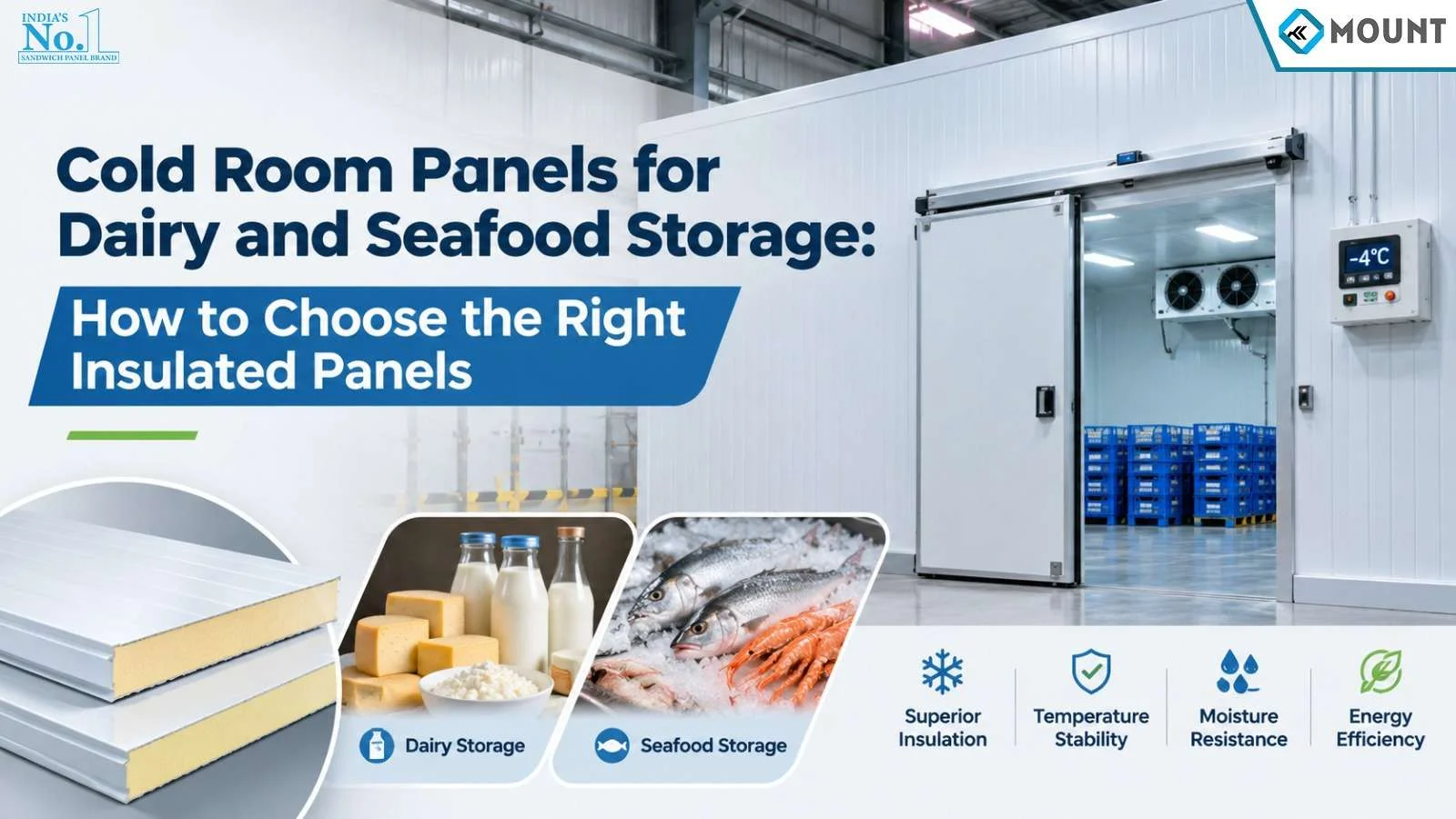
3. Cold Room Panels
Cold room panels are designed for temperature-controlled facilities.
They are used in applications such as:
- Dairy storage
- Seafood storage
- Food processing
- Refrigerated warehouses
- Pharmaceutical storage
- Cold chain facilities
The complete cold room enclosure should be designed by considering insulation, joints, doors, flooring and refrigeration requirements.
Explore cold room insulation panels for temperature-controlled applications.
4. Clean Room Solutions
Clean room panel systems are used in controlled environments where hygiene, surface finish and enclosure integrity are important.
Typical applications include pharmaceutical manufacturing, laboratories, healthcare facilities and electronics production.
The appropriate panel system depends on the facility’s operational and hygiene requirements.
Mount Next-Generation Product Portfolio
In addition to its manufacturing expansion, Mount’s published product portfolio highlights solutions for different industrial building requirements.
Sandwich PUF Roof Panels
MountRoof’s PUF roofing sheets are designed for insulated roofing applications in industrial buildings, warehouses and commercial structures.
Insulated Wall Systems
Insulated PUF wall panels are used for wall cladding, industrial enclosures and building partitions where thermal insulation is required.
Rockwool Sandwich Panels
Designed for applications requiring specific fire and acoustic performance characteristics.
Cold Room Panels
Used to construct insulated enclosures for refrigerated storage and temperature-controlled facilities.
Clean Room Solutions
Designed for controlled environments that require suitable panel surfaces and enclosure systems.
This product portfolio allows project teams to consider different insulated building solutions according to their requirements.
Advanced Manufacturing Technology at Mount
Manufacturing technology plays an important role in the consistency and efficiency of insulated panel production.
Mount expansion highlights three major areas of manufacturing capability.
1. Sandwich Panel Manufacturing
The automated continuous sandwich PUF panel production line supports large-volume panel manufacturing.
Important production considerations include metal sheet preparation, profiling, insulation core application, bonding, cutting and dimensional inspection.
2. Advanced PEB Manufacturing Systems
The integrated PEB manufacturing facility supports processes such as fabrication, blasting, painting, forming and finishing.
Bringing these processes together helps coordinate manufacturing activities for pre-engineered building components.
3. Polycarbonate Manufacturing
Mount published expansion information also identifies a polycarbonate sheet manufacturing facility with a reported capacity of 350 tons per month.
This adds another product category to its broader manufacturing portfolio.
Why Manufacturing Capacity Matters for Industrial Projects
Production capacity is an important consideration when selecting a manufacturer for large industrial projects.
It can influence production planning, material availability and supply coordination.
Bulk Order Management
Large industrial buildings and warehouses may require substantial panel quantities.
Manufacturing capacity helps suppliers plan and manage these requirements.
Production Scheduling
Automated production infrastructure can support the coordination of panel manufacturing with project schedules.
Product Consistency
Controlled manufacturing processes help maintain specified product dimensions and production characteristics.
Customisation Requirements
Industrial projects may require different panel lengths, profiles, thicknesses and configurations.
Manufacturers should be able to confirm the availability of these options.
Delivery Coordination
Manufacturing capacity needs to be supported by proper packaging, transportation and dispatch planning.
A high stated production capacity does not automatically guarantee product quality or timely delivery. Buyers should also review quality documentation and confirm project commitments.
Applications of Sandwich Panels Across Industries
Sandwich panels are used in several industries because different panel configurations can support different building requirements.
Industrial Buildings
Used for factory roofing, insulated walls and industrial building envelopes.
Warehouses and Logistics Facilities
Used in warehouse roofing and wall systems where suitable insulation and building protection are required.
Cold Storage Facilities
Used to construct insulated enclosures for refrigerated storage and temperature-controlled operations.
Food Processing Units
Used in selected food processing environments where temperature management and suitable surface finishes are important.
Pharmaceutical Facilities
Specialised insulated panel systems are used in pharmaceutical production and controlled environments.
Clean Rooms and Laboratories
Used in facilities where hygiene, cleanability and enclosure integrity are important.
Commercial Buildings
Insulated panels may be incorporated into suitable commercial roofing, wall cladding and building systems.
How to Choose the Right Sandwich Panel Manufacturer in India
Manufacturing capacity is only one part of supplier evaluation.
Before selecting a sandwich panel manufacturer, buyers should consider the following factors.
1. Manufacturing Infrastructure
Check whether the manufacturer has the production facilities and equipment needed for your required panel type.
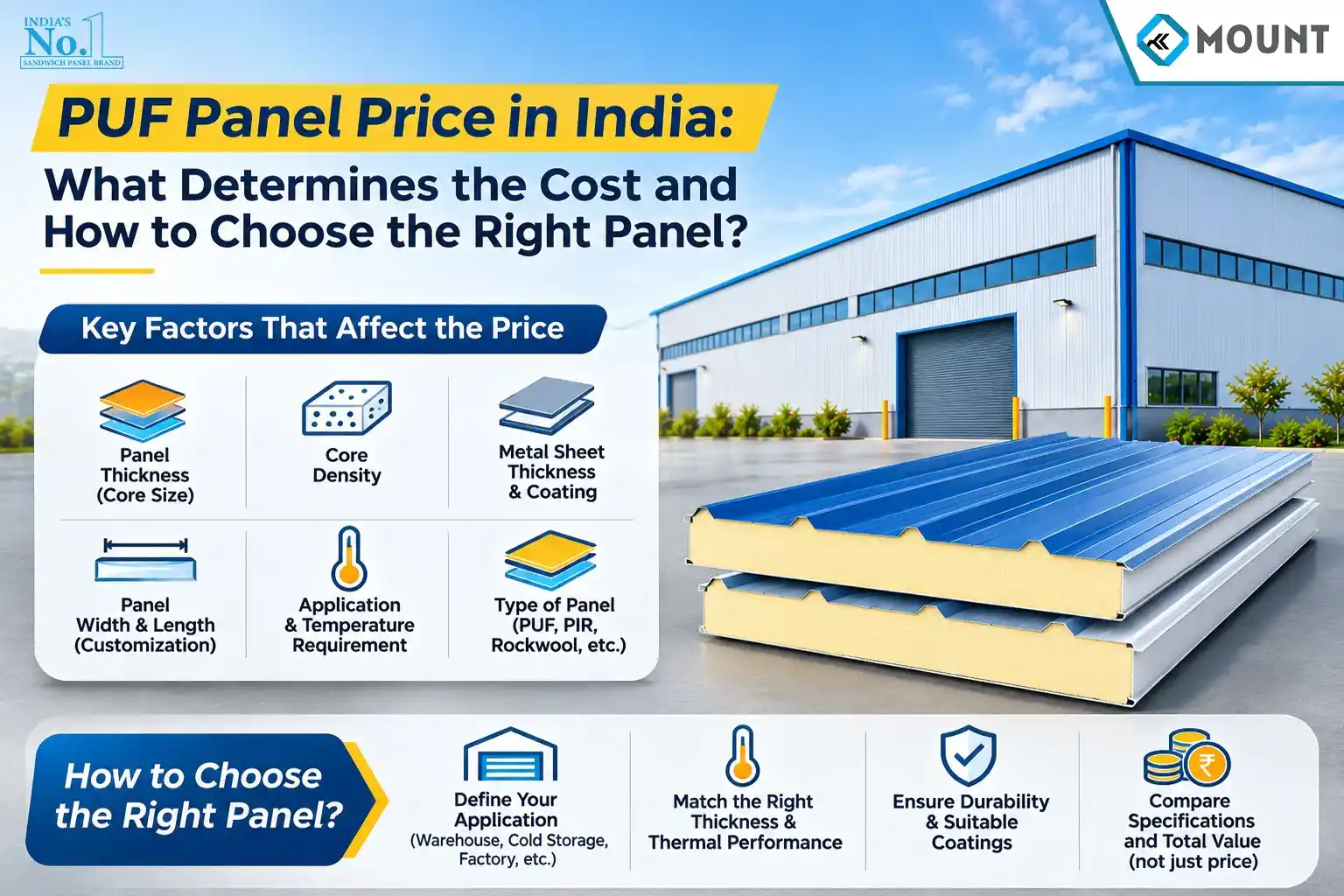
2. Product Specifications
Review:
- Insulation core material
- Panel thickness
- Core density
- Thermal conductivity
- Metal sheet thickness
- Protective coating
- Panel profile
- Effective coverage width
3. Quality Documentation
Request technical datasheets, relevant test reports and applicable quality certificates.
4. Product Range
Check whether the manufacturer offers suitable panel systems for roofing, walls, cold storage and other specialised applications.
5. Project Experience
Evaluate the manufacturer’s experience with projects similar to your building or facility requirements.
6. Production and Delivery Planning
Confirm manufacturing schedules, order quantities, dispatch arrangements and delivery commitments.
7. Technical Support
Ask about product selection guidance, installation requirements, jointing systems and technical assistance.
8. Warranty and After-Sales Support
Understand product warranty conditions and the support available after delivery and installation.
Frequently Asked Questions About Sandwich Panel Manufacturers in India
1. Who is the largest sandwich panel manufacturer in India?
There is no single independently verified national ranking covering every sandwich panel material and manufacturer. Mount reports a monthly production capacity of 7,00,000 square metres specifically for sandwich PUF panels following its manufacturing expansion.
2. What is the monthly sandwich PUF panel production capacity of Mount?
Mount published manufacturing expansion information reports a sandwich PUF panel production capacity of 7,00,000 square metres per month.
3. Where is the Mount manufacturing facility located?
Mount expanded manufacturing campus is located in Tumakuru, Karnataka, India.
4. How much did Mount invest in its manufacturing expansion?
Mount published expansion information describes an investment of ₹250 crore in its manufacturing expansion.
5. How large is the Mount manufacturing campus?
The company’s published expansion information describes its manufacturing campus as spanning 22 acres.
6. What other manufacturing capacities does Mount have?
The expansion page reports monthly capacities of 2,500 MT for pre-engineered buildings, 1,000 MT for cold formed sections and 350 tons for polycarbonate sheets.
7. What types of sandwich panels are available?
Common sandwich panel types include PUF, PIR, Rockwool and EPS panels. Product availability depends on the manufacturer’s portfolio.
8. What is the difference between PUF and Rockwool sandwich panels?
PUF panels use polyurethane foam for thermal insulation, while Rockwool panels use mineral wool and are selected for applications requiring specific fire and acoustic performance characteristics.
9. Are sandwich panels suitable for cold storage?
Yes. Specialised insulated panels are commonly used in cold storage facilities. Panel selection should consider operating temperatures, insulation requirements, jointing, sealing and refrigeration design.
10. What are sandwich panels used for in industrial buildings?
They are commonly used for insulated roofing, wall cladding, partitions, cold storage enclosures and other industrial building applications.
11. Why is automated sandwich panel manufacturing important?
Automated manufacturing helps control production processes, support repeatable panel dimensions and coordinate different stages of panel production.
12. Does higher production capacity guarantee better panel quality?
No. Manufacturing capacity indicates production scale. Buyers should also evaluate material specifications, quality controls, technical documentation and product consistency.
13. What specifications should buyers check before purchasing sandwich panels?
Important specifications include insulation core material, thickness, density, thermal conductivity, metal sheet thickness, coating, panel profile, dimensions and installation requirements.
14. What is the difference between roof and wall sandwich panels?
Roof panels are designed for roofing applications, including drainage and weatherproofing requirements. Wall panels are designed for wall cladding and partition applications. Their profiles, fixing arrangements and design requirements can differ.
15. How should buyers select a sandwich panel manufacturer?
Buyers should compare manufacturing capabilities, product specifications, technical documentation, quality processes, delivery planning, project experience and technical support.
Conclusion
Sandwich panels have become important components of modern industrial construction, supporting insulated roofing, wall cladding, cold storage and specialised building applications.
Mount manufacturing expansion at Tumakuru includes a reported sandwich PUF panel production capacity of 7,00,000 square metres per month, a second fully automated continuous panel production line and an integrated pre-engineered building manufacturing facility.
With additional manufacturing capabilities in cold formed sections and polycarbonate sheets, Mount expanded infrastructure supports a broader range of industrial building requirements.
For buyers planning industrial buildings, warehouses, cold storage facilities or insulated building envelopes, the right manufacturer should be selected based on verified production capabilities, technical specifications, quality documentation and project requirements.
Similar Events
 06 November, 2026