 May 19, 2026
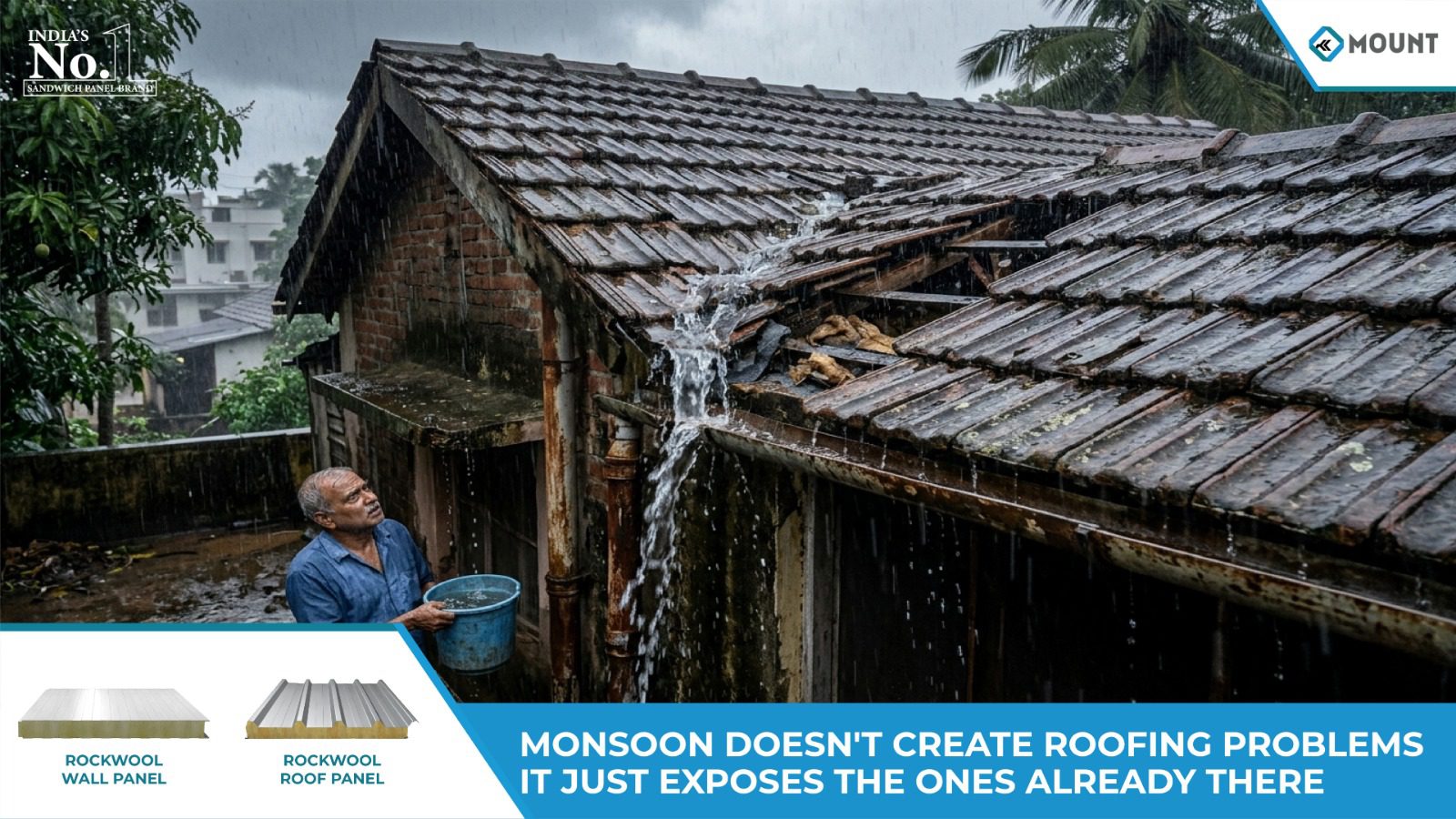
Monsoon Doesn’t Create Roofing Problems: It Just Exposes the Ones Already There
Every year, the same pattern repeats.
First heavy rain, and suddenly there are leaks. Water stains appear where nothing existed before. Panels that seemed fine during summer start showing issues.
It’s easy to blame the monsoon. But in most cases, the rain isn’t the problem , it’s just the first time the roof is being tested continuously.
What shows up during those weeks is usually the result of decisions made much earlier , design shortcuts, material compromises, or installation gaps that didn’t seem critical at the time.
Water Doesn’t Enter Randomly , It Follows Weak Points
A properly built roofing system doesn’t fail under rain. It fails where continuity is broken.
Most leak paths start at joints , panel overlaps, fastener penetrations, ridge connections. These are areas where sealing depends on both design and execution.
In systems using sandwich panels for roofing, even a small discontinuity in joint sealing can allow capillary action to pull water inside. Once that happens, the path isn’t always vertical. Water travels laterally along panel interfaces or insulation layers.
This is why leaks often appear away from the actual entry point, making diagnosis more complicated.
Waterproofing Isn’t a Layer , It’s a System
There’s a tendency to treat waterproofing as an add-on. In reality, it’s built into how the roof is designed.
Panel geometry, joint profile, sealant compatibility, and fastening method all contribute to water resistance.
For example, in Roofing PUF Panels, the interlocking mechanism plays a major role. If alignment is off even slightly during installation, the joint loses its effectiveness.
Sealants applied on wet or dusty surfaces also fail prematurely. During dry months, this may not show. Under sustained rainfall, it becomes obvious very quickly.
Drainage Design: The Most Underestimated Factor
Drainage Issues That Lead to Long-Term Damage
Water that doesn’t drain becomes a structural problem over time.
Key drainage-related issues include:
- Insufficient roof slope (less than design requirement)
- Blocked gutters due to debris accumulation
- Improperly sized downpipes
- Uneven purlin levels creating local depressions
- Lack of overflow provisions
In large-span structures like a roof for warehouse, even small deviations in slope can result in ponding, increasing load and exposure duration.
Material Behaviour Under Continuous Moisture
Materials don’t fail instantly under rain. They degrade.
Low-grade metal sheets begin to corrode at exposed edges. Coatings lose adhesion. Insulation layers absorb moisture if not properly sealed.
For Rockwool Roof Panels, moisture ingress can affect thermal performance if the system is not sealed correctly. While the core itself is non-combustible, trapped moisture can still create performance issues.
Similarly, in systems sourced from a PUF Roofing Panel Manufacturer, bonding integrity between layers becomes important. Once water enters, it can weaken adhesion over time.
Installation Gaps , The Real Root Cause
Most roofing failures trace back to installation, not material.
Misaligned panels, uneven fastening torque, improper sealant application , these are small errors individually, but they create cumulative risk.
During dry conditions, these gaps remain inactive. Under continuous rainfall, they become active failure points.
This is why working with an experienced roofing panel manufacturer who also understands execution reduces risk. The gap between design intent and on-site implementation becomes smaller.
Why Repairs During Monsoon Rarely Solve the Problem
Once leaks appear during monsoon, fixing them becomes difficult.
Wet surfaces prevent proper sealing. Identifying the exact entry point is challenging because water travels internally. Temporary fixes may stop visible leakage but don’t address the underlying issue.
In many cases, repairs carried out during this period need to be revisited once conditions improve.
For buildings using peb roofing panels, this often leads to repeated intervention cycles , patchwork instead of resolution.
Preventive Engineering vs Reactive Maintenance
The difference between a stable roof and a problematic one usually comes down to when the issues are addressed.
Preventive checks before monsoon , joint inspection, sealant verification, drainage clearance , are far more effective than reactive repairs during rain.
For systems built with insulated panels for steel buildings, maintaining joint integrity and ensuring no exposure points exist is critical before the season begins.
This approach shifts roofing from a maintenance concern to a performance-controlled system.
Mount Roofing & Structures: Addressing the Root, Not the Symptom
Mount approaches roofing systems with a focus on eliminating failure points at the design and execution stage.
Instead of treating leaks as isolated issues, the emphasis is on understanding how water interacts with the entire system , joints, slopes, materials, and installation practices.
As a Top PUF Panels Manufacturer And Suppliers In India, their approach integrates panel design with real-world site conditions, reducing the likelihood of hidden vulnerabilities.
For clients, this means fewer surprises when the roof is exposed to continuous stress.
Final Thought
Monsoon doesn’t damage a roof that’s been engineered correctly.
It simply exposes:
- Weak joints
- Poor sealing
- Incomplete drainage
- Installation inconsistencies
The difference between a stable system and a problematic one usually comes down to what was checked or ignored , before the rains began.
FAQs
Q1: Why do roof leaks appear suddenly during monsoon?
A: Because continuous rainfall exposes existing weak points that remain inactive during dry conditions.
Q2: Can panel joints alone cause leakage?
A: Yes, improperly sealed or misaligned joints are one of the most common sources of water ingress.
Q3: How does water travel inside roofing systems?
A: Through capillary action and internal layers, often appearing away from the original entry point.
Q4: Are temporary repairs effective during monsoon?
A: They can reduce visible leakage but usually don’t resolve the root cause due to wet conditions.
Q5: How can roofing failures be prevented before monsoon?
A: Through inspection of joints, sealants, drainage systems, and ensuring proper alignment and sealing of panels.
Similar Events
 23 October, 2026