 May 1, 2026
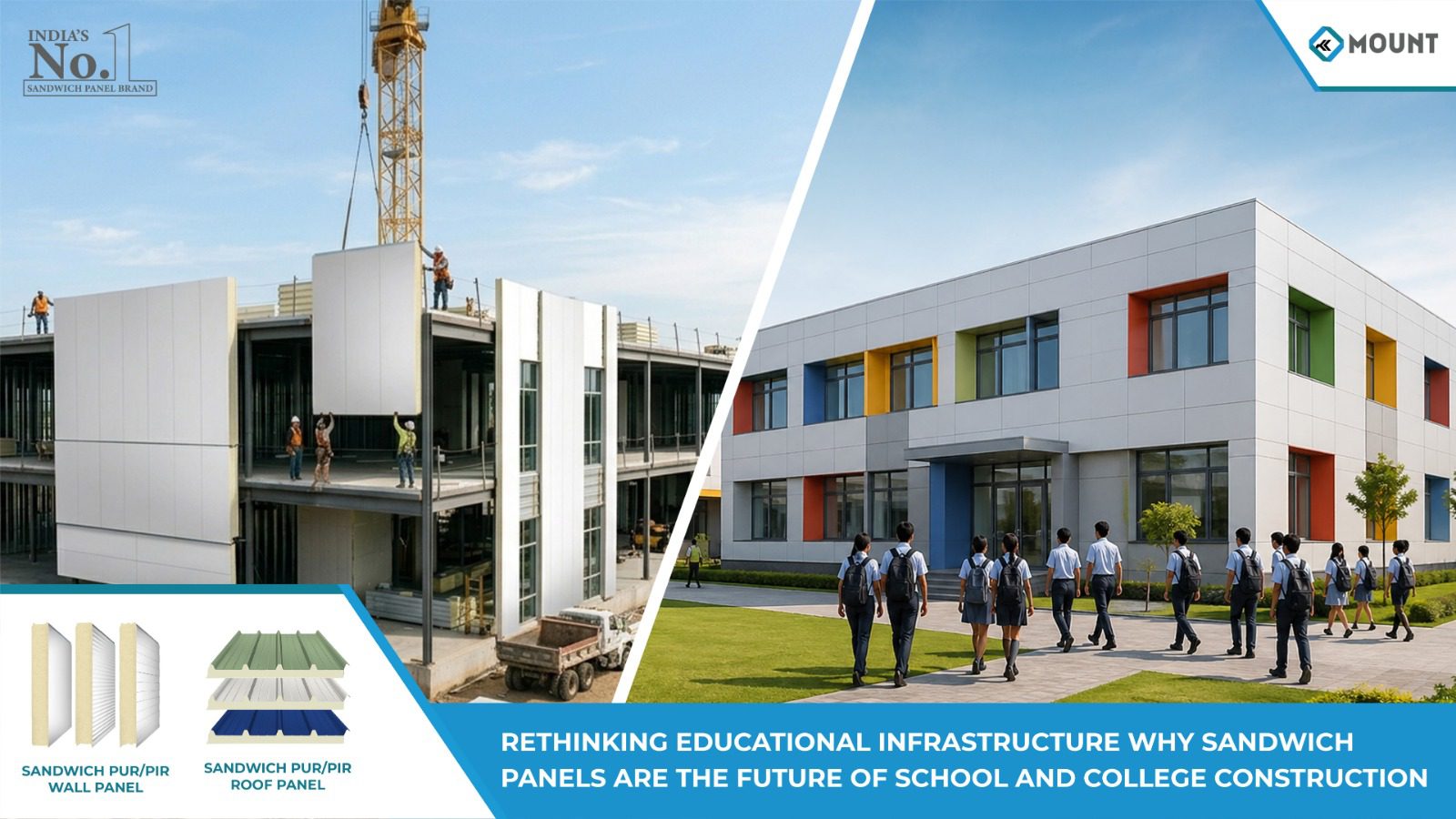
Rethinking Educational Infrastructure: Why Sandwich Panels Are the Future of School and College Construction
Across India, educational infrastructure is expanding at a pace that most traditional construction systems struggle to keep up with. New schools, private universities, and training institutes are coming up not just in metros, but across Tier II and Tier III regions as well. The challenge isn’t demand , it’s execution.
Most institutional projects still rely on conventional construction methods. While familiar, these methods come with predictable issues: extended timelines, cost variability, and buildings that start demanding maintenance sooner than expected. For institutions trying to go operational within a fixed academic calendar, delays are more than just inconvenience , they directly affect revenue cycles and admissions.
This is where engineered construction systems are beginning to take precedence. Companies like Mount are actively working with institutions to move away from fragmented construction approaches toward integrated building solutions. In this context, working with a sandwich panel manufacturer is less about sourcing material and more about adopting a faster, more controlled construction methodology.
Moving Beyond Conventional Materials
At a basic level, sandwich panels consist of two metal sheets with an insulated core. But in practice, their role is much more structural. They replace multiple layers of conventional construction , walling, insulation, and finishing , with a single system.
Depending on the requirement, different panel types are used. PUF panels are typically selected where thermal performance is critical. EPS panels are often used for more cost-sensitive applications. Rockwool panels come into play where fire resistance and acoustic control are priorities.
For institutions exploring insulated panels for steel buildings, this approach simplifies both design and execution. Instead of coordinating multiple vendors and materials, the building envelope becomes a single engineered component.
Where Traditional Construction Falls Short
One of the biggest issues with conventional school and college construction is time. Projects tend to stretch, often crossing academic deadlines. On top of that, maintenance begins earlier than anticipated , seepage, heat gain, and acoustic issues are common complaints.
Classrooms in particular highlight these gaps. Poor insulation leads to uncomfortable indoor conditions, especially in regions with high temperature variation. Noise control is another concern, especially for campuses located near highways or urban zones.
Scalability is another limitation. Many institutions expand in phases, but traditional structures don’t always allow seamless additions. This is where working with an experienced insulation panel supplier changes the approach entirely , buildings are designed with expansion in mind from day one.
What Sandwich Panels Change
The most immediate difference is speed. Panel-based construction reduces dependency on on-site processes, allowing faster erection of structures. This helps institutions align project completion with academic schedules more reliably.
Thermal insulation is another major advantage. Buildings remain more stable internally, reducing the need for continuous cooling. Over time, this has a direct impact on operational costs.
Acoustic performance also improves noticeably. Whether it’s lecture halls or auditoriums, better sound control creates a more focused learning environment.
From a maintenance standpoint, panels require far less intervention compared to conventional walls. This is one of the reasons why sandwich panels for walls are increasingly being specified in institutional projects.
Application Across Campus Infrastructure
Educational campuses are not uniform , they include classrooms, labs, hostels, admin blocks, and sports facilities. One of the reasons panel systems are gaining traction is their ability to adapt across all these formats.
For example, laboratory spaces benefit from the clean, non-porous surfaces of panels. Hostels require thermal comfort. Auditoriums demand acoustic control. A single system that can address all these requirements reduces complexity at the design stage.
Working with a puf panel manufacturer allows institutions to standardise construction across campus while still meeting different functional needs.
Looking at Cost Beyond Construction
There’s often a perception that panel-based systems are only about faster construction. In reality, the bigger advantage shows over time.
Shorter project timelines reduce financing costs. Lower energy consumption brings down operational expenses. Minimal maintenance reduces lifecycle costs. When looked at together, the return on investment becomes clearer.
This is where engaging a reliable sandwich panel manufacturer becomes critical , not just for supply, but for long-term project viability.
Design and Compliance Considerations
Modern campuses are also paying more attention to how infrastructure looks and feels. Sandwich panels offer enough flexibility in finishes and colours to support contemporary architectural design without adding complexity.
Safety remains a key requirement. Solutions like Fire Proof Wall Panels and Rockwool-based systems address fire compliance, especially in high-occupancy buildings. Advanced options such as PIR Sandwich Panels and Modular PUR Panels are also being considered for projects where both fire performance and insulation are important.
Mount Roofing & Structures: A Systems-Driven Approach
Mount has been working in this space for over three decades, but what sets them apart is their approach. Instead of operating as a material supplier, they function as a solutions provider , integrating panels, structural systems, and execution.
As a Top PUF Panels Manufacturer And Suppliers In India, their strength lies in controlled manufacturing, project-specific customisation, and the ability to deliver within defined timelines. For institutional clients, this reduces coordination challenges and ensures consistency across large-scale projects.
For decision-makers evaluating infrastructure partners, the advantage is clear , fewer dependencies, better control, and predictable outcomes.
What the Future Looks Like
Educational infrastructure is moving toward modular, scalable models. Institutions want buildings that can adapt , whether that means expanding capacity, upgrading facilities, or improving energy efficiency.Sandwich panels fit naturally into this shift. They allow faster construction, better performance, and easier expansion. More importantly, they align with how institutions are now thinking about infrastructure , not as a one-time investment, but as a long-term asset.
FAQs
Q1 : In what ways do sandwich panels accelerate construction schedules in educational facilities?
A : Panel construction enables the simultaneous execution of several stages in parallel because of eliminating several processes carried out on-site, such as curing and plastering.
Q2 : What considerations should be made in choosing among PUF, EPS, and Rockwool panels?
A : It depends on the need for heat insulation, fire safety criteria, acoustic performance, and financial restrictions. While Rockwool panels should be applied in areas critical from the fire-safety perspective, PUF panels demonstrate higher insulation properties.
Q3 : Are sandwich panels effective in terms of spanning large spans, as auditoriums require?
A : Yes, in combination with steel structures, sandwich panels help build large spans economically.
Q4 : Can existing campuses be expanded using sandwich panels?
Yes, panel systems are modular, making them suitable for phased expansion without major disruption.
Q5 : Is phased construction possible using sandwich panels?
Due to modularity, panel construction allows extending buildings and integrating additional objects into campus architecture without hindering operations.
Similar Events
 23 October, 2026