 Jul 8, 2026
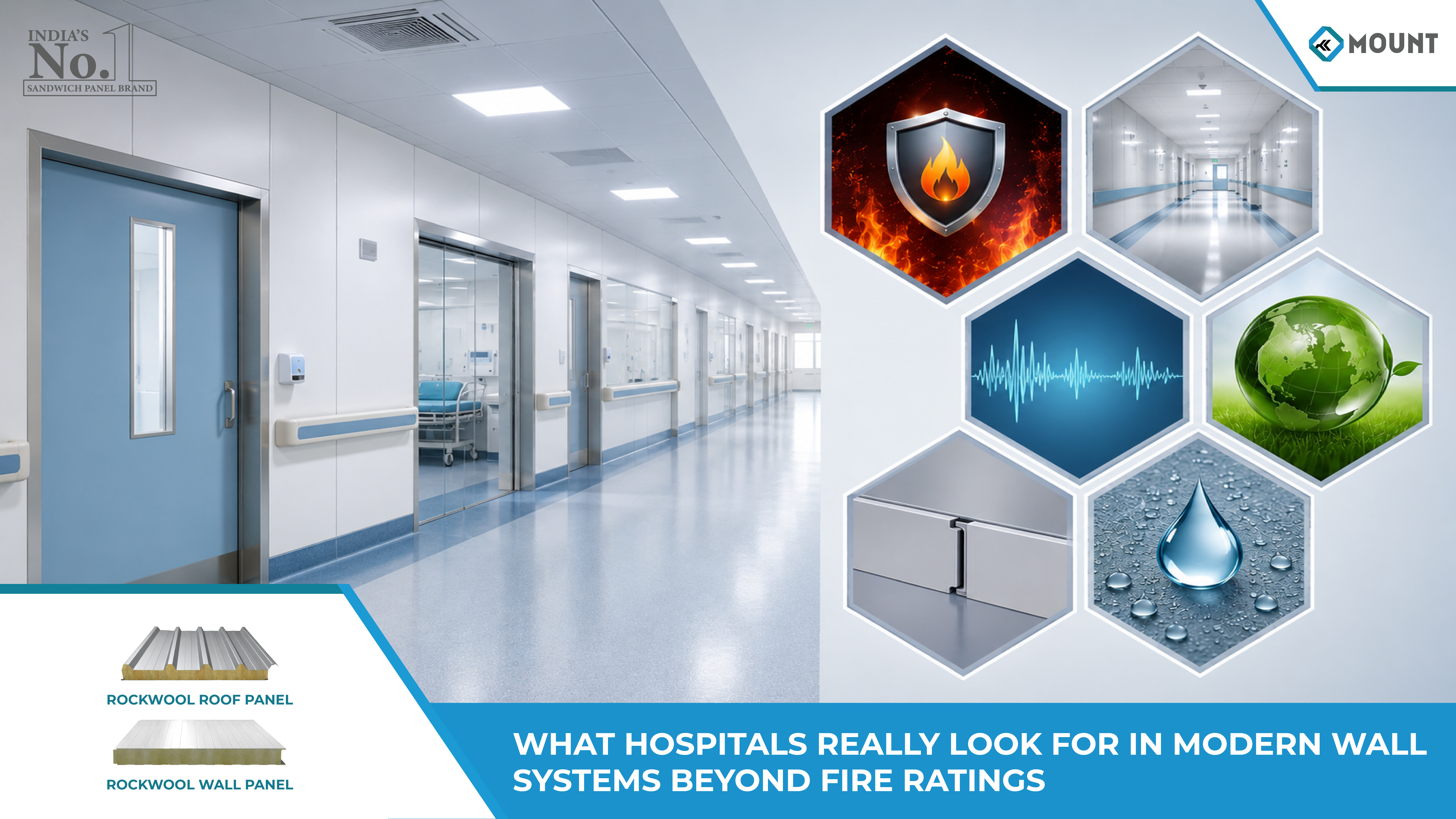
What Hospitals Really Look for in Modern Wall Systems Beyond Fire Ratings
Walk into the planning meeting for a new hospital, and fire safety will almost always be one of the first topics discussed.
It has to be.
Healthcare buildings accommodate vulnerable patients, operate around the clock, and must comply with stringent safety regulations. But once the discussion moves beyond statutory requirements, another set of questions begins to shape the project.
Will the walls withstand continuous cleaning and disinfection?
Can they support controlled environments inside operation theatres and laboratories?
Will they remain reliable after years of exposure to moisture, temperature fluctuations, and heavy daily use?
These questions have changed the way healthcare facilities evaluate sandwich panels. Today, consultants are looking beyond basic compliance and focusing on wall systems that contribute to hygiene, durability, thermal stability, and long-term operational performance.
Hospital Walls Have a Much Bigger Job Than Separating Rooms
Unlike offices or commercial buildings, hospitals never really stop functioning.
Patient wards, emergency departments, ICUs, imaging suites, laboratories and operation theatres remain active every hour of the day. Equipment is moved constantly, walls are cleaned repeatedly, and environmental conditions have to remain stable despite continuous occupancy.
That places far greater demands on the wall system.
Healthcare consultants believe Rockwool insulated wall panels provide more than structural separation. They should help maintain thermal comfort, withstand frequent cleaning, reduce maintenance interventions and contribute to environments where patient safety remains the priority.The wall system has become an active component of hospital performance rather than a passive building element.
Infection Control Begins with the Building Envelope
Hospital-acquired infections remain a major concern across healthcare facilities, making surface hygiene an important part of building design.
Traditional wall assemblies often require multiple finishing layers, joints and surface treatments that can deteriorate over time. As these finishes age, they become harder to clean and maintain consistently.
Mount’s Factory-manufactured Rockwool insulated sandwich panels provide a different approach.
Manufactured with smooth pre-finished steel facings and a non-combustible Rockwool core, they create uniform wall surfaces that tolerate repeated cleaning and disinfection. Their precision-engineered tongue-and-groove joints reduce unnecessary gaps where dust or contaminants may accumulate, helping housekeeping teams maintain cleaner environments with less effort.
For hospitals, that translates into lower maintenance requirements while supporting everyday infection-control practices.
Environmental Stability Depends on More Than HVAC Systems
Heating, ventilation and air-conditioning systems receive considerable attention during hospital design.
The wall system deserves the same level of consideration.
Operation theatres, sterile processing departments, pathology laboratories and pharmaceutical storage areas all depend on controlled environmental conditions. If heat, moisture or condensation begin entering through the building envelope, mechanical systems have to compensate continuously to maintain stable indoor conditions.
This is where Mount’s Rockwool panel thickness becomes an important engineering decision rather than simply a product specification.
Selecting the appropriate panel thickness based on the intended application helps reduce heat transfer, improve thermal stability and support efficient HVAC operation. Mount manufactures Rockwool panels in multiple configurations, allowing consultants to specify insulation levels according to the environmental requirements of each healthcare space rather than relying on a standard solution.
A Quieter Environment Supports Better Patient Care
Hospitals are filled with activity.
Medical equipment operates continuously, stretchers move through corridors, staff communicate across departments, and emergency care never follows a fixed schedule. While this activity is essential, excessive noise can affect patient recovery, concentration in treatment areas and the overall healthcare experience.
This is one reason acoustic performance has become an important design consideration. The mineral wool core used in Rockwool Panels for Building Insulation naturally absorbs airborne sound more effectively than many conventional wall assemblies. When incorporated into patient wards, consultation rooms, intensive care units and diagnostic spaces, these panels help create quieter interiors without adding multiple layers of acoustic treatment.
For healthcare consultants, this means a single wall system can contribute to thermal insulation, fire safety and sound control simultaneously.
Fire Performance Should Work Alongside Other Building Requirements
Fire safety remains one of the most critical aspects of hospital infrastructure, but Wall systems are expected to perform across several parameters at the same time. They should withstand daily cleaning, remain dimensionally stable, contribute to environmental control and continue performing throughout decades of continuous operation.
Similarly, roofing systems specified for healthcare projects often include Mount’s Fire Resistant Roof Panels as part of the overall passive fire protection strategy. Together with insulated wall systems, these products help consultants create coordinated building envelopes that support fire compartmentation while maintaining thermal and structural performance.
The focus has shifted from selecting individual products to designing an integrated healthcare infrastructure system.
Why Hospitals Are Moving Towards Prefabricated Wall Systems
Healthcare construction follows demanding schedules.Many hospital expansions take place while medical services continue operating, leaving very little room for delays, rework or excessive site activity.
This is one reason prefabricated insulated wall systems are replacing conventional masonry in many modern healthcare projects.
Factory-manufactured panels offer dimensional accuracy, consistent quality and significantly cleaner installation processes. Since much of the manufacturing is completed before the material reaches site, installation becomes faster and more predictable, allowing project teams to maintain tighter construction schedules while reducing dependence on multiple finishing trades.
For consultants and EPC contractors, this translates into improved quality control from manufacturing through installation.
Why Healthcare Infrastructure Teams Choose Mount
Healthcare projects demand building systems that continue performing long after construction has been completed.
Mount Roofing & Structures works closely with architects, consultants, EPC contractors and healthcare developers to deliver insulated wall systems engineered for demanding medical environments. As an experienced Rockwool sandwich panel manufacturer, Mount combines advanced automated manufacturing with precision engineering to produce insulated panels that support hygiene, thermal efficiency, acoustic comfort and long-term durability.
Manufactured using high-density Rockwool cores, smooth pre-finished steel facings and precision interlocking joints, Mount’s wall systems are designed to simplify installation while creating reliable building envelopes capable of supporting operation theatres, ICUs, laboratories, clean rooms and other critical healthcare spaces.
For healthcare facilities, selecting the right wall system is no longer simply about compliance.
It is about creating an environment that protects patients, supports medical professionals and continues delivering dependable performance throughout the life of the building.
FAQs
1. Why are insulated wall panels becoming popular in hospital construction?
They combine thermal insulation, hygiene, durability, acoustic performance and fire resistance within a single prefabricated system, making them suitable for modern healthcare facilities.
2. How does Mount Rockwool Panels improve hospital buildings?
Rockwool provides thermal insulation, sound absorption and fire resistance while helping maintain stable indoor conditions required for sensitive healthcare environments.
3. Why is panel thickness important in healthcare wall systems?
The appropriate panel thickness helps reduce heat transfer, improves energy efficiency and supports environmental control in spaces such as operation theatres, laboratories and ICUs.
4. Why do consultants prefer prefabricated insulated panels over conventional masonry?
Factory-manufactured panels provide consistent quality, cleaner installation, faster project execution and reduced maintenance compared with traditional site-built wall assemblies.
5. Why do healthcare developers partner with Mount Roofing & Structures?
Mount provides precision-engineered insulated wall systems backed by advanced manufacturing, technical expertise and application-specific solutions that help hospitals create durable, hygienic and energy-efficient healthcare environments.
Similar Events
 23 October, 2026