 Aug 24, 2026
The New Standard for Acoustic Performance in Educational Campuses
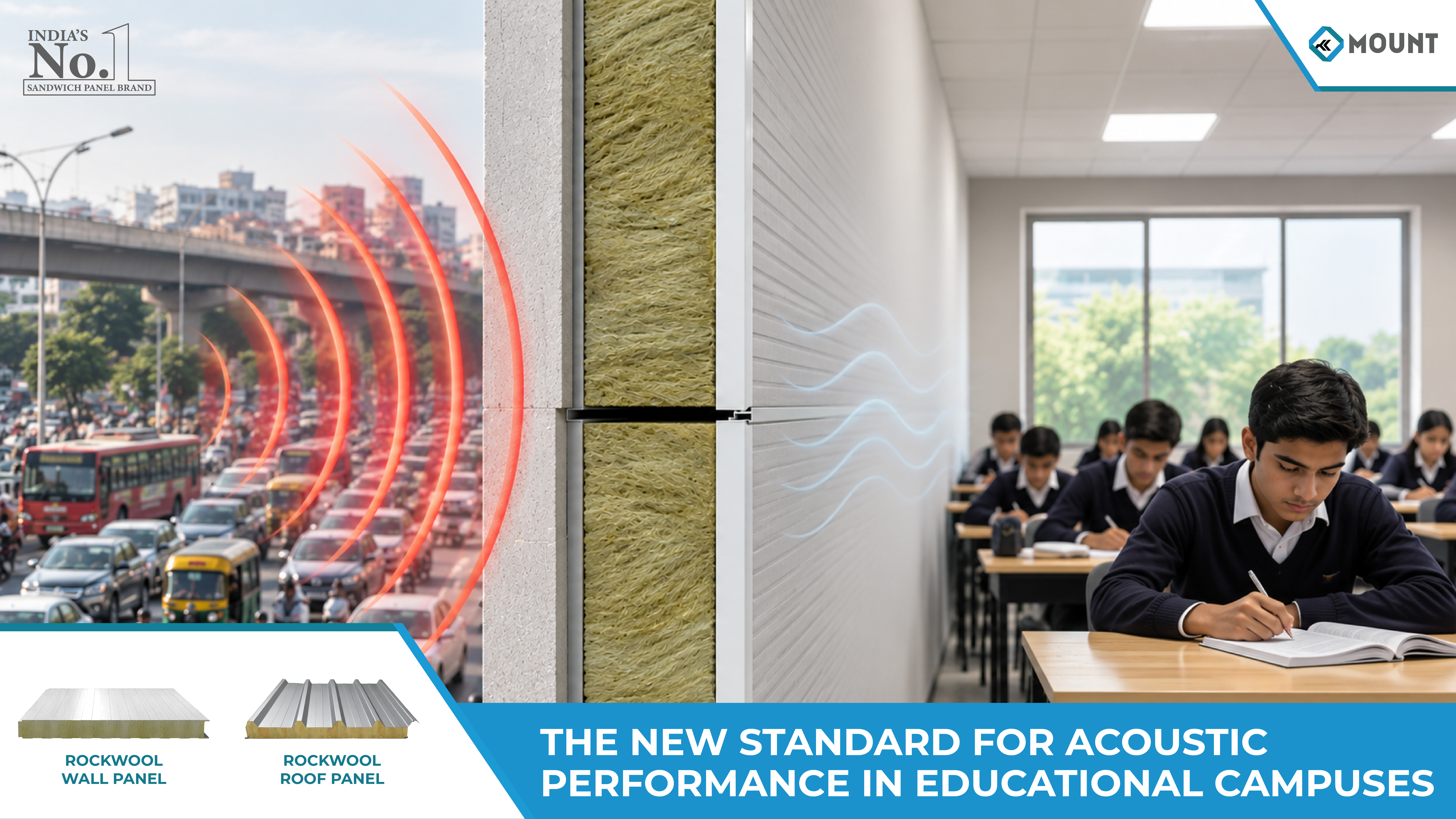
Sit in the back row of most Indian college lecture halls built before 2015, and you’ll notice something architects rarely accounted for: you can hear the corridor, the classroom next door, and sometimes the traffic outside, almost as clearly as the lecturer at the front. For decades, campus design treated acoustics as an afterthought, something to fix with curtains or foam panels once the building was already occupied and the complaints had started rolling in. Mount Roofing & Structures has watched this pattern shift meaningfully over the last few years, as institutions increasingly ask for Rockwool wall panels and acoustic performance data before construction even begins, not after.
That change is overdue. A learning environment where students strain to follow a lecture over ambient noise isn’t just uncomfortable; it measurably affects how well information gets retained.
Why Noise Is Now a Design, Stage Conversation
Concentration is the first casualty of a noisy classroom. Sustained background noise forces the brain to work harder just to filter out distraction, leaving less cognitive capacity for the actual task of learning, a cost that compounds across a six or seven hour school day.
Communication suffers just as directly, and not only in lecture halls. Laboratories, where instructions often need to be heard precisely for safety reasons, and libraries, where even moderate noise leakage undermines the entire purpose of the space, both depend on the kind of acoustic separation that Mount Rockwool panels for industrial buildings have long delivered in demanding environments, but that many older institutional buildings simply weren’t designed to provide.
Productivity, for staff as much as students, follows the same pattern. Faculty working in adjoining offices or research buildings report that persistent low-level noise, HVAC hum, activity from neighbouring rooms, external traffic contributes to fatigue over the course of a working day in ways that are easy to underestimate until the space is fixed with properly specified Rockwool sandwich panel installation.
It’s Not Just About Sound
Here’s where campus design gets more complicated than a typical acoustic renovation. A wall or roofing system installed in a school, university, or training centre can’t just absorb or block sound , it also has to hold up structurally for decades, resist fire spread in line with institutional safety codes, and manage thermal performance across classrooms that are occupied for hours at a stretch, often without the luxury of aggressive HVAC use.
This is precisely the intersection where Mount Rockwool sandwich panel installation. have found a growing second life in institutional construction. Rockwool, as a mineral wool insulation core, was originally specified heavily in industrial and commercial settings for its combination of acoustic absorption and fire performance , and those same properties translate directly into what educational campuses now need from lecture halls, indoor sports facilities, and auditoriums built to modern safety expectations.
What to Actually Specify
Getting the acoustic outcome right starts with understanding what’s being specified, not just choosing a product off a catalogue page.
Rockwool sandwich panel thickness is the single biggest lever institutions have over both acoustic and thermal performance. A thicker core generally improves sound absorption and insulation value, but the right thickness depends on the specific application, an auditorium built for public lectures has very different acoustic requirements than a standard classroom block, and specifying the same thickness across both wastes budget in one direction or underperforms in the other.
Cost is naturally part of that conversation too. Rockwool sandwich panel price varies meaningfully based on core density, facing material, and panel thickness, and institutions evaluating options are often better served comparing total lifecycle cost , energy savings, reduced maintenance, and acoustic performance over the building’s life , rather than the lowest per,square,metre quote alone.
How Mount Approaches Institutional Acoustic Design
As a dedicated Rockwool sandwich panel manufacturer, Mount works with educational institutions from the design stage onward, helping specify panel systems that balance acoustic performance against fire safety and thermal efficiency rather than treating them as separate line items. For vertical applications such as partition walls between classrooms or lecture halls, Mount’s Rockwool wall panels are engineered to deliver consistent sound attenuation without compromising the fire resistance rating institutions are required to meet.
Roof,level acoustic control matters just as much, particularly in auditoriums and indoor sports facilities where sound reflects off large overhead surfaces. Getting Rockwool roof panel thickness right at this level directly affects reverberation time , the metric that determines whether a space feels acoustically “live” and echo,prone or genuinely controlled.
Installation Quality Determines the Final Result
Even a correctly specified Rockwool system underperforms if it isn’t installed with precision. Proper installation , continuous joint sealing, correctly fitted junctions at wall,to,roof transitions, and attention to penetrations for services and wiring , is what actually delivers the acoustic and fire performance the panels were engineered to provide. Gaps at these points don’t just weaken sound insulation; they can compromise fire compartmentation too, which is a serious consideration for any institutional building.
Choosing a Partner for Campus Infrastructure That Performs
Educational institutions don’t get a second chance to fix acoustic design cheaply once a building is occupied and in daily use. Mount Roofing & Structures works with campus developers and institutional clients to specify Rockwool panel systems engineered around the actual acoustic, thermal, and fire safety requirements of each space, not a one size fits all approach borrowed from Rockwool panels for industrial buildings. For institutions where student comfort and building safety carry equal weight, that’s the standard worth building to.
FAQs
Q. How does Rockwool compare to standard PUF panels for acoustic applications in educational buildings?
A. Rockwool’s fibrous mineral structure absorbs and dampens sound more effectively than the closed, cell structure of PUF insulation, making it the preferred core material, specifically where acoustic performance, rather than thermal insulation alone, is the primary design requirement.
Q. What reverberation time is typically targeted for lecture halls versus auditoriums?
A. Reverberation time targets vary by room volume and use, but lecture halls generally require shorter, more controlled reverberation for speech clarity, while auditoriums used for musical performance may be designed with slightly longer reverberation depending on their intended acoustic character.
Q. Does Rockwool panel thickness affect fire resistance ratings independently of acoustic performance?
A. Yes. Fire resistance rating is influenced by core density and thickness in addition to facing material, meaning a panel specified purely for acoustic absorption may need thickness adjustments to also meet the required fire resistance classification for institutional buildings.
Q. Can Rockwool wall panels be retrofitted into existing classroom blocks without major structural changes?
A. In many cases, yes, provided the existing wall framework can support the additional panel weight, though retrofit projects typically require careful attention to joint continuity to avoid creating acoustic or thermal weak points at transitions with the original structure.
Q. How does humidity or moisture exposure affect Rockwool panel performance in coastal or high, rainfall campus locations?
A. Rockwool is naturally moisture resistant to a degree due to its mineral composition, but facing material and joint sealing quality still play a significant role in preventing moisture ingress that could otherwise degrade acoustic and thermal performance over time.
Similar Events

 23 October, 2026