 Aug 21, 2026
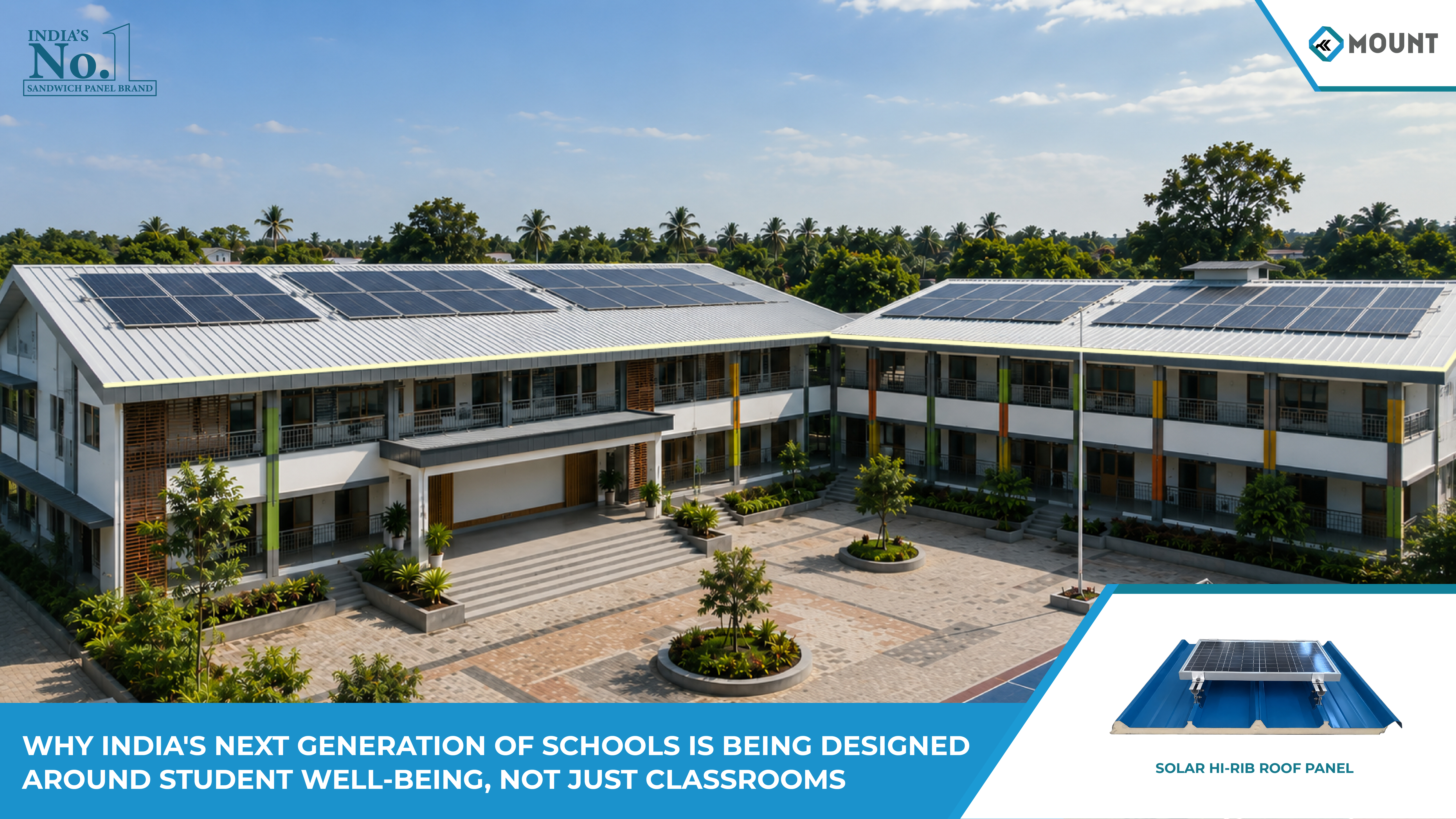
Why India’s Next Generation of Schools Is Being Designed Around Student Well,Being, Not Just Classrooms
Walk through a school campus built two decades ago and one being planned today, and the difference isn’t just aesthetic. The older building was designed around a floor plan , rows of classrooms connected by corridors, with daylight and ventilation treated as secondary concerns once the layout was finalized. The newer campus starts from a different question entirely: what does a building need to do to keep a growing child comfortable, alert, and healthy for six to eight hours a day, while also running efficiently enough that the institution can sustain it for decades without escalating operating costs.
That shift in thinking is reshaping how educational infrastructure gets specified in India, and Solar PUF Panels for roofing sit right at the center of it.
Comfort as an Educational Outcome, Not a Convenience
Indoor temperature and air quality have a documented effect on concentration and learning outcomes, which is why campus planners now treat thermal comfort as part of the academic brief rather than a facilities afterthought. A roof that transmits excessive heat into classrooms below forces mechanical cooling systems to run harder, and in institutions where budgets don’t stretch to full HVAC coverage across every building, that heat gain translates directly into uncomfortable, distracted classrooms during the hottest months of the academic year.
This is where insulated Solar Roof PUF Panel systems have become a standard specification rather than a premium add on, particularly for campuses being built or renovated with sustainability targets attached to their funding or accreditation.
The Case for Solar,Ready Campuses
Schools are natural candidates for rooftop solar. Daytime energy consumption , lighting, fans, computer labs, water heating for hostels , lines up almost exactly with peak solar generation hours, and large, relatively unobstructed roof areas across administrative blocks, hostels, and auditoriums offer substantial installable capacity. The challenge institutions run into isn’t whether solar makes sense financially; it’s whether the existing or planned roof structure can actually support a solar array without compromising long term roof performance.
This is precisely the gap that a Solar Roof PUF Panel system is engineered to close. Rather than treating solar mounting as a retrofit bolted onto a conventional roof after the fact, these panels integrate structural, insulation, and solar mounting functions into a single roofing assembly designed from the outset to carry panel loads.
Panel Profiles Built for Mounting Integrity
Not every roofing profile is suited to carrying the point loads and fixing patterns that solar mounting systems require. H-rib sandwich panels are specifically profiled to provide stronger fixing points along the panel rib, which matters when mounting brackets need to transfer wind and dead load from the solar array back into the roof structure without creating stress concentrations at the fastening points. Getting this detail wrong doesn’t show up immediately , it shows up years later as fastener fatigue or panel deformation around the mounting zones.
For campuses planning a PV Solar Roof Sandwich Panel installation, this structural compatibility should be evaluated at the roofing design stage, not after the solar contractor has already been selected. Retrofitting mounting infrastructure onto a roof that wasn’t engineered for it typically costs more and compromises the panel warranty in ways institutions don’t discover until a problem arises.
Insulation Performance Doesn’t Take a Back Seat
A common misconception is that solar,ready roofing sacrifices thermal insulation performance to accommodate mounting hardware. In a properly engineered Solar Roof Sandwich Panel, the PU foam core continues to deliver the same thermal resistance as a standard insulated panel, while the outer facing is detailed to accept solar mounting clamps without penetrating the insulation layer or compromising weatherproofing at the panel joints.
Efficient Use of Limited Rooftop Space
Educational campuses rarely have unlimited rooftop area to work with, particularly urban schools built on constrained plots. Specifying a Solar Sandwich Panel for Building Roof applications from the design stage allows institutions to maximize usable panel area across a given roof footprint, since the mounting layout is planned in coordination with the roof structure rather than worked around existing skylights, vents, and access points added without solar in mind.
Mount’s Approach to Educational Infrastructure
Mount Roofing & Structures works with educational institutions on exactly this kind of coordinated planning , evaluating roof structure, insulation requirement, and solar mounting layout together rather than as separate decisions made by separate contractors. Our Solar PUF Roof Panels and Solar PUF Panels range is engineered to hold consistent thermal and structural performance across large campus rooftops, which matters when an institution is phasing solar adoption across multiple buildings over several budget cycles.
If your institution is planning new construction or a major roof renovation with future solar adoption in mind, it’s worth bringing Mount into the design conversation before the roofing package is finalized, so the structure is genuinely solar,ready rather than solar,adapted after the fact.
Frequently Asked Questions
Q: Can existing school roofs be retrofitted for solar mounting, or does the roof need to be replaced entirely?
A: It depends on the condition and structural capacity of the existing roof; if the purlins and panel fixings can support the additional point loads from mounting brackets, retrofitting is possible, but roofs nearing the end of their service life are often better replaced with solar,ready panels rather than reinforced.
Q: What load capacity considerations apply when planning rooftop solar for hostel or auditorium buildings?
A: Roof structures need to account for the dead load of the solar array, wind uplift on the panels, and any maintenance foot traffic, which means the purlin spacing and panel gauge should be verified against the specific solar system’s mounting load before installation.
Q: How does panel profile affect long,term weatherproofing at solar mounting points?
A: Profiles designed with reinforced fixing ribs allow mounting brackets to be secured without penetrating the insulation core or compromising the panel’s weather seal, whereas standard profiles retrofitted with mounting hardware are more prone to leaks developing at the fixing points over time.
Q: Does adding solar mounting infrastructure reduce a roof panel’s thermal insulation performance?
A: Not when the panel is designed for solar integration from the outset; the insulation core thickness and density remain unchanged, and mounting clamps are engineered to attach to the outer facing without disrupting the insulation layer.
Q: What maintenance considerations are specific to solar,ready roofing compared to standard insulated roofing?
A: Beyond standard roof inspection, solar ready installations require periodic checks of mounting bracket fixings and sealant integrity around penetration points, along with coordination between roofing and solar maintenance teams since panel cleaning and roof access both affect the same surface.
Similar Events
 23 October, 2026