 May 6, 2026
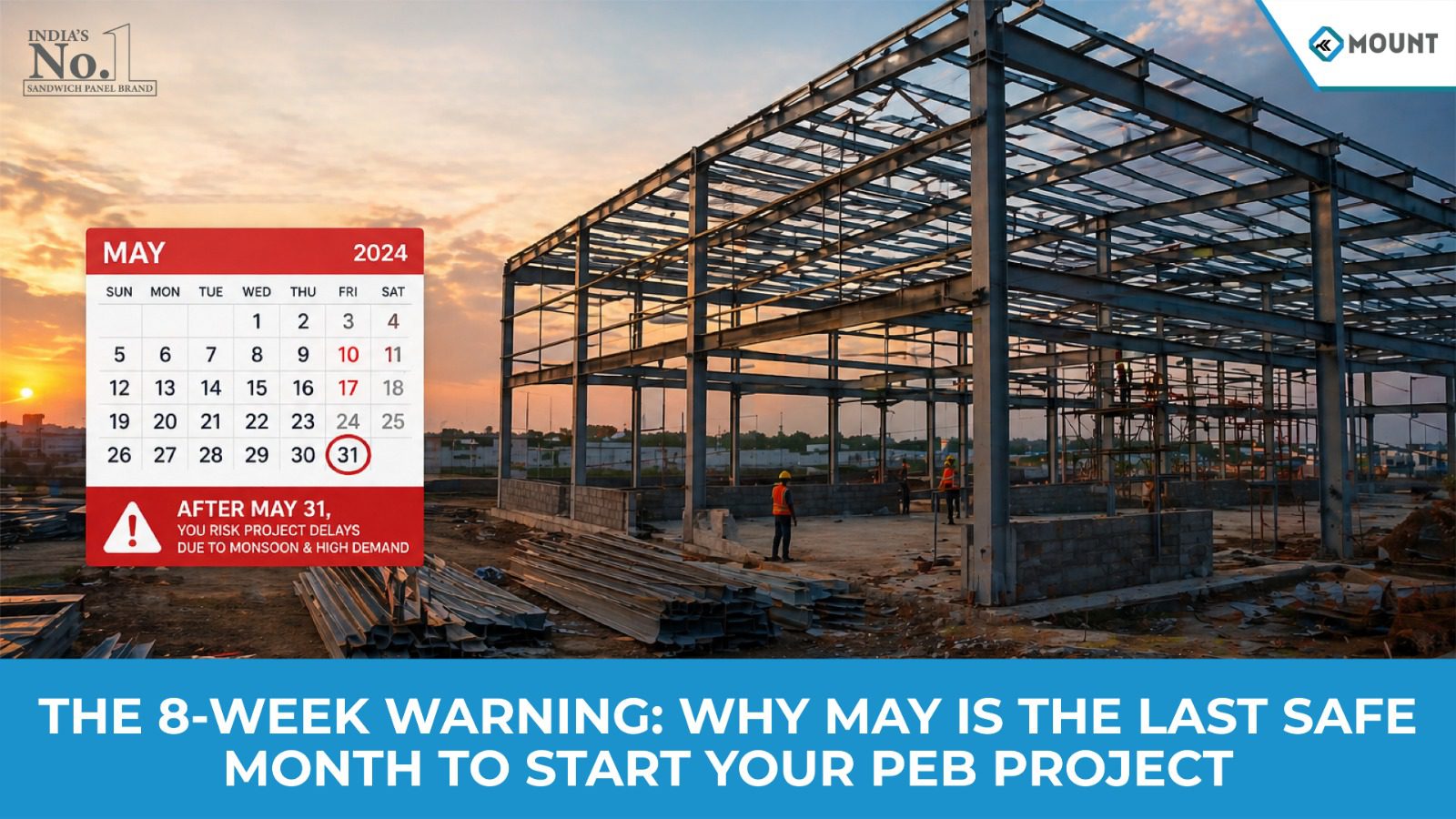
The 8-Week Warning: Why May Is the Last Safe Month to Start Your PEB Project
In most construction timelines, delays are usually blamed on approvals, budgets, or design revisions. In reality, a large number of project overruns come down to something far simpler , timing.
For Pre Engineered Buildings, timing quietly becomes one of the most critical variables, especially in India. There’s a narrow window every year where projects move smoothly, and once that window closes, execution starts getting unpredictable. That window typically ends around May.Within the industry, this is often treated as an informal “8-week warning.” Not because projects cannot start later, but because everything after that point begins to involve higher risk, tighter coordination, and less control over timelines.
Why the Monsoon Changes Everything
Mount PEB systems are designed for speed, but they still depend heavily on site readiness. The structure may be factory-fabricated, but the foundation, anchoring, and initial assembly happen on-site.
Once the monsoon sets in, these activities slow down significantly. Excavation becomes difficult, soil conditions change, and water accumulation starts affecting foundation stability. Even routine processes like curing take longer.For any Peb Construction Company, this phase becomes less about execution speed and more about managing disruptions. Material handling also gets affected , movement within the site becomes inconsistent, and storage conditions need extra attention.
The Site Becomes the Bottleneck
One of the common assumptions around PEB projects is that factory engineering eliminates delays. While fabrication timelines are controlled, site conditions remain a major variable.When projects begin after May, the probability of waterlogged land increases. Equipment mobility reduces. Even crane operations can get restricted depending on ground conditions.
This is where even experienced Pre-engineered Building Manufacturer teams face challenges , not due to lack of planning, but because external conditions limit execution flexibility.
Resource Pressure Before and After May
There’s another layer that often goes unnoticed , resource allocation.
As multiple projects aim to reach key milestones before monsoon, demand for labour, equipment, and logistics increases sharply during this period. Contractors, installation teams, and transport networks operate at near-full capacity.
Delaying beyond May means entering a phase where availability becomes uncertain. Even established Pre-engineered Metal Building Manufacturers have to rework schedules based on shifting resource availability.
Projects that start earlier typically benefit from better coordination, smoother procurement cycles, and fewer interruptions during execution.
The Cost Impact Isn’t Immediate , But It Builds
Delays rarely show up as a single large cost. They build gradually.
Extended project timelines increase site overheads , supervision, equipment rentals, and temporary infrastructure. At the same time, cash flow cycles get stretched, and operational timelines shift.For industries depending on timely infrastructure , manufacturing units, warehouses, institutional expansions , even a few weeks of delay can affect production schedules or occupancy plans.
Working with Mount, a Peb Construction Company In India that factors in seasonal timelines helps reduce this exposure, but timing still remains a decisive factor.
What Early Starters Do Differently
Projects that begin before or within May tend to follow a different execution pattern.
Site preparation gets completed under stable conditions. Foundations are cast without weather-related interruptions. The primary structure can be erected before heavy rainfall begins.This creates a buffer. Even if minor disruptions occur later, the core building remains secured.
For clients working with Pre-engineered Steel Building Manufacturer Companies, this sequencing becomes critical. It allows better alignment between factory dispatch and on-site readiness, reducing idle time and coordination gaps.
The Role of Material Systems in Weather Readiness
While timing is crucial, material choice also plays a role in how well the project withstands weather-related challenges.
Systems like insulated panels for steel buildings help protect internal environments once the structure is enclosed. They reduce exposure to moisture and support faster internal work even during light rain conditions.Similarly, working with a Top PUF Panels Manufacturer And Suppliers In India ensures that panel performance remains stable despite temperature and humidity variations.
However, even the best materials cannot fully compensate for poor timing during the early construction stages.
Mount Roofing & Structures: Planning Around Real Conditions
Mount approaches PEB execution with a strong focus on sequencing and timing. Instead of treating projects as linear timelines, the planning accounts for seasonal variables, site conditions, and resource availability.
Their integrated model , covering design, manufacturing, and installation , allows better coordination between factory output and site progress.For clients, this means fewer uncertainties. Instead of reacting to delays, projects are structured to avoid them where possible.
This approach becomes particularly relevant when working with Mount, one of the Largest Pre Engineered Metal Building Manufacturers, where scale demands tighter control over timelines.
The 8-Week Window Is About Control, Not Urgency
The idea behind the “8-week warning” isn’t to rush decisions. It’s to create awareness around how timing affects execution.PEB projects deliver speed when conditions support that speed. Once external factors like weather and resource constraints come into play, timelines become harder to predict.
Starting within the pre-monsoon window allows better control over sequencing, cost, and delivery. Beyond that, projects often require additional buffers , in time, cost, and coordination.
In practical terms, the difference between starting in May and starting in July is rarely just two months. It often reshapes the entire project timeline.
FAQs
Q1: Can PEB projects be executed during the monsoon season?
A: Yes, but progress slows due to site conditions, especially during foundation and initial assembly stages.
Q2: Why is May considered a critical month for starting PEB projects?
A: It allows key activities like site preparation and structural erection to be completed before heavy rainfall begins.
Q3: How do delays during monsoon affect project costs?
A: They increase overhead expenses, extend timelines, and can disrupt operational planning.
Q4: Does factory fabrication continue unaffected during monsoon?
A: Yes, but delays occur at the site level, which can lead to mismatches between fabrication and installation schedules.
Q5.How does Mount Roofing & Structures manage seasonal risks in PEB projects?
A: By aligning design, manufacturing, and execution timelines with seasonal conditions, reducing dependency on reactive adjustments.
Similar Events
 23 October, 2026