 Sep 5, 2026
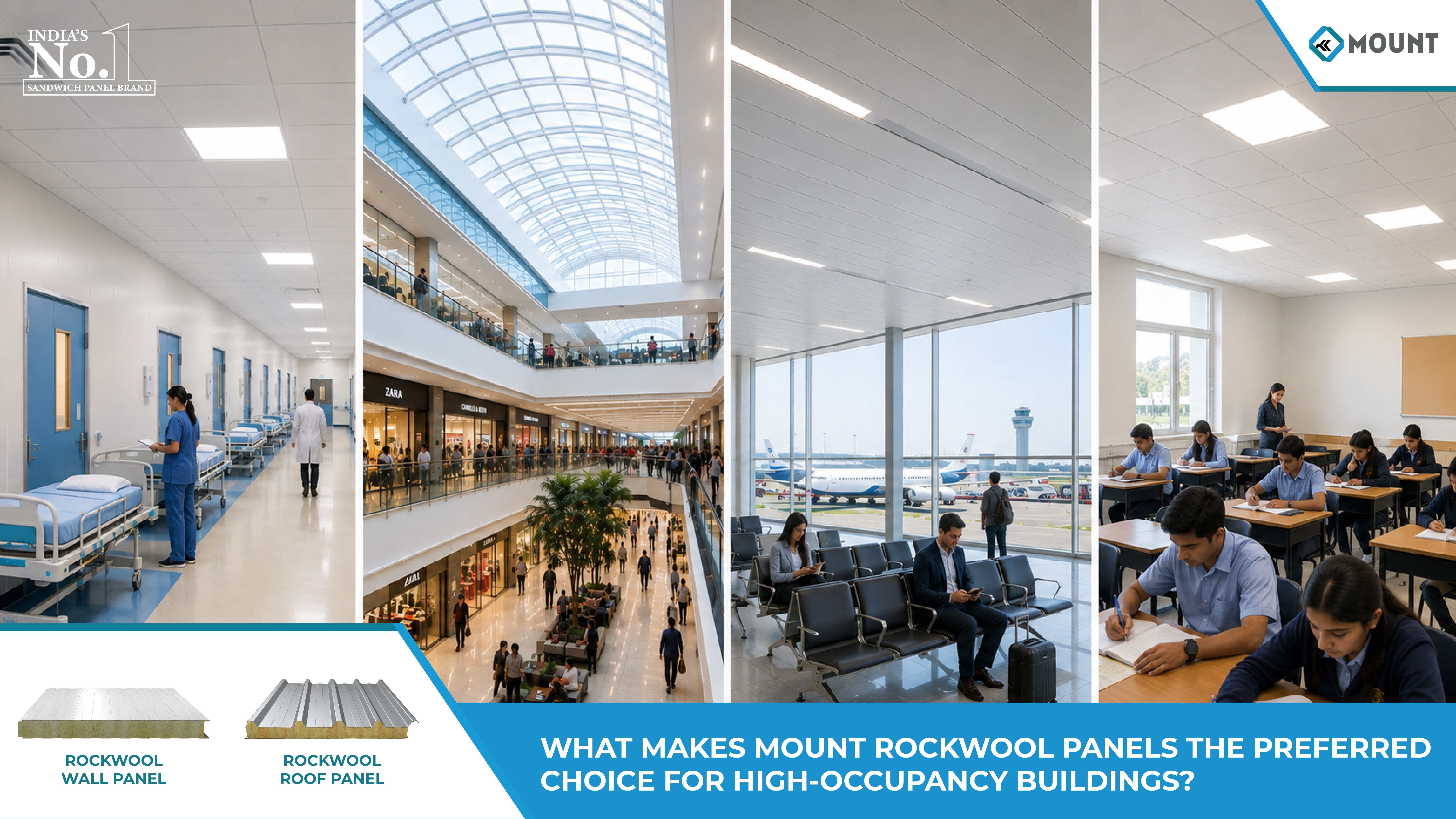
What Makes Mount Rockwool Panels the Preferred Choice for High-Occupancy Buildings?
In a high-occupancy building, the building envelope has a responsibility that extends well beyond enclosing the structure. Schools, hospitals, auditoriums, commercial facilities and public buildings accommodate large numbers of people within relatively concentrated spaces, making fire safety, acoustic control, thermal stability and occupant comfort important design considerations. Wall and roof systems must therefore be evaluated for how they contribute to the overall performance of the building.
This is where Rockwool Sandwich Panels become relevant. Mineral wool-based panel systems can combine thermal insulation with non-combustible core characteristics and acoustic performance within a factory-manufactured building-envelope component. For architects, consultants, EPC contractors and project owners, the value lies in selecting a wall or roof system around the actual performance requirements of the facility rather than treating the envelope as an aesthetic or construction-speed decision.
Why High-Occupancy Buildings Need More From Their Building Envelope
Occupancy density changes the way a building needs to be designed. More people generate more internal heat and activity, while classrooms, auditoriums, hospitals and commercial spaces may also have demanding ventilation and HVAC requirements. At the same time, these buildings often contain multiple zones with different functional requirements.
Fire safety becomes particularly important because evacuation requirements become more complex as occupant numbers increase. The building envelope should therefore form part of a broader passive fire-safety strategy, with material selection aligned to applicable codes, tested assemblies and project-specific requirements.
For Rockwool Panels for Industrial Buildings, the mineral wool core provides a non-combustible material option where fire behaviour is a key consideration. Mount’s Rockwool panels use stone wool with a stated fire resistance range of EI 60 to EI 120 and an A1 non-combustible classification under EN 13501.
Acoustic Control Is Equally Important
Fire protection is only one part of the performance equation. In a classroom, excessive sound transfer can interfere with teaching. In an auditorium, uncontrolled reverberation or sound transmission can affect the intended acoustic environment. In hospitals, controlling noise between functional areas can contribute to a more suitable indoor environment.
This makes acoustic Rockwool panels particularly relevant where sound insulation needs to be considered alongside fire and thermal requirements. Mount’s technical specifications indicate an Rw sound insulation range of 32–42 dB for its Rockwool sandwich panels, depending on the panel configuration.
The final acoustic performance of any wall or roof assembly, however, depends on more than the core material. Panel joints, interfaces, doors, glazing, service penetrations and surrounding construction can all influence sound transmission. Proper detailing is therefore essential when acoustic performance is part of the project specification.
Thermal Comfort Supports Better Indoor Conditions
Occupant comfort is also influenced by the building envelope’s ability to moderate heat transfer. External temperature fluctuations and solar exposure can affect internal conditions, increasing the demand placed on HVAC systems.
A mineral wool core provides thermal resistance while also offering the fire and acoustic characteristics for which the material is commonly specified. The appropriate panel thickness should be established according to the building’s climate, internal temperature requirements, HVAC strategy and envelope design rather than selected as a standard value for every project.
For Rockwool Wall Panels, this multi-functional approach is useful in facilities where wall systems need to contribute to fire safety, sound control and thermal performance within a single engineered assembly.
Mount Rockwool Panels for Demanding Applications
Mount manufactures Rockwool sandwich panels using a stone wool core designed for applications requiring non-combustible construction and controlled building-envelope performance. The available thickness range is stated as 50 mm to 200 mm, with core density between 100–120 kg/m³.
This makes the system suitable for applications where the wall or roof needs to perform several functions simultaneously. Mount’s documented applications include industrial buildings, fire-rated partition walls in factories and warehouses, acoustic enclosures, data-centre zone separation walls, generator rooms and transformer enclosures.
For high-occupancy infrastructure, the same design principle can be applied to spaces such as auditoriums, educational facilities, healthcare environments and commercial buildings where fire and acoustic requirements influence material selection.
Manufacturing Consistency Matters at Project Scale
A panel’s declared technical characteristics are only useful when the manufactured product remains consistent with the specified configuration. For large projects, procurement teams therefore need to consider manufacturing controls alongside the nominal properties of the insulation material.
Mount operates continuous panel manufacturing infrastructure covering PUF, PIR and Rockwool sandwich panels. Its stated overall sandwich-panel production capacity is up to 7,00,000 square metres per month, providing the manufacturing scale required for substantial project quantities.
For an insulation panel supplier, quality documentation is equally important. Mount’s available documentation includes batch-related density and thickness records and product-specific technical information, supporting greater specification traceability for project QA teams.
Designing Around the Building’s Actual Requirements
There is no single panel specification that suits every high-occupancy building. A hospital may prioritise fire behaviour, hygiene and thermal control in different combinations from an auditorium, while an educational facility may place greater emphasis on acoustic separation between occupied spaces.
The advantage of Rockwool Sandwich Panel Manufacturers with an established technical product range is the ability to approach these requirements through specification rather than generic product selection. Core density, thickness, facing, joint configuration, fire classification, acoustic requirements and installation detailing should all be considered at the design stage.
Mount’s broader panel manufacturing capability allows project teams to evaluate Rockwool alongside other insulated panel systems according to the performance requirement of each application, rather than applying one material specification across every building type.
Why Choose Mount for Rockwool Panel Requirements?
Mount brings manufacturing capability, technical product knowledge and project-scale supply together within its building-envelope offering. Its Rockwool range provides a mineral wool-based solution for applications where fire resistance and acoustic performance need to be addressed alongside thermal requirements.
For consultants and EPC contractors, working with Rockwool Sandwich Panel Manufacturers in India also requires attention to production consistency, technical documentation, panel configuration and supply capability. Mount’s continuous manufacturing infrastructure and integrated product portfolio provide a single manufacturing platform for industrial and infrastructure projects requiring engineered panel systems.
When occupant safety, acoustic control and thermal comfort are integral to the project brief, Mount can support the specification with engineered Rockwool panel solutions designed around the building’s actual performance requirements.
FAQs
Q. Why are Rockwool panels suitable for high-occupancy buildings?
A. Rockwool panels combine a mineral wool core with thermal and acoustic insulation properties, while stone wool is non-combustible. Mount’s Rockwool panels are specified with A1 non-combustible classification and EI 60 to EI 120 fire resistance, depending on the assembly.
Q. Can Rockwool panels improve acoustic separation between occupied spaces?
A. They can contribute to acoustic separation because the mineral wool core provides sound insulation. Mount specifies an Rw range of 32–42 dB for its Rockwool sandwich panels, with actual assembly performance dependent on construction details and interfaces.
Q. What Rockwool panel thickness should be specified for an auditorium or classroom?
A. Thickness should be determined from the project’s fire, acoustic, thermal and structural requirements. The surrounding wall or roof construction and required acoustic separation should also be considered rather than selecting thickness based on one parameter alone.
Q. Are Rockwool panels suitable for industrial as well as public buildings?
A. Yes. Mount documents applications including industrial buildings, factories, warehouses, acoustic enclosures and equipment rooms, in addition to applications where fire-rated construction is required.
Q. What should consultants verify before approving a Rockwool panel system?
A. The specification should be checked for core density, thickness, fire classification, tested fire-resistance assembly, acoustic data, facing specification, joint details, structural requirements, installation method and manufacturer documentation. These parameters should correspond to the specific project design and applicable standards.
Similar Events
 23 October, 2026